Can Japan Afford to Cut Its Corporate Tax?
IMF Blog, August 5, 2014
Source details
- Canonical URL
- Can Japan Afford to Cut Its Corporate Tax?
Other formats
Bibliographic details
- Authors: Ruud de Mooij, Ikuo Saito
- Published: August 5, 2014
Background and fiscal context
- Japan announced it will reduce the corporate income tax rate as part of its revised growth strategy presented in June.
- The Japanese corporate income tax rate is "more than 35 percent" for most businesses and is one of the highest among the industrialized countries of the Organization for Economic Cooperation and Development.
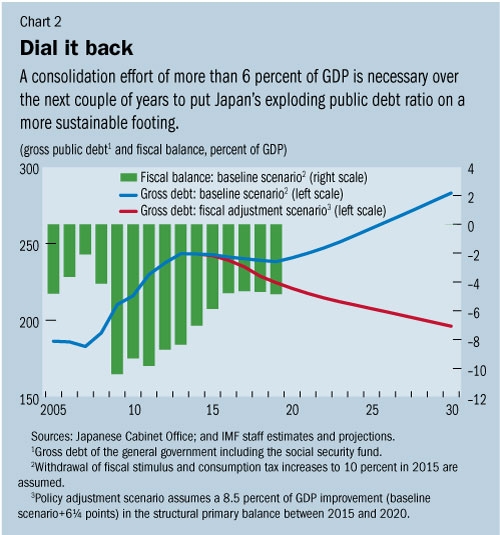
- The International Monetary Fund staff report argues that a consolidation effort of "more than 6 percent of GDP" is necessary over the next couple of years to put the exploding public debt ratio on a more sustainable footing.
- The consolidation would reinforce other planned measures, such as the next consumption tax rate hike to "10 percent in October 2015".
Revenue effects and empirical evidence
- A unilateral reduction of the corporate rate would produce nontrivial revenue losses: reducing the rate by "5 percentage points—without offsetting measures—could lower revenue by some 0.4 percent of GDP".
- Claims that a rate cut would be (more than) self financing via base expansion are rejected by a recent IMF Working Paper.
- Empirical consensus estimates indicate:
- "A 5 percentage–point reduction in the rate will raise the level of investment by 3½ percent in the long run (relative to baseline)."
- "Between 10 and 30 percent of the static revenue loss from a rate cut can be recovered through these investment effects and other behavioral responses (such as income shifting and corporate financial choices)."
- For Japan, historical tax elasticities have been smaller than elsewhere, so the lower bound of these recovery estimates might be more likely.
- Even with behavioral responses, such effects are far from sufficient to make a cut self financing.
Policy options and design principles
- Objective: address weaknesses of the corporate income tax that deter investment, while maintaining the tax as a key revenue source.
- Options emphasized:
- Shift toward a higher consumption tax.
- Even when increased to "10 percent", the consumption tax rate will still be low internationally.
- As a relatively growth-friendly and stable revenue source in an ageing society, further increases may be attractive to finance a lower corporate rate.
- To address regressivity concerns, increases could be combined with targeted transfers to low-income households, similar to the program introduced with the first consumption tax increase.
- Replace local corporate income tax rates with better local revenue sources.
- "Almost one third of the Japanese rate comprises taxes imposed by prefectures and municipalities."
- Better local taxes include taxes on immovable property, which are more stable, fairer, and less distortive for economic growth.
- Eliminate distortions for small and medium-sized enterprises.
- The current system encourages small firms to pay wages and discourages them from paying dividends.
- Reforms needed: reform of dividend taxes and a lower wage deduction in the personal income tax to increase neutrality.
- With less arbitrage, overall revenue can increase and business structures become more efficient.
- Broaden the base.
- Japan has a very large number of special tax incentives, including for small and medium-sized enterprises; some are ineffective or create distortions.
- Streamlining incentives is desirable, but the expected revenue yield is limited.
- Depreciation allowances and loss treatment are not quite as generous compared with other countries, and cutting them risks discouraging investment and reducing growth.
- Reduce the rate gradually.
- An immediate corporate income tax rate cut creates a windfall gain on past investments.
- A credible pre-announced rate reduction will reduce such windfalls and limit fiscal costs in the short run, while still encouraging investment.
Innovative approaches
- Consider reforms that substitute for or complement a rate cut, for example:
- Introduce an incremental allowance for corporate equity (ACE), modeled on Italy’s example.
- The ACE is a deduction at a fixed notional rate for equity increases through either retained earnings or equity issuances—relative to some base year.
- The incremental allowance does not grant relief on past investment and, therefore, incurs little fiscal cost in the short run and grants no windfall gains.
- Incremental investment is significantly encouraged, addressing Japan’s need for new investment.
- The allowance eliminates the tax discrimination in favor of debt over equity, improving neutrality.
- Recent experiences in Italy and Belgium are encouraging regarding practical implementation.
Conclusion and strategic message
- Fiscal constraints in Japan are acute, and the need for boosting growth is also urgent.
- Tax reforms should aim to maximize the growth effect per yen of tax relief granted.
- Scarcity should provoke innovation in tax policy; unconventional and carefully designed reforms may deliver more growth per fiscal cost than a blunt rate cut.
Ruud de Mooij and Ikuo Saito, August 5, 2014 — Can Japan Afford to Cut Its Corporate Tax?
Content in this bundle
- 日本:法人税率を引き下げることができるか; ルード・デ・ムーイ、齊藤郁夫 iMFdirect ブログ 2014年8月5日掲載
- Wp14138
- Staff Discussion Note