U.S. Labor Force: Where Have All the Workers Gone?
IMF Blog, August 7, 2014
Source details
- Canonical URL
- U.S. Labor Force: Where Have All the Workers Gone?
Other formats
Bibliographic details
- Authors: Ravi Balakrishnan
- Published: August 7, 2014
Key findings on participation and trends
- Labor force participation rate stood at 62.9 percent in July 2014.
- This represents a 3 percentage point decline since the Great Recession and is the lowest rate since 1978.
- Fully one-half of the gains in participation rates between 1960 and 2000 have been reversed in the last six years.
- The equivalent of 7.5 million workers have been lost from the U.S. labor force.
- The “golden” era was 1960–1990, when participation rates increased from 60 to 66 percent.
- Even before the Great Recession, participation had been declining, with a continuation of the fall since the 2001 recession and the bursting of the dotcom bubble.
- Long-term unemployed are still higher than at any previous peak since World War II.
Causes and decomposition of the decline
- Structural changes linked to population aging have been an important part of the downtrend.
- Cyclical factors related to the availability of jobs and wage dynamics have also been important, particularly following the Great Recession.
- Our study attributes around 50 percent of the decline in participation since the Great Recession to aging.
- Cyclical forces account for a further 30–40 percent of the decline since the Great Recession.
- The remainder of the post-2007 decline reflects other forces, including:
- A significant decline in youth participation driven mainly by a decline in the number of students who are also working (not primarily by increased college enrollment).
- Rising applications for disability insurance, amplified by demographics (more of the population in the over-50s age group) and an upward spike in applications following the Great Recession; many applicants exited the labor force while applications were pending, including some who were eventually denied benefits.
Reversibility and near-term scenario
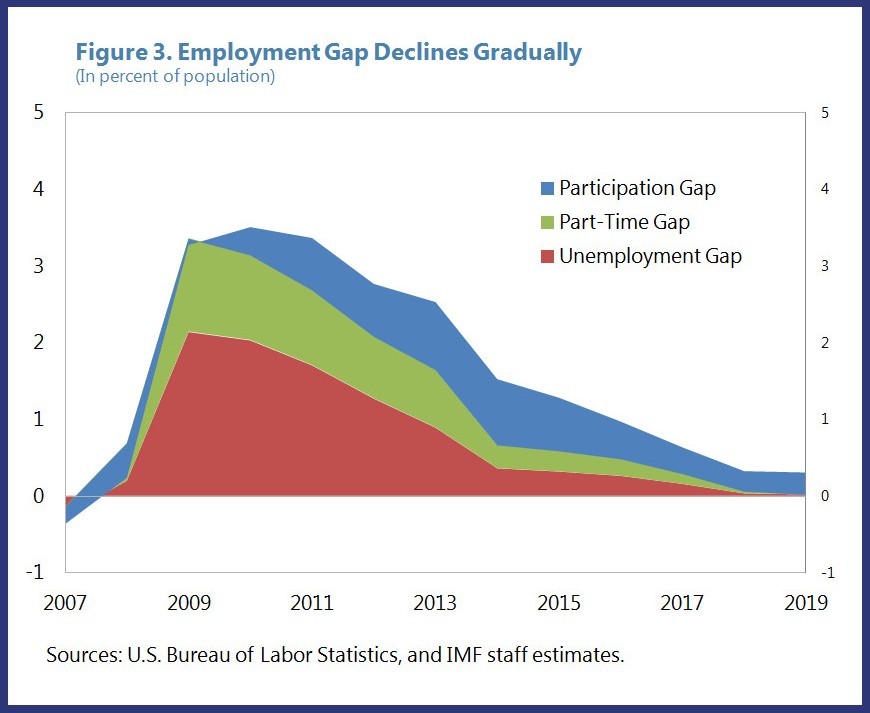
- Using detailed state level data, the analysis suggests that up to one-third of the post-2007 decline in participation rates is reversible.
- Over the next few years, a temporary respite is expected with about 2 million workers coming back into the labor market as job prospects improve.
- By 2017 participation rates should again start to decline as population aging begins to dominate and more-than-offset the cyclical bounce back.
Policy recommendations to boost sustained participation
- Economic policies that get the country growing again to strengthen the labor market, raise wages, and bring people back into the labor force.
- Labor supply measures to boost potential growth and raise human capital and productivity, including:
- Enhancing training and job search assistance programs.
- Better family benefits, including more affordable childcare, to support continued work by both parents and help reverse the downward trend in female participation.
- Immigration reform that provides greater visa opportunities for high-skilled immigrants to boost the size and productivity of the labor force and likely improve the government’s fiscal position.
Source: U.S. Labor Force: Where Have All the Workers Gone?, Ravi Balakrishnan, August 7, 2014.
Content in this bundle
- Country Report