Structural Reforms Can Help Japan’s Post-Consumption Tax Blues
IMF Blog, August 14, 2014
Source details
- Canonical URL
- Structural Reforms Can Help Japan’s Post-Consumption Tax Blues
Other formats
Bibliographic details
- Authors: Stephan Danninger
- Published: August 14, 2014
Short-term shock and near-term outlook
- Japan’s GDP declined by almost 7 percent in the second quarter.
- The consumption tax increase this April contributed to the decline, but it is not the full story; large spending swings following major tax increases are common (example cited: Germany’s 2007 VAT increase had a short-lived impact).
- With the near-term outlook increasingly uncertain, faster progress on structural reforms—the third arrow of Abenomics—is essential to lift expectations and maintain confidence.
Role of structural reforms and business expectations
- Abenomics has made progress in ending deflation and jumpstarting the economy.
- Recent IMF staff research shows firms need clarity about future growth opportunities before they start to invest.
- Faster implementation and a more comprehensive approach to structural measures are needed to lift expectations and encourage investment.
Unstashing corporate cash as a growth resource
- Over the last decade, Japan’s average ratio of cash holdings relative to market capitalization exceeded 40 percent.
- This ratio is more than double the equivalent figure for many other G-7 countries.
- IMF staff research suggests governance and legal framework reforms could lead to more efficient use of these resources.
- Measures cited: raising the number of external independent directors; adoption of a corporate governance code for firms.
- Empirical evidence: firms with many external directors rarely hold large cash reserves.
- Recent steps already taken: amendments to the Company Act and introduction of a Stewardship Code for institutional investors.
Labor market duality and shortages
- Shortages in Japan’s labor market are becoming a growth bottleneck due to an aging population, limited access to foreign workers, and rising demand for skill-intensive services (especially in health).
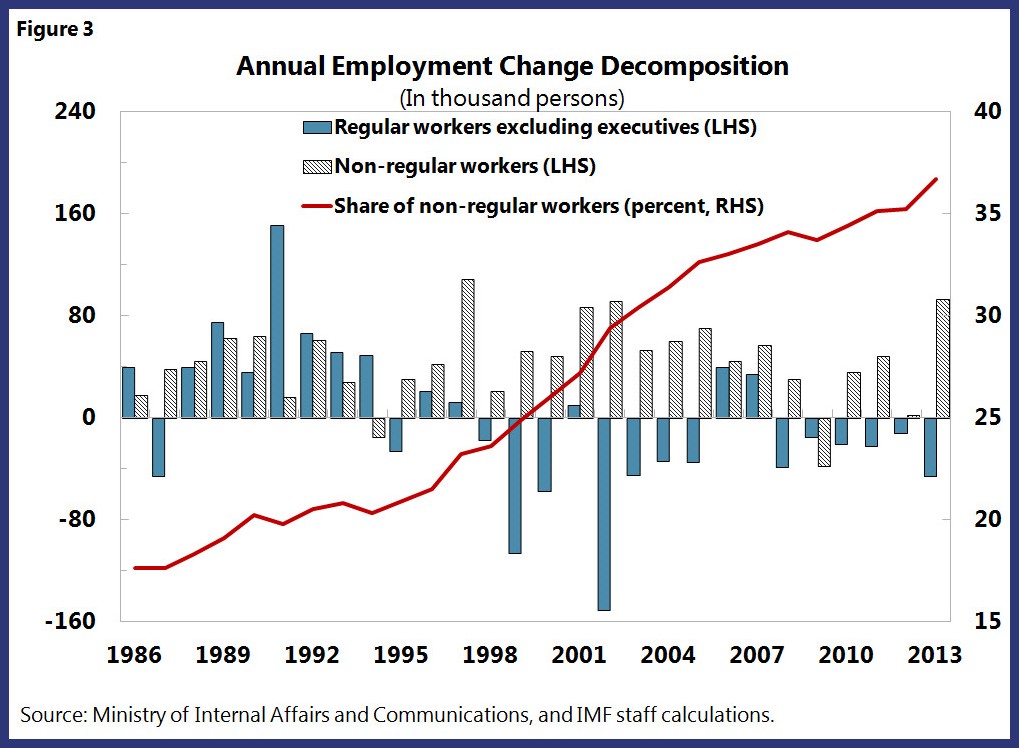
- Japan’s segmented labor market (regular lifetime employment vs. rising irregular employment) reduces productivity growth and labor attachment for many, including highly educated women and younger workers.
- Narrowing differences between regular and irregular employment could reduce inefficiencies and help reallocate talent to where it is needed most.
- There are no easy fixes, but addressing labor market rigidities would enhance growth potential.
Fiscal and monetary policy priorities
- Japan’s public-debt-to GDP ratio is at over 240 percent of GDP.
- The consumption tax rate increase to 10 percent (this and next year) would reduce the deficit by about 2 percent of GDP—an important down payment toward restoring fiscal sustainability.
- A still sizeable future consolidation need of another 6 percent of GDP remains, leaving fiscal risks large.
- Recommendation: adopt a concrete fiscal strategy beyond 2015 to limit risks of a sudden rise in interest rates and allow flexible responses to downside risks.
- On monetary policy:
- The Bank of Japan has made great strides in ending deflation; inflation and inflation expectations are increasing.
- Real interest rates are declining and lifting returns on capital investments.
- The IMF view: the Bank of Japan’s easing policy is appropriately accommodative now; if progress in raising inflation stalls, it should act swiftly and expand its asset purchases.
Key policy recommendations and priorities
- Speed up implementation of structural reforms (third arrow of Abenomics) to lift expectations and confidence.
- Reform corporate governance and legal frameworks to encourage firms to deploy large cash holdings productively (e.g., more external independent directors; corporate governance code).
- Address labor market duality to increase labor supply and productivity, especially for highly educated women and younger workers.
- Adopt a concrete fiscal strategy beyond 2015 to manage the high public-debt-to GDP ratio and the remaining 6 percent of GDP consolidation need.
- Maintain accommodative monetary policy and be prepared to expand asset purchases if inflation progress stalls.
Source: Structural Reforms Can Help Japan’s Post-Consumption Tax Blues — Stephan Danninger, August 14, 2014.
Content in this bundle
- 構造改革は、日本の消費税引き上げ後の憂鬱感を解消するのに役立つ, ステファン・ダニンガー, iMFdirect ブログ 2014年8月14日掲
References
- https://www.imf.org/wp-content/uploads/2014/08/figure-one.jpg
- Balance Sheet Repair and Corporate Investment in Japan
- https://www.imf.org/wp-content/uploads/2014/08/figure-two.jpg
- Unstash the Cash! Corporate Governance Reform in Japan
- https://www.imf.org/wp-content/uploads/2014/08/figure-three.jpg
- The Path to Higher Growth: Does Revamping Japan’s Dual Labor Market Matter?
- https://www.imf.org/wp-content/uploads/2014/08/figure-four.jpg