What’s Lurking in the Shadows of China’s Banks
IMF Blog, September 15, 2014
Source details
- Canonical URL
- What’s Lurking in the Shadows of China’s Banks
Other formats
Bibliographic details
- Authors: Steven Barnett, Shaun Roache
- Published: September 15, 2014
Definitions and terminology
- Shadow banking: financial intermediation that takes place outside of banks. The profession lacks a uniform definition; IMF has used terms including “off-balance sheet and nonbank financial intermediation,” “nonbank intermediation,” and “shadow banking.”
- In China, a common operational definition is: total social financing less bank loans (excluding equity issuance).
- Note on labels: focus is on the facts and functions of nonbank intermediation rather than on the name.
Growth and composition
- Rapid expansion since the global financial crisis in 2008; the “pink part” in Figure 1 has more than tripled since 2008, albeit from a low base.
- Shadow banking has accounted for half of the increase in overall credit to the economy (total social financing)—even more than bank loans.
- The pink part (shadow bank or nonbank intermediation) consists of four components:
- Corporate bonds (largest component of so-called shadow banking).
- Entrusted loans: corporate-to-corporate loans administered by a bank (bank acts as bookkeeper with no “skin in the game”).
- Bankers’ acceptances: letters of guarantee issued by a bank; “undiscounted” until they are discounted and recorded as bank loans.
- Trust loans: lending by trust companies that, on paper, merely bring borrower and investor together for a fee.
- Comparative size:
- Broader measure (the pink area in Figure 1): 55 percent of GDP.
- Forthcoming October Global Financial Stability Report estimate (subtracting corporate bonds): 35 percent of GDP.
- Corporate bonds account for nearly 20 percent of GDP.
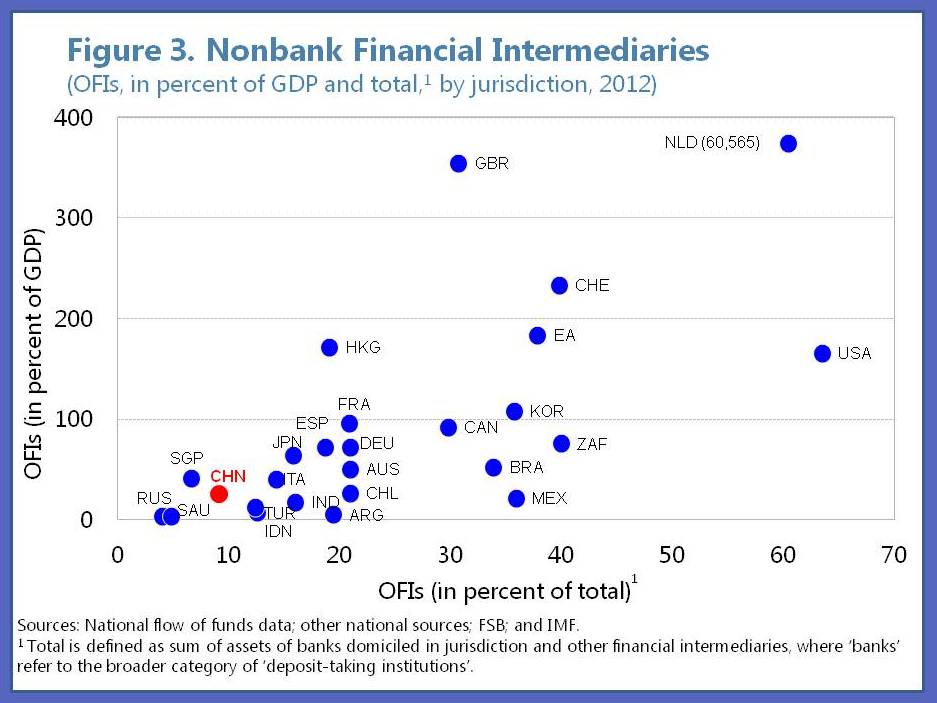
- Financial Stability Board’s filtered estimates suggest China’s shadow banking sector is quite small relative to international comparisons when parts not formally involved in “credit intermediation” are excluded.
Benefits observed
- Marks progress in financial development.
- Provides companies with alternative borrowing channels.
- Provides households with more investment opportunities, important given the ceiling on deposit interest rates.
Risks, concerns, and structural issues
- Circumvention of regulations: shadow banking can be used to bypass rules such as the deposit interest rate ceiling (and other regulations).
- Example: customers buy bank wealth management products offering higher returns instead of deposits; those products may invest through shadow banks in assets resembling bank loans.
- Movement of intermediation outside formal banking -> reduced application of safeguards such as:
- Capital requirements
- Provisions against loan losses
- Loan-to-deposit ratios
- Established supervision and regulation
- Uncertainty over economic substance: unclear whether entities like trusts are mere loan arrangers or are lending like banks and taking on credit risk.
- Investor protection and moral hazard:
- Investors appear largely protected from losses in fixed income trusts and wealth management products; few observed cases of investor losses.
- Perception of implicit guarantees by trust companies or selling banks (reputational risk).
- Risk of investors underestimating underlying risk and allocating too much saving to these products.
- Regulatory challenge: supervisors and regulators are trying to keep up with a fast-moving sector; recent successes exist but sector remains a huge challenge.
Key takeaways and outlook
- Shadow banking in China is simultaneously a sign of financial development and a source of potential systemic risks.
- Measurement depends on definitions: broader measures yield substantially larger shares of GDP (55 percent) than narrower measures (35 percent).
- The forthcoming October Global Financial Stability Report will provide a broader discussion of shadow banking in China and elsewhere.
Source: What’s Lurking in the Shadows of China’s Banks — Steven Barnett, Shaun Roache; September 15, 2014
Content in this bundle
- 中国银行的影子中潜藏着什么; 作者:Steven Barnett和Shaun Roache; 2014年9月15日