Carbon Pricing: Good for You, Good for the Planet
IMF Blog, September 17, 2014
Source details
- Canonical URL
- Carbon Pricing: Good for You, Good for the Planet
Other formats
Bibliographic details
- Authors: Ian Parry
- Published: September 17, 2014
The challenge and policy framing
- Since the 1992 Earth Summit, policymakers have struggled to agree on an international regime for controlling emissions.
- Presently, only around 12 percent of global emissions are covered by pricing programs, such as taxes on the carbon content of fossil fuels or permit trading programs that put a price on emissions.
- Reducing CO2 emissions is widely seen as a classic “free-rider” problem: individual countries may hesitate to bear costs when benefits largely accrue to other countries and future generations.
Domestic co-benefits of CO2 pricing
- Fossil fuel combustion, especially coal, is a leading cause of local outdoor air pollution, which, according to World Health Organization figures, is estimated to cause over 3 million premature deaths a year worldwide.
- Taxing the carbon content of coal will increase its price and decrease its use, leading to both fewer CO2 emissions and better public health due to cleaner air.
- A carbon tax would also increase motor fuel prices, reducing traffic congestion and accidents as people economize on vehicle use—especially where existing motor fuel excises do not fully charge for these adverse effects.
- These health and other “co-benefits” add to the gains in economic efficiency from pricing CO2 emissions.
- Until dedicated policies (like charges for local air pollution) are fully implemented, the indirect impact of CO2 pricing can help alleviate domestic environmental problems in the shorter term.
Key findings from the IMF working paper (domestic-interest perspective)
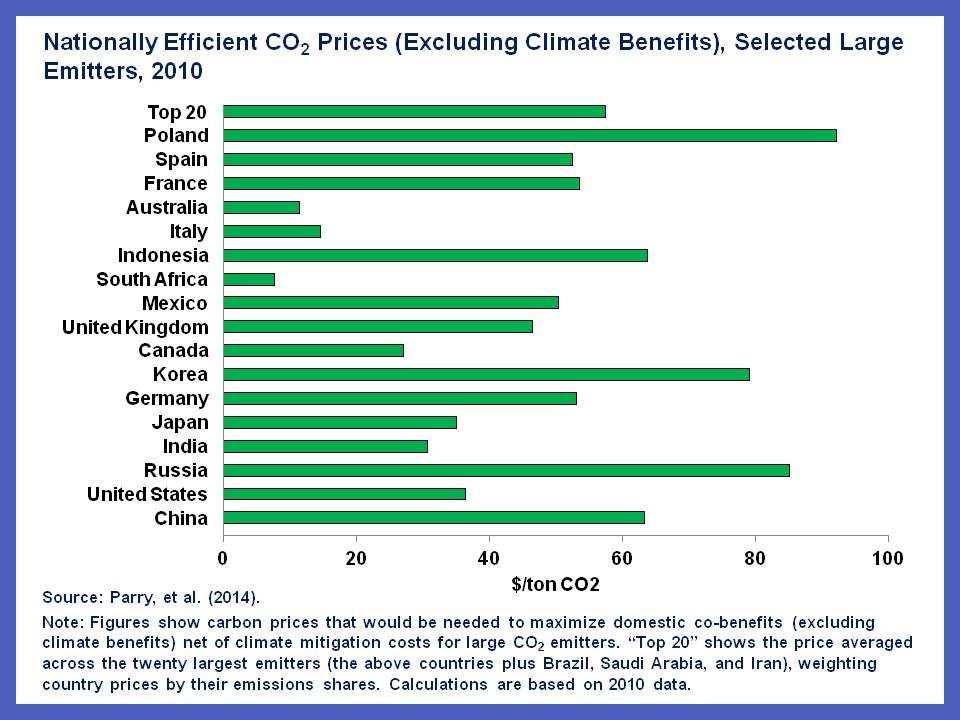
- A substantial carbon tax (or CO2 pricing through trading systems) is justified by national interests, on average $57.5 per ton of CO2 across the top twenty emitters.
- This $57.5 per ton figure is:
- Several times the recent prices in the European Union’s Emissions Trading System.
- 60 percent higher than the climate damages per ton of CO2 estimated by an inter-agency group for the U.S. government.
- Prices that are efficient from a national perspective vary considerably across countries:
- Relatively high in China and Poland—where most CO2 reduction would come from less reliance on coal and there is high population exposure to coal pollution.
- Relatively low in Australia—where population exposure is far more limited.
- Implications:
- Countries need not wait on an international agreement to move ahead with their own CO2 pricing schemes.
- Any international regime should be flexible, allowing some countries (with high co-benefits) to set higher CO2 prices than others.
Fiscal implications and the role of finance ministries
- CO2 pricing through carbon taxes or trading systems with allowance auctions would raise significant new government revenues.
- It is important to use these revenues productively—most obviously to lower the burden of other taxes.
- Environmental tax reform is framed as smarter taxes, not higher overall taxes.
- Finance ministries have a potentially pivotal role in integrating carbon pricing into broader fiscal reforms and should advocate effective carbon pricing.
- Carbon taxes can represent a straightforward extension of existing motor fuel excises by building a carbon charge into them and applying similar charges to other fossil fuel products.
International context and timing
- These findings complement work such as the report by the Global Commission on the Economy and Climate.
- The analysis is intended to inform participants at the United Nations Climate Summit and to catalyze commitments ahead of the December 2015 meetings in Paris.
- There is no need for action to await coordinated measures adopted by many countries—a lot can be achieved by countries acting in their national self-interest.
Ian Parry, September 17, 2014 — "Carbon Pricing: Good for You, Good for the Planet"