Now Is a Good Time to Invest in Infrastructure
IMF Blog, September 30, 2014
Source details
- Canonical URL
- Now Is a Good Time to Invest in Infrastructure
Other formats
Bibliographic details
- Authors: Abdul Abiad, Davide Furceri, Petia Topalova
- Published: September 30, 2014
A crumbling backbone: public capital trends
- The stock of public capital, the most widely available proxy for infrastructure, has declined significantly as a share of output over the past three decades in both advanced and developing countries.
- In advanced economies, public investment was scaled back from about 4 percent of GDP in the 1980s to 3 percent of GDP at present.
- Maintenance spending has also fallen, especially since the financial crisis.
- In emerging market and developing countries, sharply higher public investment in the late 1970s and early 1980s raised public capital stocks, but since then public capital relative to GDP has fallen.
Macroeconomic effects of public infrastructure investment
- Increased public infrastructure investment raises output in the short term by boosting demand and in the long term by raising the economy’s productive capacity.
- Quantified effects in a sample of advanced economies:
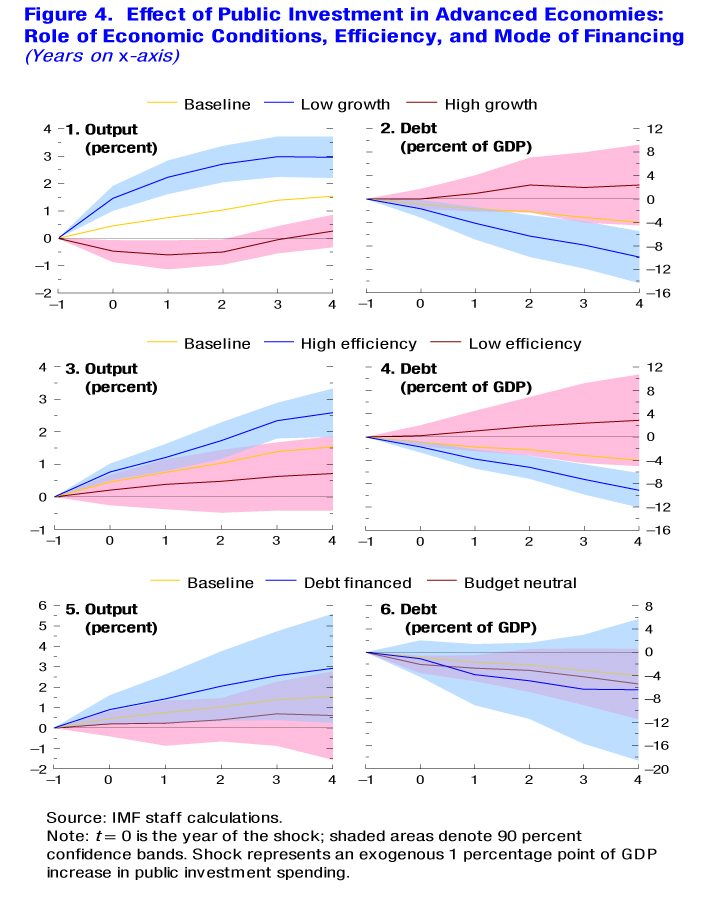
- A 1 percentage point of GDP increase in investment spending raises the level of output by about 0.4 percent in the same year.
- The same 1 percentage point of GDP increase raises output by 1.5 percent four years after the increase.
- The boost to GDP from increasing public infrastructure investment tends to offset the rise in debt, so that the public-debt-to-GDP ratio does not rise when investment is done correctly.
Factors that strengthen investment payoffs
- Timing and macro conditions:
- The short-term boost to output is substantially larger when public investment is undertaken during periods of economic slack and monetary policy accommodation, with the latter limiting the increase in interest rates in response to the rise in investment.
- Investment efficiency:
- Output effects are bigger in countries with a high degree of public investment efficiency—where additional public investment spending is not wasted and is allocated to projects with high rates of return.
- Financing modality:
- Public investment financed by issuing debt has larger output effects than when financed by raising taxes or cutting other spending.
Policy implications and country considerations
- Current global conditions present a golden opportunity to increase public infrastructure investment in countries with infrastructure needs:
- Many advanced economies still have substantial economic slack and interest rates at historic lows, increasing the multiplier effect of investment.
- Many emerging market and developing countries may lack comparable slack and tend to have less efficient public investment processes; increased investment in these countries may yield smaller output boosts and could increase public debt if not implemented efficiently.
- Examples of emerging market and developing countries where infrastructure bottlenecks have been constraining growth: Brazil, India, the Philippines, and South Africa.
- Core policy prescription:
- Invest now, but invest well—target investments where there is a clear need and ensure high efficiency and productivity of projects.
- Productive and efficient public infrastructure investment can provide a much-needed boost to output today and in the future.
Abdul Abiad, Davide Furceri, Petia Topalova — September 30, 2014
Content in this bundle
- Country Report
- Country Report
- Country Report
- Country Report
- Chapter 3: Is It Time for An Infrastructure Push? the Macroeconomic Effects of Public Investment