Smart Fiscal Policy Will Help Jobs
IMF Blog, October 8, 2014
Source details
- Canonical URL
- Smart Fiscal Policy Will Help Jobs
Other formats
Bibliographic details
- Authors: Vitor Gaspar
- Published: October 8, 2014
Unemployment overview
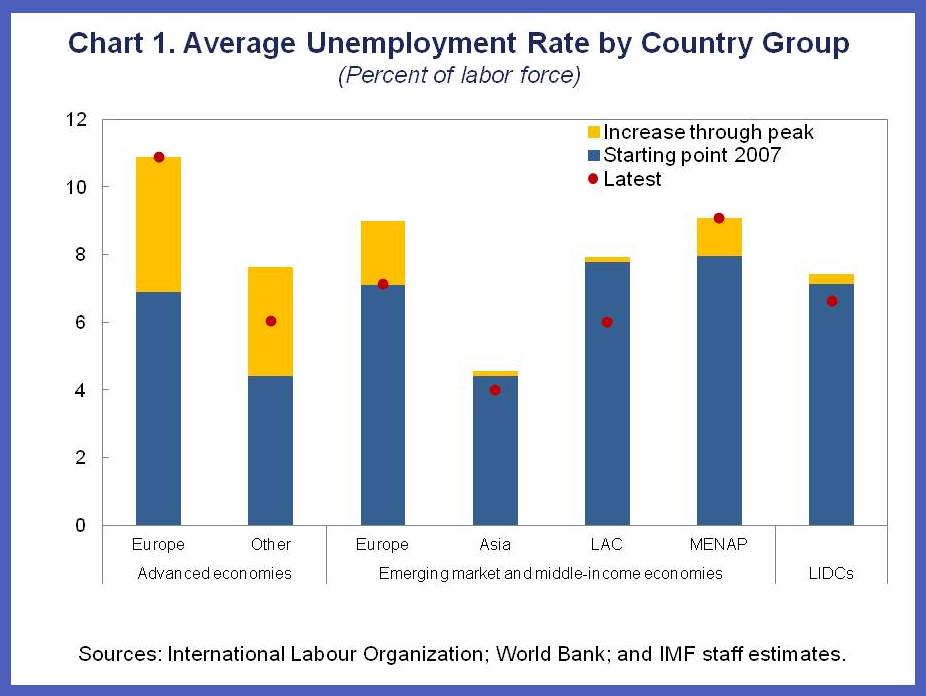
- "Unemployment remains unacceptably high in many countries."
- "Global unemployment currently exceeds 200 million people."
- "An additional 13 million people are expected to be unemployed by 2018."
- "The most worrisome is youth unemployment."
- "There are examples of advanced economies in Europe where youth unemployment surged above 50 percent."
- In several developing economies, job creation does not absorb the large number of young workers entering the labor force every year.
- "This puts unemployment at the top of the global policy agenda."
Working together: Fiscal and Structural
- Theme of the October 2014 Fiscal Monitor: "Can fiscal policy do more for jobs?"
- Fiscal policy cannot substitute for labor market reforms where persistent rigidities exist, but it can work in tandem with broader structural reform efforts to support job creation.
- Fiscal policy can:
- Foster macroeconomic conditions supportive of economic activity and labor markets.
- Facilitate structural reforms in the labor market by offsetting short term economic costs and helping build political consensus through compensation where needed.
- Be part of the overall design of structural policy measures.
- Conditions for effective fiscal support of structural reform:
- It should not raise debt sustainability risks.
- The costs and benefits of the reform need to be well identified.
- The costs need to be constrained in size and duration.
- There needs to be sufficient certainty that reforms will be carried fully to their end.
- Political economy point: "it is very important to improve the understanding of the political dimension of economic policy."
Fiscal Monitor's three possibilities (how fiscal policy can help)
- First: Fiscal policy can foster macroeconomic conditions supportive of activity and labor markets.
- Example: "deficit reduction can be designed and timed to minimize negative effects on employment."
- "Clearly, the adequate policy mix for each country needs to be tailored to its specific circumstances."
- Second: Fiscal policy can facilitate structural reforms in the labor market.
- Fiscal policy can offset short-term economic costs of reform and compensate adversely affected groups to build consensus.
- Third: Fiscal policy can be part of the overall design of structural policy measures.
- Example for advanced economies: "a carefully designed reduction in employer social security contributions on young workers can improve youth employment."
- Examples for emerging market and developing economies: "removing tax barriers, providing basic public services, and offering greater access to finance and training can help address challenges related to informality and low growth in labor productivity."
Current fiscal environment
- "In the last six months, interest rates have been low and volatility in bond markets has been subdued."
- This has "helped ease immediate pressures on public finances in most countries."
- Caution: "we are at a difficult juncture. Underlying fiscal vulnerabilities and fiscal risks continue to accumulate."
- Advanced economies:
- "debt levels are stabilizing but remain elevated."
- "In some cases, debt exceeds 100 percent of GDP."
- Policy balance: "it is important to bring government debt down to safer levels" while being mindful of "the uneven economic recovery and the risk of persistent low inflation in some countries, especially in the euro area."
- Emerging economies:
- "deficits and debt ratios are generally moderate, but still remain above pre-crisis levels."
- Risks include "off-budget transactions and government guarantees."
- Policy priority: raise potential growth while rebuilding fiscal buffers used during the crisis.
- Low-income developing countries:
- "fiscal risks are generally modest."
- Policy focus: "mobilizing revenue, better budget prioritization, and higher efficiency of public spending."
- Some countries also need to "strengthen fiscal governance."
Smart fiscal policy — core definition and prescriptions
- Smart fiscal policy is imperative where there is "an anemic recovery, weak potential growth, and very low inflation."
- Smart fiscal policy should:
- Support jobs and growth while bringing public debt to safer levels.
- Value efficient public investment and facilitate structural reform.
- "This is no time for complacency."
Vitor Gaspar, October 8, 2014 — Smart Fiscal Policy Will Help Jobs
Content in this bundle
- IMF Fiscal Monitor; Back to Work: How Fiscal Policy Can Help, October 2014