Natural Gas: The New Gold
IMF Blog, October 22, 2014
Source details
- Canonical URL
- Natural Gas: The New Gold
Other formats
Bibliographic details
- Authors: Rabah Arezki
- Published: October 22, 2014
What’s cooking
- Over the last decade, discovery of massive quantities of unconventional gas resources has transformed global energy markets and reshaped the geography of global energy trade.
- Consumption of natural gas now accounts for nearly 25 percent of global primary energy consumption.
- The share of oil has declined from 50 percent in 1970 to about 30 percent today.
- Natural gas is lighter than air, expensive to transport, and markets tend to be regional because shipping requires costly pipeline networks or liquefaction infrastructure, dedicated vessels, and re-gasification at destination.
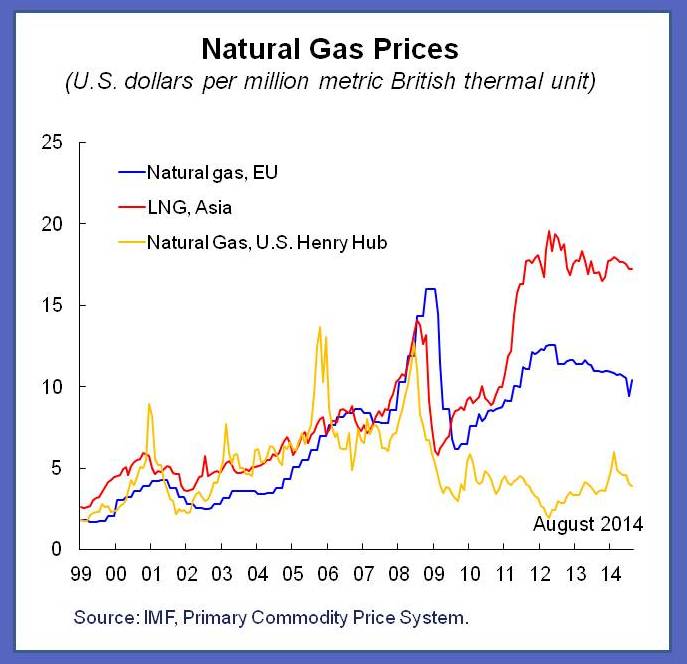
- Limited global integration of gas markets has produced substantial price differences across regions despite increasing liquefied natural gas trade.
U.S. shale gas revolution
- Advances in shale rock drilling produced a sharp surge in U.S. gas production; the United States is the world’s largest natural gas producer and is expected to become a net exporter of natural gas.
- U.S. fossil fuel imports decreased to $225 billion in 2013 from $412 billion in 2008.
- Surging supply has driven down U.S. natural gas prices by about 70 percent in recent years.
- Regional price comparisons cited:
- $4 per million British thermal units in the United States
- $10 in Europe
- close to $17 in Asia
- Cheaper natural gas in the United States has increased U.S. competitiveness in non-energy products:
- Estimates show cheaper natural gas has helped lift manufacturing exports by about 6 percent since the start of the shale gas boom.
- The channels operate at both the intensive (expansion by existing firms) and extensive (new firm entry) margins.
- The shale revolution has helped stabilize international energy prices by freeing supply for European and Asian markets, offsetting some shortages from geopolitical disruptions.
The Fukushima disaster and aftermath
- The Fukushima Daiichi nuclear disaster in March 2011 induced a sharp increase in the use of natural gas due to environmental liabilities associated with nuclear power generation.
- Before the disaster, about one-quarter of Japan’s energy was generated by nuclear reactors.
- Following the disaster, Japan halted production at all nuclear power plants; electric power companies increased use of fossil-fuel power stations and appended natural gas turbines to existing plants.
- Japan’s liquefied natural gas imports have increased dramatically—by about 40 percent—since the disaster, making Japan the world’s largest importer of liquefied natural gas.
- The sharp increase in natural gas demand led to higher prices in Asia—and Japan in particular—double that in Europe and four times higher than in United States.
Geopolitical tensions
- The crisis in Ukraine highlighted European energy markets’ dependence on natural gas.
- Ukraine and countries in southeast Europe appear particularly vulnerable to potential disruptions of Russian gas supply; persistent cutoffs would most impact Ukraine and southeast European countries receiving Russian gas transiting through Ukraine.
- Other countries could be affected through rising spot prices, which may spread from natural gas to other fuels.
Fuel for thought — implications and policy recommendations
- If the United States gradually becomes a net exporter of liquefied natural gas, domestic natural gas prices are expected to rise but still remain markedly lower than in Europe and Asia, given liquefaction costs.
- Natural gas is the cleanest source of energy among other fossil fuels (petroleum products and coal) and avoids liabilities potentially associated with nuclear power generation.
- The abundance of natural gas could provide a “bridge” between the current global energy mix and a future with a higher share of renewable energy sources.
- Energy policy matters for coal and renewable deployment and will impact global trade in energy; Europe and Japan face trade-offs among environmental concerns, economic efficiency, and energy security.
- Getting the balance right between environmental, economic efficiency, and energy security should figure prominently on policy makers’ agendas.
Source: Natural Gas: The New Gold — Rabah Arezki, October 22, 2014.