Does Raising the Minimum Wage Hurt Employment? Evidence from China
IMF Blog, October 23, 2014
Source details
- Canonical URL
- Does Raising the Minimum Wage Hurt Employment? Evidence from China
Other formats
Bibliographic details
- Authors: Prakash Loungani
- Published: October 23, 2014
Overview and motivation
- Raising the minimum wage is a polarizing issue: one side worries it will lower employment; the other emphasizes positive impacts on living standards of the poor.
- Much existing evidence comes from high-income (“advanced”) economies; less is known about emerging markets where minimum wage policy is on the agenda.
- China accounts for nearly 25 percent of the global labor force, so evidence from China is important for understanding minimum wage effects in emerging markets.
Data and methodology
- First study to use data on minimum wage changes for over 2400 counties in China.
- Minimum wage data are combined with employment data from the Annual Survey of Industrial Firms, which covers over 70 percent of China’s manufacturing employment.
- Although China instituted a minimum wage system in 1994, enforcement was significantly tightened only in 2004; results described are based on post-2004 data.
- Strategy to address omitted factors: compare firms with “twin” firms in contiguous regions (assumption that contiguous-region firms are more likely to have similar employment trends) and control for developments in employment at the twin firm.
Main empirical findings
- On average across all firms:
- "a 10% percent increase in the minimum wage lowers employment by a little over 1% percent."
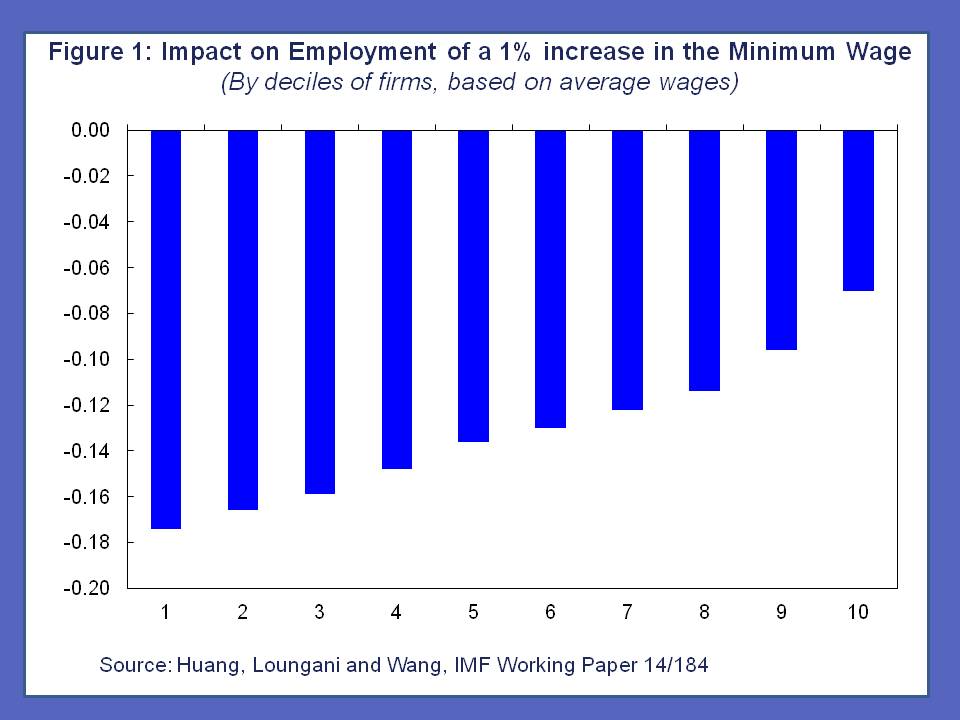
- Heterogeneous effects by firm wage level (firms grouped into deciles based on average wage):
- Lowest-wage decile: "a 10% increase in minimum wages lowers employment by nearly 1.8%."
- Highest-wage decile: impact is "0.6%."
- The impact declines steadily across deciles from low-wage to high-wage firms.
- Impact on firm wages:
- On average, "an increase in the minimum wage raises wages by about 1%."
- Lowest-wage decile: increase is "about 2.5%."
- Effect declines steadily across deciles; essentially no impact for the highest decile.
- Robustness: without twin-firm controls, the estimated impact is qualitatively similar to Figure 1 but quantitatively smaller on average.
Interpretation and mechanism insights
- The minimum wage affects employment and wages unevenly across the wage distribution of firms:
- Low-wage firms experience larger employment declines and larger wage increases.
- High-wage firms experience smaller employment declines and negligible wage increases.
- The twin-firm contiguous-region identification strategy helps mitigate concerns that observed employment changes are driven by unobserved local shocks rather than minimum wage changes.
Policy implications and recommendations
- Information on employment and wage impacts is critical for setting the minimum wage level.
- The study’s evidence for China:
- Suggests that "a 10% increase in the minimum wage lowers employment by 1%."
- Notes that impacts of this magnitude have been found in studies for high-income countries but generally for sub-groups such as teenagers or low-skilled workers.
- Policy design must account for differential effects across low-wage and high-wage firms:
- Minimum wage settings should balance equity (ensuring low-wage workers can afford a living) and efficiency (avoiding exclusion of low-wage workers from employment prospects).
- If raising the minimum wage lowers employment and excludes low-wage workers from employment prospects, it may have adverse effects on both welfare and efficiency.
Source: Does Raising the Minimum Wage Hurt Employment? Evidence from China — Prakash Loungani, October 23, 2014
Content in this bundle
- 提高最低工资会损害就业吗?中国的情况; iMFdirect博客
- Wp14184