A Downturn Without Layoffs? Reconciling Growth And Labor Markets In Latin America
IMF Blog, October 29, 2014
Source details
- Canonical URL
- A Downturn Without Layoffs? Reconciling Growth And Labor Markets In Latin America
Other formats
Bibliographic details
- Authors: Bertrand Gruss
- Published: October 29, 2014
Employment trends and headline facts
- Publication: Bertrand Gruss, October 29, 2014.
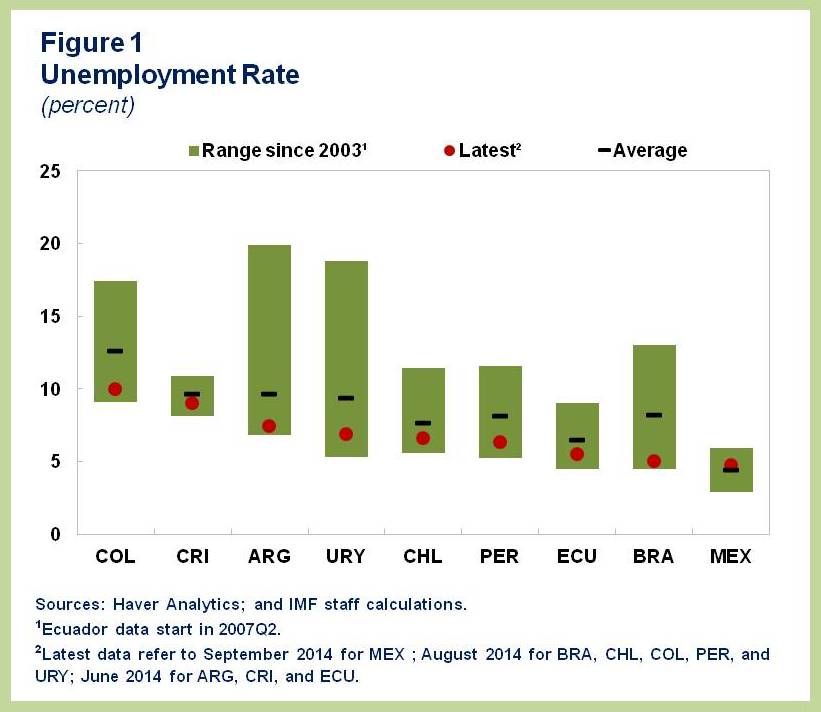
- Recent pattern: Economic activity has slowed markedly in the last three years, with some South American countries slipping into outright recession more recently, while unemployment rates have hovered at record-low levels in most countries.
- Countries repeatedly referenced: Brazil, Chile, Colombia, Peru, Mexico, Uruguay, Argentina, Costa Rica, Ecuador.
Signs of weakening beneath the surface
- Comparison period: first three quarters of 2014 versus the average over 2011-13.
- Employment:
- Employment was still growing in 2014 in most countries, but generally at a softer pace than a few years ago.
- Uruguay stands out as having seen stronger employment growth more recently.
- In Brazil, job creation has stalled altogether.
- Unemployment rates:
- Unemployment rates were on a downward path in most countries during 2011-13.
- In 2014, the record became more mixed: unemployment continued to decrease in Colombia, Brazil, Mexico, and Peru (though generally at a slower pace), but started to edge up in Argentina, Chile, Costa Rica, Ecuador, and Uruguay.
- Despite recent softening, unemployment in most countries remains well below the long-term average or typical estimates of the natural rate.
- Real wages:
- Real wage growth is slowing in most countries, but remains firmly in positive territory.
Historical patterns and Okun-style analysis
- Scope: Regional Economic Outlook Update analysis for Brazil, Chile, Colombia, Peru, Mexico, and Uruguay.
- Output–employment relationship:
- Country-specific historical relationships between output and employment (a version of Okun’s Law) indicate employment growth in the four quarters through June 2014 was not stronger than expected for any of these countries.
- In some cases (Brazil and Mexico), job creation fell significantly short of what economic activity would have predicted.
- Unemployment dynamics:
- Changes in unemployment over the last year can be broadly explained by output growth for most countries.
- Exception: Brazil — by June 2014 the unemployment rate was about 1 percentage point lower than would have been expected given the economy’s sharp slowdown.
- Contributing factor in Brazil: a surprisingly large drop in labor participation (by about 1½ percentage points). If this drop proves temporary, unemployment could increase rather quickly going forward.
Prospects and policy options
- Outlook:
- Employment growth is likely to remain subdued for some time because labor markets typically lag the overall economy.
- Output growth is not expected to revert to the high rates of the “golden decade” anytime soon.
- Unemployment rates will probably rise somewhat and real wage growth may well moderate further.
- Slower growth of aggregate wage income will make it increasingly difficult to sustain the pace of poverty reduction and other social achievements observed in previous years.
- Policy priorities:
- Overwhelming priority: rekindle economic growth while preserving macroeconomic stability.
- Limited scope for demand-side stimulus given that economic slack is still limited in most countries and fiscal balances are weak in some economies.
- Emphasis should be on supply-side reforms to foster higher productivity and create better conditions for private investment.
- Key reform areas: improvements in physical infrastructure, educational systems, and the general business environment.
- Rationale: targeted reforms in these areas are the most promising avenue for reviving growth and generating more and better-paid jobs over the medium term.
Source: Bertrand Gruss, IMF blog post, October 29, 2014.
Content in this bundle
- 102914p
- wreo1014