Mind the Dragon: Latin America’s Exposure to China
IMF Blog, November 11, 2014
Source details
- Canonical URL
- Mind the Dragon: Latin America’s Exposure to China
Other formats
Bibliographic details
- Authors: Bertrand Gruss, Fabiano Rodrigues Bastos
- Published: November 11, 2014
Overview and context
- Authors: Bertrand Gruss, Fabiano Rodrigues Bastos
- Date: November 11, 2014
- Key premise: The share of exports from Latin America going to China is now ten times larger than in 2000, tying the region’s economic fate more closely to China’s economic performance.
Evidence from financial markets: growth surprises and FX reactions
- Method: Analyze the immediate response of foreign exchange (FX) markets to surprises in key Chinese economic indicators (reaction of currencies to deviations between actual outcomes and expected values).
- Main findings:
- The response of exchange rates to a surprise on the growth rate of China’s industrial value added is large and significant for commodity exporters in Latin America, such as Brazil, Chile, and Colombia.
- The change in JP Morgan’s Latin America currency index is significant and relatively large (noted as larger than the change in the analogous Asian currency index).
- Peru exhibits a surprisingly low and insignificant FX response, potentially reflecting more frequent exchange rate interventions.
- Commodity exporters from other regions, such as Norway, also experience a significant exchange rate response to Chinese growth surprises.
- Other emerging markets—Mexico, Poland, and Turkey—show strong FX responses; interpreted as positive news in China lifting global confidence and risk appetite, benefiting liquid currencies that act as proxies for emerging market assets.
Transmission channel: commodities
- Rationale: Many Latin American countries are highly dependent on commodities and China is the largest world buyer of these products; therefore commodity prices are a key transmission channel.
- Empirical evidence:
- China’s growth surprises have a significant and large effect on the price of many commodities that are very relevant for Latin America.
- Investment behavior is consistent with this channel: capital expenditure by the world’s top mining companies started slowing in the prior year amid revisions to long-term growth in China and declining metal prices.
- Mining companies are reportedly focused on improving operational efficiency and investment selectiveness in response to structural challenges.
Historical macroeconomic context
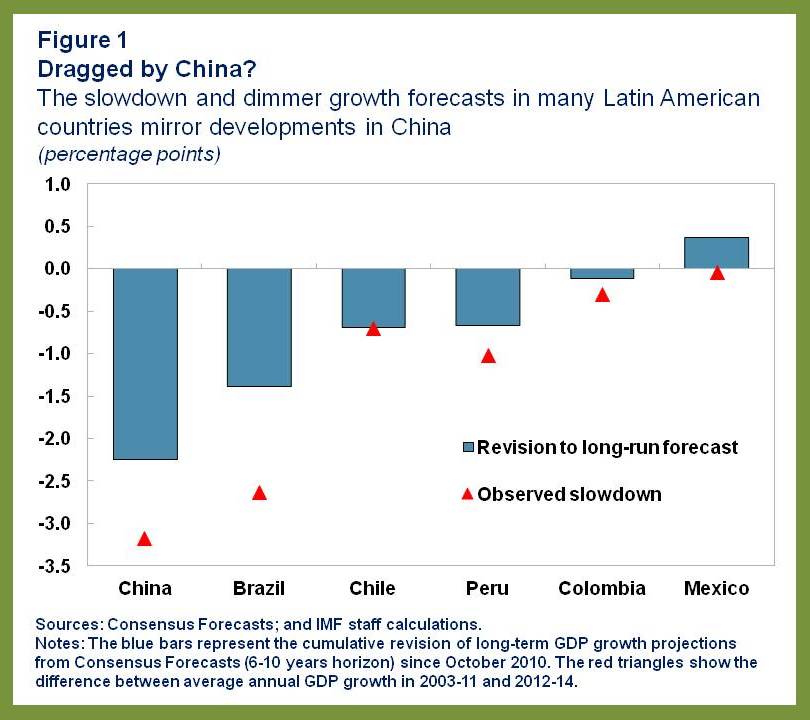
- Commodity-driven growth uplift: Output growth in Latin America rose from an average of 2.5 percent in 1982-2002 to 4.5 percent in 2003-11, largely fueled by China’s double-digit growth in the 2000s.
- Recent reassessments: China’s long-term projected growth has been cut by 2¼ percentage points since mid-2010.
Risks and scenarios
- A sharper slowdown in China represents one of the key risks for Latin America and warrants preparation.
- Even a gradual slowdown with rebalancing toward consumption could weaken demand for commodity-intensive goods (notably metals) by more than currently projected and priced in, implying downside risks to commodity exporters.
Policy recommendations to increase resilience
- Macro policy:
- Ensure prudent fiscal policy.
- Maintain low inflation.
- Preserve flexible exchange rates.
- Structural policy:
- Pursue a credible and bold agenda of structural reforms focused on improving education, infrastructure, and the business environment.
- Boost productivity and the ability to move up the value chain to raise potential growth and reduce vulnerability to external confidence shocks.
Source: Mind the Dragon: Latin America’s Exposure to China, Bertrand Gruss and Fabiano Rodrigues Bastos, November 11, 2014.
Content in this bundle
- De Olho no Dragão: A América Latina e Sua Exposição à China; 10 de novembro de 2014
- Regional Economic Outlook: Western Hemisphere - Rising Challenges; April 2014
- wp14154