Turkey’s Recipe to Escape the Middle-Income Trap
IMF Blog, December 15, 2014
Source details
- Canonical URL
- Turkey’s Recipe to Escape the Middle-Income Trap
Other formats
Bibliographic details
- Authors: Gregorio Impavido, Uffe Mikkelsen
- Published: December 15, 2014
Overview
- Turkey is undergoing economic transition with slowing growth that risks the country being caught in a “middle-income trap,” unable to join the ranks of high income economies.
- The country grew at 6 percent per year on average in the period 2010-13, with policies supportive of domestic consumption.
- Reliance on consumption has generated a large current account deficit, mostly financed by short-term capital flows.
Current macroeconomic situation and constraints
- Reliance on consumption at the expense of investment, slow export growth, and sizable investment needs have hurt potential growth.
- Low domestic savings and competitiveness challenges have limited investment and exports, which have also suffered from slow growth in Europe.
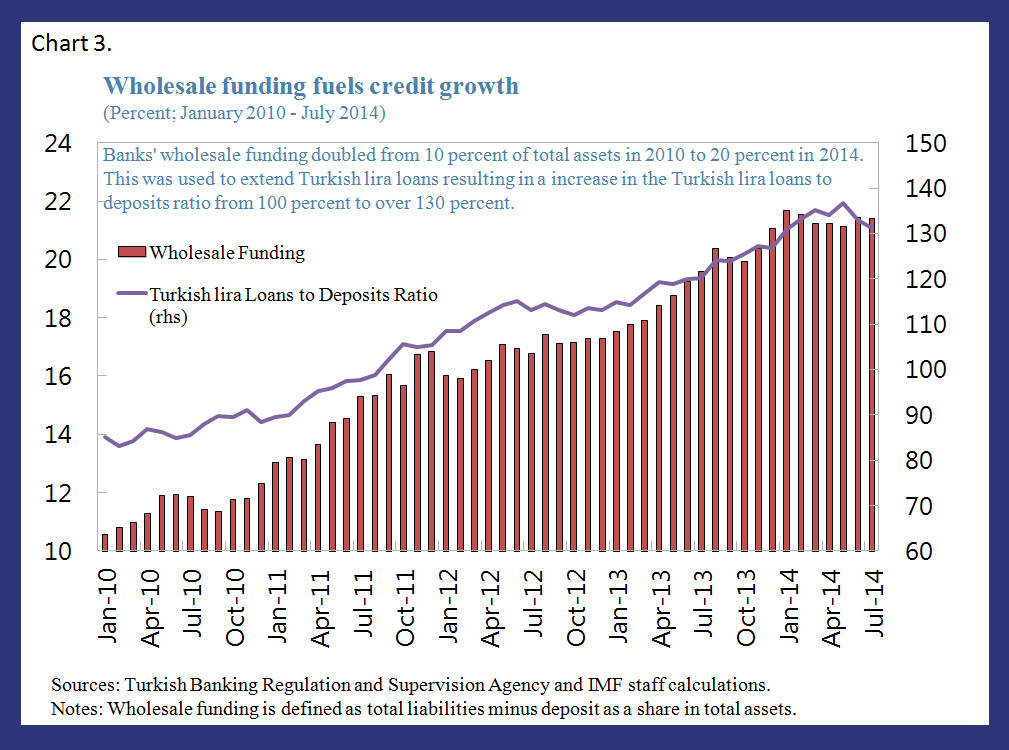
- Ample capital inflows intermediated by local banks have led to rapid leveraging in foreign currency (FX) in the financial sector and increasing wholesale funding.
- Capital inflows have also put upward pressure on the exchange rate, promoted leveraging in FX, and fuelled excessive credit growth, potentially exposing the banking sector to direct rollover and indirect FX risk.
Growth projection and rebalancing need
- With current policies, Turkey's economy is expected to grow only 3.5 percent annually over the next five years.
- Going forward, the economy must be rebalanced to make it more competitive and to restore output and employment growth.
Four areas for rebalancing the economy (findings and recommendations)
- More public savings
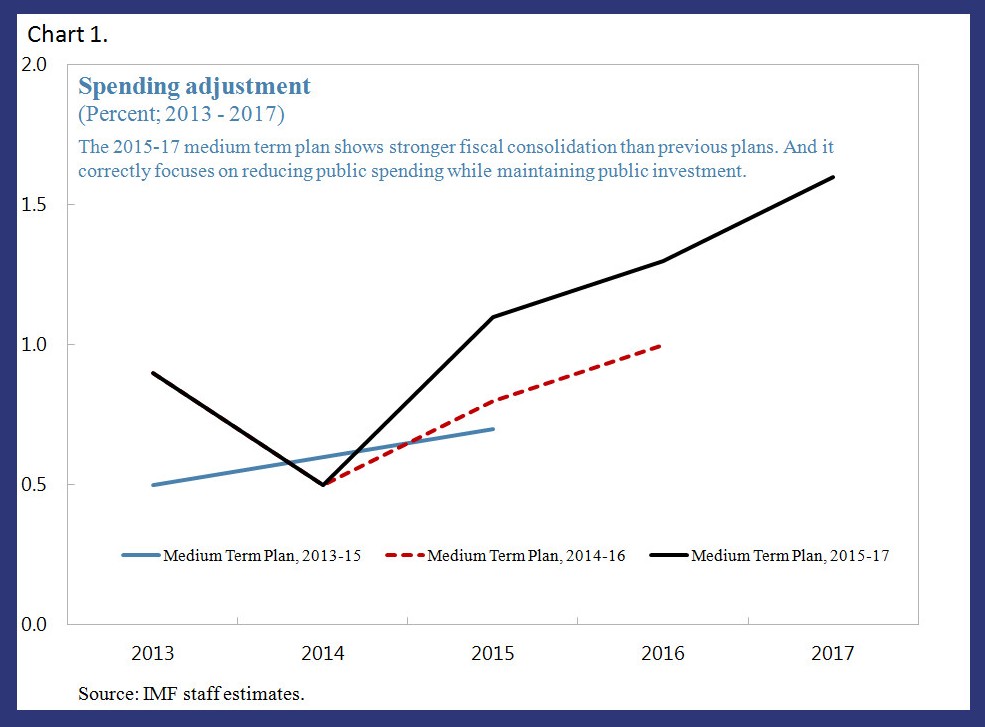
- The tighter fiscal policy in the government’s medium term program is focused on reducing current spending while preserving public investment.
- This will increase national savings in the medium term by about 1.3 percent of GDP.
- IMF staff analysis shows that policies that directly increase national savings reduce the external imbalance without weakening private investment—such adjustment has the least negative impact on growth and employment.
- If adjustment were left to monetary policy only or to the markets, the negative effect on growth and private investment would be much larger.
- Renewed focus on the inflation target
- The Central Bank of the Republic of Turkey (CBRT) has missed its inflation target in the past.
- At present, the markets do not believe the 5 percent inflation target can be met in the short term.
- With the envisaged tighter fiscal stance, the burden on monetary policy to meet the inflation target will be lower, facilitating the authorities’ disinflation objective.
- An expanded macroprudential toolkit to preserve financial stability
- Rapid FX leveraging and increasing wholesale funding have complicated the CBRT’s task to meet the inflation target while safeguarding financial stability.
- Authorities introduced tools to reduce excessive consumer lending in the first half of 2014.
- More recently, they introduced additional measures to contain foreign exchange risk and promote the banking sector’s reliance on core funding.
- More private savings and structural reforms
- In the longer run, rebalancing will depend on structural reforms; the authorities need to accelerate the ambitious structural reform program included in the 10th Development Plan.
- Priority should be given to policies that encourage higher private sector savings, which has the highest impact on the external imbalance with the least negative impact on growth.
Gregorio Impavido, Uffe Mikkelsen — December 15, 2014
Content in this bundle
- Türkiye’nin Orta Gelir Tuzağından Kurtulma Reçetesi
- Country Report
- Country Report