What Happens to Public Health Spending in IMF-Supported Programs? Another Look
IMF Blog, December 21, 2014
Source details
- Canonical URL
- What Happens to Public Health Spending in IMF-Supported Programs? Another Look
Other formats
Bibliographic details
- Authors: Benedict Clements, Sanjeev Gupta, Masahiro Nozaki
- Published: December 21, 2014
Background
- Improvements in health have a large positive effect on well-being and economic activity; the 2013 Lancet Commission indicates about 11 percent of the economic growth in recent decades can be attributed to these improvements.
- The impact of IMF-supported programs on public health spending has been the subject of earlier research covering periods before the global financial crisis, which found a positive effect of Fund-supported programs on public health spending (Martin and Segura, 2004; Center for Global Development, 2007; Clements, Gupta and Nozaki, 2013).
- This analysis reassesses the evidence for developing economies extending the sample to 2003 to 2012.
Empirical findings (2003–2012)
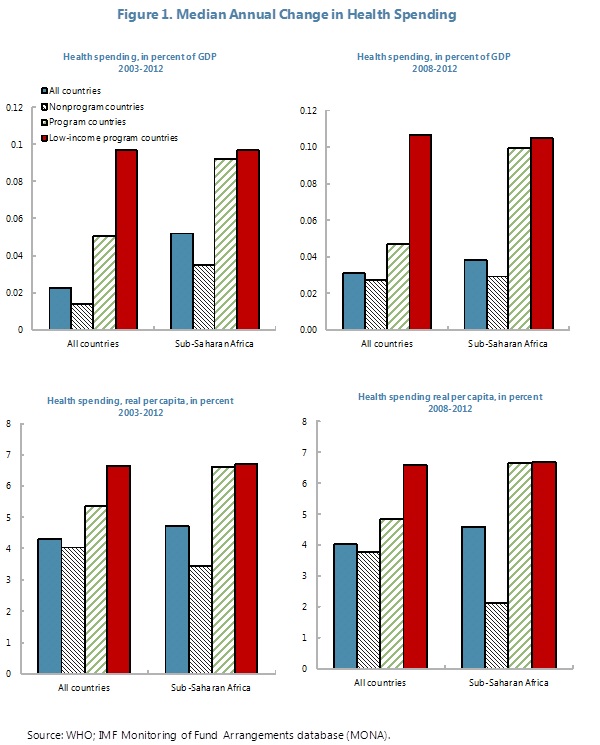
- Broad patterns from earlier peer-reviewed analysis continue to hold: spending rises at a brisker pace in countries with Fund-supported programs than in those without.
- Health spending as a share of GDP has been rising at a faster annual pace in countries with Fund-supported programs, especially:
- low-income countries (which pay zero interest under Fund-supported programs), and
- countries of Sub-Saharan Africa.
- Over a 10 year period, the cumulative difference between program and non-program low-income countries is about 0.6 percentage points of GDP.
- The 2013 econometric analysis indicates that if macroeconomic factors that affect health spending are controlled for, the impact almost doubles.
- Other measures of spending increases show the same pattern:
- Real health spending per person grew by an average of about 6½ percent a year in low-income countries with programs.
- Low-income countries without programs averaged spending increases of 4½ percent.
- Developments between 2008 and 2012 show a similar story during and after the global financial crisis.
- Countries adversely affected by the Ebola virus also show greater spending increases (as a percent of GDP) during periods with Fund-supported programs:
- Guinea increased by 0.7 percentage points (2010 to 2013).
- Liberia increased by 1.6 percentage points (2010 to 2013).
- Sierra Leone increased by 0.24 points (2010 to 2013).
Channels and mechanisms
- Tax reform emphasis in Fund-supported programs can raise revenues, helping countries increase social spending in a fiscally sustainable manner.
- Programs that lead to higher economic growth can generate fiscal space (including through more robust revenue growth) to finance increased health outlays.
- IMF-supported programs can have a catalytic effect on donor financing, deepening the pool of resources for priority spending on health and other programs.
- More recently, the incorporation of minimum floors on social spending in Fund-supported programs has encouraged countries to raise health spending; the IMF’s Independent Evaluation Office found that 29 of 30 recent programs incorporated these minimum floors (IEO, 2014).
Policy implications and recommendations
- Fund-supported programs are compatible with country plans to expand public spending on health.
- Raising health spending is necessary but not sufficient for better health outcomes; countries should also focus on reforms that improve the efficiency of health spending, where there is significant room for improvement (Coady, Francese, and Shang, 2014).
Benedict Clements, Sanjeev Gupta, Masahiro Nozaki — December 21, 2014 — What Happens to Public Health Spending in IMF-Supported Programs? Another Look.
Content in this bundle
- 基金组织支持的规划对公共卫生支出有何影响?对问题的重新审视
- IMF支援プログラムでは公的医療費に何が生じているのか?もうひとつの見解 - ベネディクト・クレメンツ、 サンジーブ・グプタ、野崎仁宏
- 122114ar