A Big Step Forward for Bolstering Financial Inclusion
IMF Blog, January 28, 2015
Source details
- Canonical URL
- A Big Step Forward for Bolstering Financial Inclusion
Other formats
Bibliographic details
- Authors: David Marston, Era Dabla-Norris, D Filiz Unsal
- Published: January 28, 2015
Summary and objectives
- Authors: David Marston, Era Dabla-Norris, D. Filiz Unsal
- Publication date: January 28, 2015
- Purpose: Present a new framework to identify barriers to financial inclusion, estimate how removing those barriers affects country output and inequality, and evaluate policy levers to promote inclusion.
Why financial inclusion matters
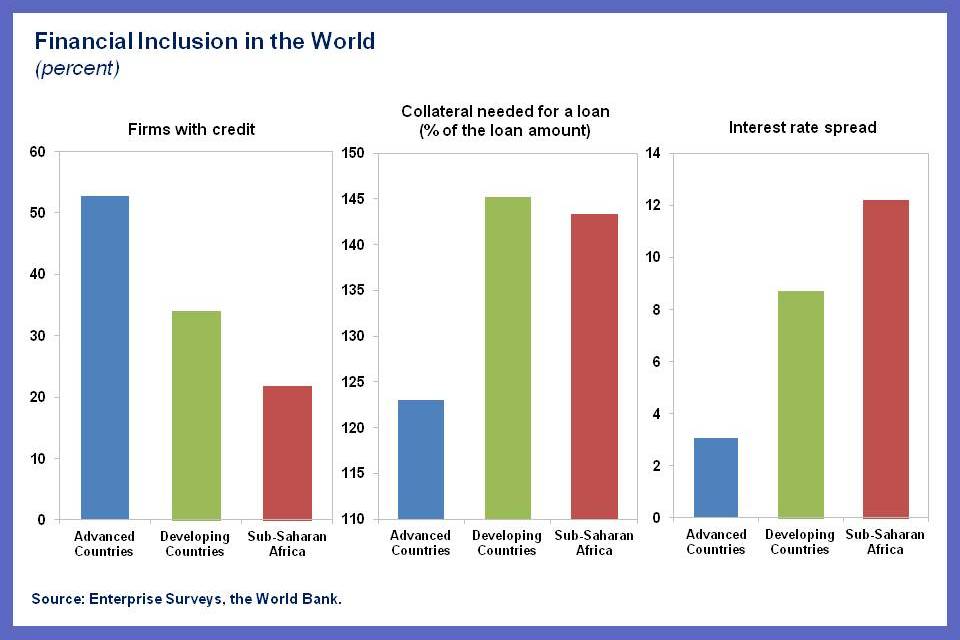
- Large gaps in global access to finance:
- "Slightly more than half of the firms (58 percent) in developing countries and only one-fifth of those in low-income countries have access to bank credit."
- Binding barriers for firms, especially small and medium-sized enterprises:
- High costs, travel distance, onerous paperwork.
- Limited credit, high collateral requirements, high interest rates.
- Economic consequences documented:
- Individuals rely on limited savings to become entrepreneurs.
- Fledgling enterprises depend on self-financing for investment needs, limiting firm size, innovation, and productivity.
Framework application and country case findings
- Countries analyzed:
- Low-income: Kenya, Mozambique, Uganda.
- Emerging markets: Egypt, Malaysia, Philippines.
- Key cross-country findings:
- Disentangling constraints is crucial; policy impact depends on country-specific characteristics.
- Example: Uganda’s output is most responsive to relaxing collateral requirements (identified as the most binding constraint).
- Example: Malaysia’s major obstacle is high participation costs for access to financial services.
- Financial inclusion increases output, but effects on inequality vary:
- Reducing the cost of accessing financial services can reduce income inequality as previously excluded enterprises obtain credit and workers receive higher wages.
- Relaxing collateral requirements may initially increase inequality because wealthy firms use less collateral to leverage more, increasing production and profit; over time, as banks lower collateral requirements, relatively poorer agents gain and inequality can decline.
- Distributional consequences can be sharp:
- Lowering participation costs tends to benefit the poor, while wealthy firms may lose somewhat due to higher interest rates and wages.
- Policies targeting financial depth (e.g., relaxed collateral) benefit productive firms but can impose losses on less productive firms and firms with low credit demand.
Policy implications and recommended measures
- No one-size-fits-all solution; prioritize country-specific diagnosis of binding constraints.
- Foundational actions for governments:
- Develop appropriate legal, regulatory, and institutional frameworks and a supporting information environment.
- Introduce and enforce laws that protect property or creditor rights.
- Set standards for disclosure and transparency.
- Promote credit information-sharing systems and collateral registries.
- Educate and protect consumers.
- Operational and targeted measures governments could consider:
- Grant exemptions from onerous documentation requirements.
- Allow correspondent banking arrangements.
- Shift to using electronic payments into bank accounts for government payments.
- Expected outcomes of implementing these measures:
- Expanded firms’ access to finance, increased financial inclusion, reduced inequality, and boosted growth.
Ongoing and future work
- Framework being applied to additional countries; "over 20 country studies completed or in progress," including:
- Colombia, Costa Rica, El Salvador, Guatemala, Honduras, India, Nicaragua, Nigeria, Paraguay, Panama, Peru, Uruguay, the Economic Community of Central African States, the Democratic Republic of Congo, Nigeria, and Zambia.
- Invitation to follow future research and case studies on financial inclusion.
Source: A Big Step Forward for Bolstering Financial Inclusion (January 28, 2015).