How Can Egypt Achieve Economic Stability and Better Living Standards Together?
IMF Blog, February 11, 2015
Source details
- Canonical URL
- How Can Egypt Achieve Economic Stability and Better Living Standards Together?
Other formats
Bibliographic details
- Authors: Christopher Jarvis
- Published: February 11, 2015
A difficult starting point
- Political transition over the past four years left chronic economic problems unaddressed and made new problems acute.
- Key socioeconomic outcomes in 2013/14:
- Economic growth: 2.2 percent.
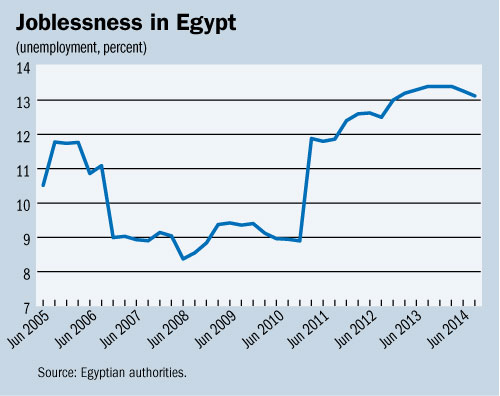
- Unemployment: peaked at 13.4 percent, with highest levels among youth and women.
- Poverty: rose to 26.3 percent the year before, with another 20 percent of the population estimated to be close to the poverty line.
- Average inflation: 10 percent.
- Central bank reserves: fell short of covering three months worth of imports.
- Fiscal and debt deterioration between fiscal year 2010/11 and 2013/14:
- Overall fiscal deficit rose from 9.8 percent of GDP in fiscal year 2010/11 to 13.8 percent in 2013/14.
- General government debt increased from 76.6 percent of GDP to 90.5 percent over the same period.
- Structural weaknesses predating 2011 include inefficient subsidies, cumbersome business regulations, low human capital, poor infrastructure, low access to finance, and poor external competitiveness.
Policies to raise growth and lower deficits: subsidy reform and exchange rate flexibility
- Fuel subsidies:
- In 2013/14, Egypt spent over 6 percent of its GDP on fuel subsidies—more than on health or education.
- Fuel subsidies tend to benefit better-off segments and capital-intensive industries rather than the poor and labor-intensive industries needed to reduce unemployment.
- Subsidies contribute to large fiscal deficits and rising public debt, limiting spending on infrastructure.
- Subsidy reform measures and effects:
- Increasing fuel prices can generate large savings.
- Savings can finance conditional cash transfers to vulnerable people and allow more resources for roads, schools, hospitals, and power plants.
- The authorities began implementing subsidy reform the previous summer and are designing a conditional cash transfer system financed in part by subsidy-savings.
- Rebalancing spending toward health, education, and infrastructure can help the poor in the short term and raise potential growth in the longer term.
- Exchange rate flexibility:
- A more flexible exchange rate can strengthen competitiveness, attract foreign investment and tourism, and support exports of new industries.
- These developments can create jobs and support long-term growth and higher living standards.
- Recent movement of the exchange rate of the Egyptian pound against the U.S. dollar is described as a step in the right direction.
Structural reforms are crucial
- Improve business environment:
- Example: According to the World Bank, it takes 218 days to get a construction permit in Egypt, compared to only 29 days in the Republic of Korea.
- Dismantling inefficient regulations and red tape is essential to increase investment, spur jobs, and formalize the informal sector.
- Current plans to issue a revised investment law are noted as moving in the right direction.
- Build modern, transparent institutions:
- Institutions should encourage accountability, good governance, and fair, transparent rules to ensure gains from growth benefit all and access to jobs and opportunities is evenhanded.
- Financial sector improvements:
- Only 10 percent of Egyptians currently have bank accounts.
- Increasing diffusion of financial services and extending more credit to small job-creating businesses could help the economy.
- Adoption of a micro-finance law could help develop the financial sector.
- Education and human capital:
- Improving the educational system is paramount; jobs require graduates prepared for the modern labor market.
- The constitution mandates rebalancing spending toward health and education; if implemented efficiently, this could support higher, more inclusive growth while preserving fiscal sustainability.
Conclusions and policy implications
- The objectives of restoring economic stability and improving living standards are complementary; several policies can advance both goals.
- Steadfast implementation of reforms can:
- Restore economic stability (lower deficits, debt, inflation; rebuild reserves),
- Spur jobs and growth,
- Improve poverty and social outcomes through targeted transfers and spending on human capital and infrastructure.
- The IMF remains committed to helping Egypt achieve better living standards.
Christopher Jarvis, February 11, 2015