Resolving Residential Mortgage Distress: Time to Modify
IMF Blog, March 11, 2015
Source details
- Canonical URL
- Resolving Residential Mortgage Distress: Time to Modify
Other formats
Bibliographic details
- Authors: Jochen Andritzky
- Published: March 11, 2015
Overview
- Housing crises with high mortgage debt can create a vicious circle: falling housing prices → reduced household wealth → lower consumption → deeper economic slowdown → more mortgage defaults.
- A new IMF Working Paper compares housing crises and policy responses in Iceland, Ireland, Spain, and the United States and argues for a two-stage approach: temporary debt service relief during the crisis followed by durable loan modifications in the recovery.
Why policymakers worry about mortgage distress
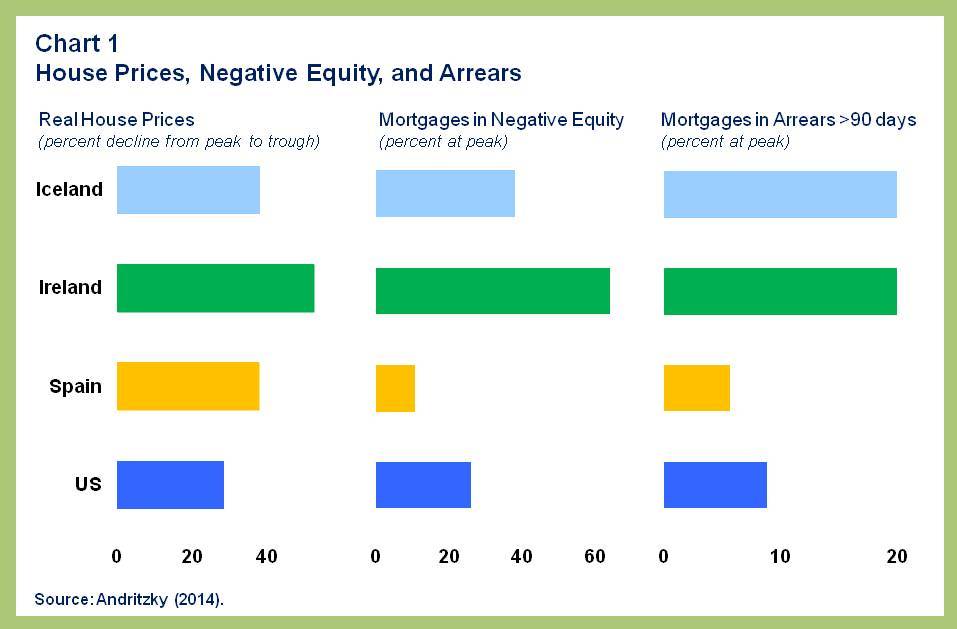
- Housing busts and high mortgage debt can amplify initial shocks, for example through forced home sales flooding property markets and depressing prices.
- This negative feedback affected Iceland, Ireland, Spain, and the United States with varying intensity.
- Prevention of boom-bust cycles is preferable, but widespread mortgage default requires crisis-resolution strategies.
- There is no “one-size-fits-all” solution; country-specific factors and the stage of recovery matter.
Providing breathing space with temporary forbearance
- Forbearance: lenders offered debt service relief (e.g., reducing mortgage payments to interest only for a limited time).
- Benefits:
- Helps households adjust consumption more smoothly.
- Risks and implementation caveats:
- Invites free riding by borrowers not under severe financial distress.
- Should be considered only for borrowers currently under proven financial strain with sufficiently strong prospects to recover debt service capacity.
- Lenders must closely monitor forborne loans.
- Role in strategy:
- Forbearance can act as a crisis stopgap that dovetails with later loan modifications during the recovery.
Foreclosure will have to play a role
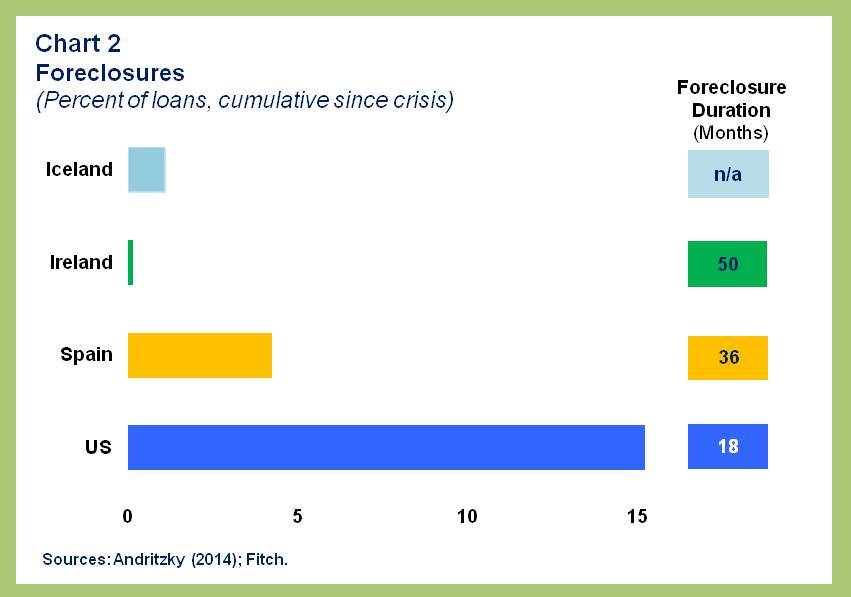
- Cross-country variation: foreclosure was widespread in some countries (particularly the US) and largely absent in others (such as Ireland).
- Trade-offs:
- Benefits: strong foreclosure rights decrease lenders’ loan losses and contain opportunistic borrower behavior.
- Costs: large scale foreclosures can depress house prices and trigger more defaults — especially harmful in systemic housing crises.
- Policy lessons:
- Foreclosure moratoria introduced in some countries had mixed results; delays can increase opportunistic defaults and overall workout costs.
- Making foreclosure more costly through temporary fees or taxes could incentivize lenders to consider foreclosure alternatives in a systemic crisis.
Time to modify (loan modification)
- Definition: A loan modification is a one-time, permanent amendment to the terms of a loan which reduces the monthly debt service payments. The most common type is a maturity extension which reduces monthly amortization payments.
- Role in recovery:
- Loan modifications can help homeowners overcome debt servicing difficulties as incomes and house prices rebound.
- Determining the right modification at the height of a crisis is difficult; the recovery phase makes it easier to set suitable terms.
- Loan modifications during the recovery phase complement temporary forbearance arrangements.
- Evidence and institutional support:
- Available statistics suggest that more than 10 percent of mortgages underwent some type of modification or restructuring in each of the four countries.
- Outcomes were often supported by dedicated policies, such as the Homeowner Affordable Modification Program (HAMP) in the US and supervisory workout targets in Ireland.
- Barriers and policy remedies:
- High renegotiation costs and obstacles (prudential rules, taxes) limited the extent of loan modification.
- Recommendations:
- Strengthen policies to reduce barriers to modifications while applying tight eligibility criteria to contain free riding.
- Frameworks for orderly debt renegotiation (e.g., a code of conduct or a statutory insolvency framework) can improve lender–borrower coordination.
- Prudential or fiscal policies can set appropriate incentives to encourage loan modifications.
Reducing distress through across-the-board debt relief
- Features:
- Provides immediate relief to many mortgagees.
- In Iceland, broad-based debt relief was facilitated in part by foreign bank creditors bearing the losses.
- Trade-offs:
- High upfront cost of broad-based debt relief often outweighs economic benefits and would eventually need to be covered by taxpayers.
Conclusion and policy recommendations
- No universal solution; policy must account for country-specific factors and the stage of recovery.
- Immediate aftermath of systemic housing crises:
- Facilitate temporary forbearance as selective and time-bound breathing space for overindebted households.
- Recovery phase:
- Foster durable resolution of distress by facilitating loan modification.
- Foreclosure:
- Recognize foreclosure’s negative side effects in systemic crises, but retain foreclosure as an efficient resolution tool in some cases and as an incentive for constructive borrower behavior.
Jochen Andritzky, March 11, 2015 — "Resolving Residential Mortgage Distress: Time to Modify"