Dams And Dikes For Public Finances
IMF Blog, March 18, 2015
Source details
- Canonical URL
- Dams And Dikes For Public Finances
Other formats
Bibliographic details
- Authors: Vitor Gaspar, Richard Hughes, Laura Jaramillo
- Published: March 18, 2015
Overview
- Authors: Vitor Gaspar, Richard Hughes, Laura Jaramillo.
- Date: March 18, 2015.
- Central thesis: A risk-based approach to fiscal policymaking is needed to detect potential problems early, build institutional resilience, and manage public finances in a world of correlated, asymmetric, and non-linear fiscal risks.
- Contextual points:
- Public debt began a steadily rising trend in the 1970s; debt-to-GDP leveled off in the 1990s; the global financial crisis restored an upward trend.
- Liabilities not reflected in standard debt figures—such as public pension and health costs—have continued to accumulate.
- Clear and present risks highlighted include: low growth and low inflation in the euro area and Japan; adverse exchange rate and financing pressures in developing economies; sharply lower oil prices and persistently low commodity prices harming commodity exporters.
- Contingent liabilities to struggling banks and troubled public enterprises are additional sources of risk that can materialize when macro fundamentals are weak.
Evidence and characteristics of fiscal risks
- Key empirical observations:
- Before the 1970s, sharp public debt increases were associated with the World Wars and Depression.
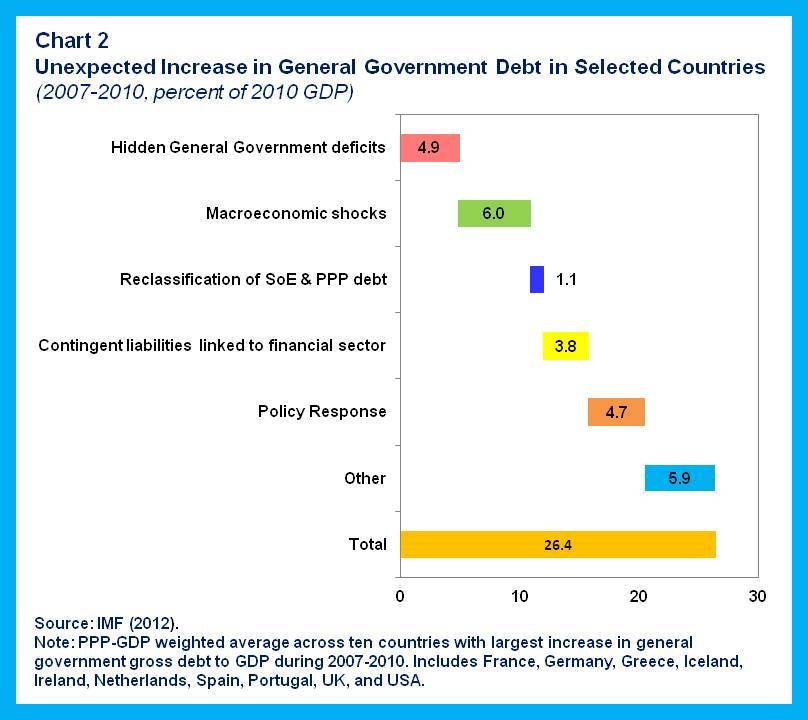
- The global crisis revealed multiple, systematically linked sources of increases in debt for the 10 countries hardest hit by the crisis.
- Fiscal risk properties emphasized:
- Highly correlated:
- Realizations of one risk often coincide with others (example: undisclosed general government deficits; adverse macroeconomic developments; contingent liabilities to the financial sector, SOEs and PPPs; and government discretionary responses).
- Asymmetric:
- Political and forecasting biases: upside risks to forecasts are often “banked,” while downside risks and contingent liabilities (e.g., guarantees) are typically excluded, skewing forecasts toward optimism.
- Illustration noted: optimistic bias by EU countries in forecasting government debt over the last 12 years.
- Non-linear:
- Small disturbances may scale proportionally, but extreme events can generate much larger financial, economic, social and political consequences (e.g., spiraling interest rates, depreciating exchange rates, “sudden stop” from market cutoff).
- Reference to Olivier Blanchard’s “dark corners” where economies can badly malfunction.
Current practices and IMF tools
- Country practices:
- Many countries produce point estimates and alternative macro-fiscal scenarios (examples: EU Stability Programs).
- Some countries publish statements of fiscal risk identifying sources, magnitude, and sometimes likelihood of discontinuous risk (example: the Philippines).
- A few countries produce stochastic projections and probabilistic presentations (example: UK Office of Budget Responsibility’s probabilistic “fan charts” used to estimate probability of meeting medium-term fiscal objectives).
- In most cases, fiscal risk analysis is produced to satisfy legal or multilateral requirements or relegated to budget appendices.
- IMF contributions and tools:
- Fan charts in the Fund’s debt sustainability analyses.
- Work on future liabilities from age-related spending.
- Heat maps in fiscal transparency evaluations already published for Bolivia, Costa Rica, Ireland, Mozambique, Portugal, and Russia.
Policy recommendations and next steps
- Analytical approach:
- Adopt systematic, risk-based fiscal policymaking that explicitly accounts for correlated, asymmetric, and non-linear fiscal risks.
- Mainstream fiscal risk assessments into fiscal decision making rather than relegating them to appendices or compliance documents.
- Institutional and methodological priorities:
- Enhance fiscal transparency, including adoption of international accounting standards.
- Analyze and forecast public sector balance sheets comprehensively, including contingent liabilities and future liabilities from age-related spending.
- Set medium-term fiscal objectives that balance inclusive growth, stability, and risk management.
- Use probabilistic and stochastic tools (e.g., fan charts, stochastic projections) to present uncertainty and to estimate probabilities of meeting fiscal objectives.
- Policy instruments to build resilience:
- Prevent and minimize fiscal risks through better measurement and by recognizing correlated, asymmetric, and non-linear features.
- Strengthen institutional setups to limit ex-ante accumulation of contingent liabilities (recognizing the common role of the state as insurer of last resort).
- Pursue targeted public investments, structural reforms, and fiscal institution improvements to support growth and generate greater “upside risk” for public finances.
Framing metaphor and final point
- Machiavelli analogy: Just as dikes and dams are built in quiet times to control violent rivers, countries should construct frameworks of dikes and dams for public finances now that calm is returning, so they can better weather the next storm.
Vitor Gaspar, Richard Hughes, Laura Jaramillo — March 18, 2015 (Dams And Dikes For Public Finances).
References
- https://www.imf.org/wp-content/uploads/2015/03/fad-blog-fiscal-risks-chart-1.jpg
- https://www.imf.org/wp-content/uploads/2015/03/fad-blog-fiscal-risks-chart-2.jpg
- https://www.imf.org/wp-content/uploads/2015/03/fad-blog-fiscal-risks-chart-3.jpg
- Olivier Blanchard calls “dark corners
- debt sustainability analyses
- heat maps in fiscal transparency evaluations