Growth Dividend from Stabilizing Fiscal Policies
IMF Blog, April 8, 2015
Source details
- Canonical URL
- Growth Dividend from Stabilizing Fiscal Policies
Other formats
Bibliographic details
- Authors: Xavier Debrun
- Published: April 8, 2015
Key findings on fiscal stabilization and growth
- Study covers experience with fiscal stabilization during the past three decades in a broad sample of 85 advanced, emerging market, and developing economies.
- Governments can use fiscal policy to smooth fluctuations in economic activity, and this can lead to higher medium-term growth.
- In advanced economies, making fiscal policies more stabilizing could cut output volatility by about 15 percent, with a growth dividend of about 0.3 percentage point annually.
- Fiscal stabilization coefficients measure the impact of a one percentage-point change in output on the budget balance (in percent of GDP); a coefficient equal to 1 means the fiscal response is exactly of the same size as the initial shock.
- Fiscal stabilization coefficients can be quite sizable, especially in advanced economies; in emerging markets and developing economies stabilization is generally more modest and less frequent, though some have large coefficients.
- Cross-country correlations between volatility and stabilization coefficients are clearly negative, indicating overall reduction in output volatility due to fiscal stabilization.
- A more stable macroeconomic environment created by fiscal stabilization has positive effects on medium-term growth, plausibly because less uncertainty encourages investment in physical, human, and social capital.
How fiscal policy stabilizes output
- Fiscal policy stabilizes the economy when the budget balance increases when output rises and decreases when output falls.
- During a contraction:
- Tax revenues fall with income (or tax rates can be deliberately cut), and unemployment benefits increase with the number of unemployed, helping maintain income and purchasing power.
- Policymakers can also raise demand directly by deliberately spending more, with a higher deficit (or lower surplus) cushioning the blow on output.
- The response of the government budget balance to economic activity is the key to understanding fiscal contribution to output stability.
Role and limits of automatic stabilizers
- Automatic stabilizers—tax payments that move with income and social transfers such as unemployment benefits—operate in real time without decision or implementation lags, making them a very effective way to make fiscal policy stabilizing.
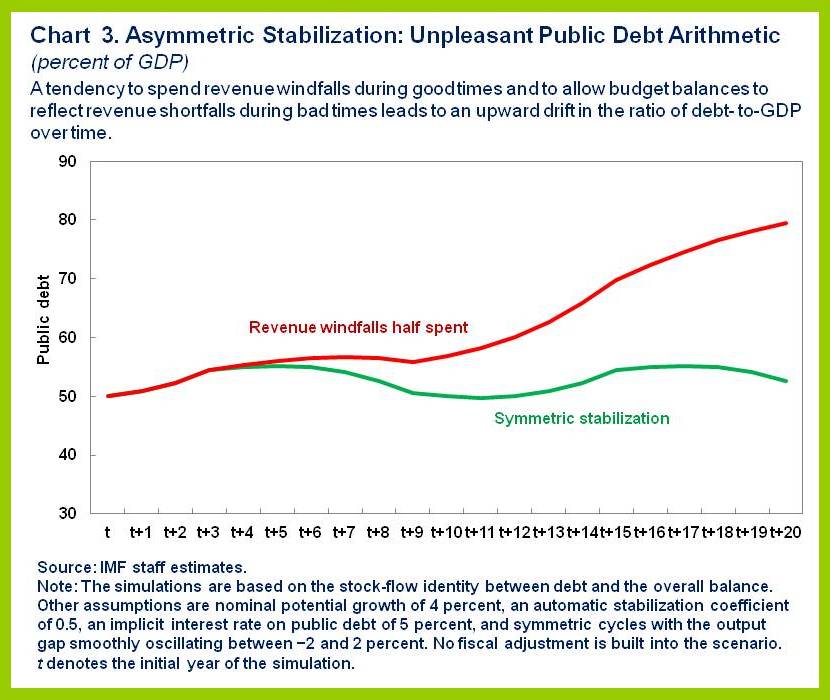
- Fiscal actions often undermine automatic stabilizers, most notably the tendency to spend revenue windfalls during good times.
- Simulations (described in the source) show:
- “Symmetric stabilization” with deficit reductions in good times fully offsetting deficit increases in bad times can produce a stable public debt path.
- Spending just half of revenue increases during booms while letting deficits fully absorb downturns can send debt on an upward path.
Policy implications and recommendations
- Avoid measures that destabilize output, such as spending increases in good times; stability, growth, and debt sustainability could all greatly benefit from such restraint.
- A well-designed fiscal framework can encourage policies that preserve stabilization properties of the budget.
- Countries could augment automatic stabilizers, but this should not be done through undue increases in taxes and transfer programs because these can have undesirable side effects on growth and employment.
- The Fiscal Monitor discusses options to boost stabilizers while avoiding these caveats; one practical starting point is preventing certain tax deductions from increasing during booms and decreasing during recessions.
Source: Growth Dividend from Stabilizing Fiscal Policies, Xavier Debrun, April 8, 2015
Content in this bundle
- 稳定性财政政策的增长红利; iMFDirect博客; 2015年4月8日
- 安定化機能が優れた財政政策から得られる成長の配当: ザビエル・デブラン iMFdirect ブログ, 2015年4月8日掲載
- Chapter 2. Can Fiscal Policy Stabilize Output?, Fiscal Monitor, April 2015
- Дивиденды роста от стабилизирующей налогово-бюджетной политики; Ксавьер Дебрун; 8 апреля 2015 года