Oil Prices and Public Finances: A Double-Edged Sword
IMF Blog, April 15, 2015
Source details
- Canonical URL
- Oil Prices and Public Finances: A Double-Edged Sword
Other formats
Bibliographic details
- Authors: Benedict Clements, Marta Ruiz-Arranz
- Published: April 15, 2015
Overview
- Authors: Benedict Clements, Marta Ruiz-Arranz
- Date: April 15, 2015
- Key context: Oil prices have fallen about 45 percent since September (see April 2015 World Economic Outlook), producing large fiscal effects for both oil exporters and oil importers.
Fiscal effects on oil exporters
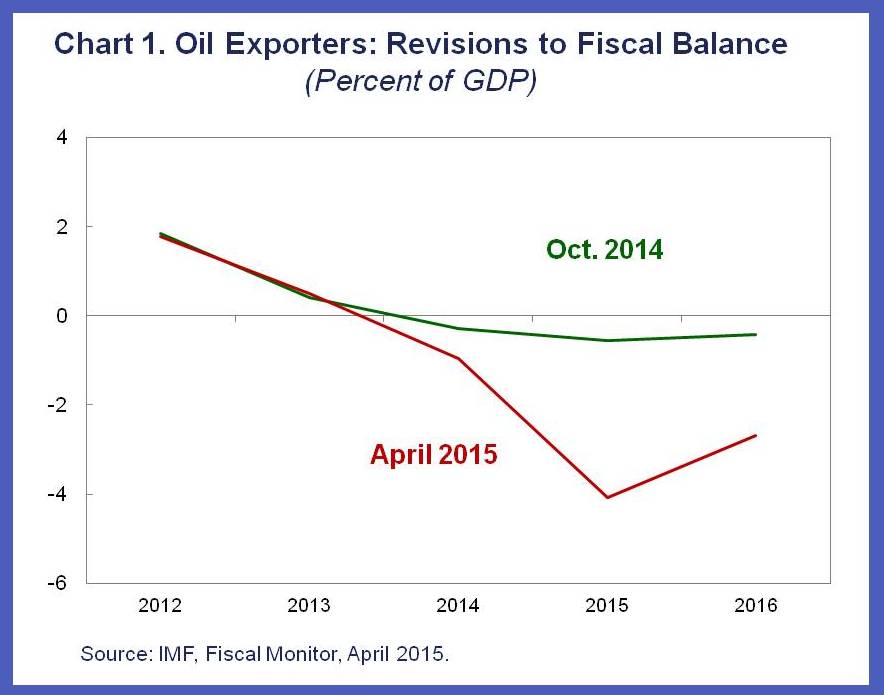
- The decline in prices is expected to cut exporters' revenues by an average of 4 percent of GDP in 2015.
- The large revenue loss is reflected in a predicted deterioration in fiscal balances for exporters in 2015.
- Short-term mitigation options:
- Countries with significant financial assets (net of public debt), including the Gulf Cooperation Council countries and Norway, can use those assets to mitigate the shock.
- Some countries are allowing their currencies to weaken to partially offset lower oil revenues in foreign currency terms.
- Given the size of the shock, most exporters will have to cut government spending to achieve a sustainable fiscal position.
- Medium- and long-term adjustments needed:
- Boost the non-oil revenue base.
- Improve natural resource management.
- Improve the efficiency of government spending.
- Strengthen fiscal frameworks to better cope with commodity price and revenue volatility.
- Note: The October 2015 Fiscal Monitor will explore fiscal framework challenges in more detail.
Fiscal effects on oil importers
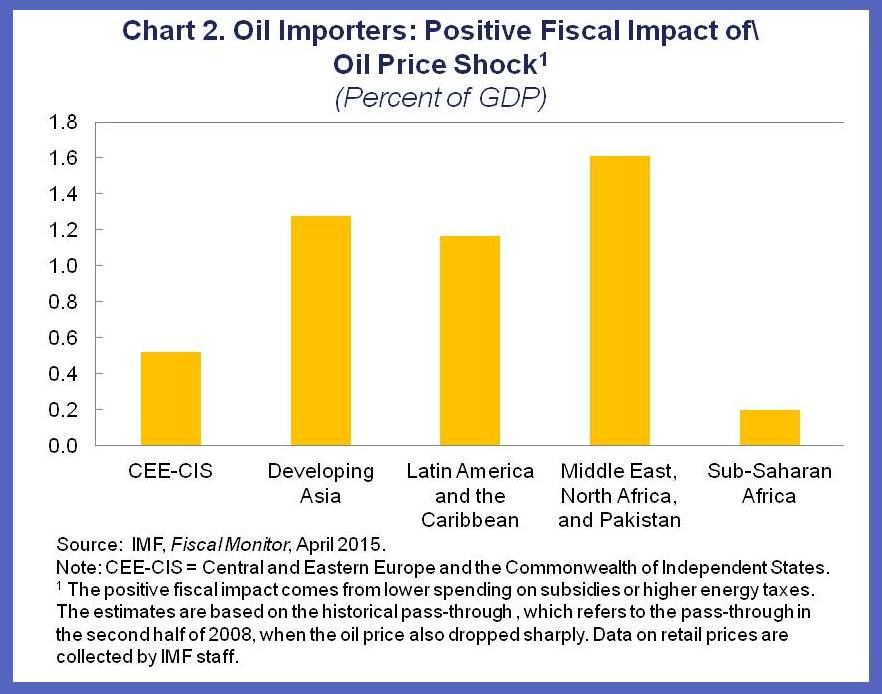
- Importers generally benefit from the decline, but with significant variation across regions.
- Fiscal effect depends on domestic energy price regulation:
- If governments regulate domestic energy prices and leave domestic prices unchanged, the reduction in global oil prices lowers the amount governments must pay for energy subsidies, so governments keep the windfall.
- For a typical oil importing country, about one-third of the decline in oil prices will be passed on to consumers, and two-thirds will go to governments.
- Under this scenario, fiscal savings are expected to be about 1 percent of GDP in 2015.
Policy recommendations and reform opportunities
- The oil price decline provides an opportunity to initiate energy subsidy and taxation reforms that would:
- Lock in savings.
- Improve public finances.
- Boost long-term economic growth.
- Specific reform aims:
- Get energy prices right to rationalize energy consumption and reduce adverse environmental effects.
- In emerging market and developing economies, use savings from subsidy and tax reform to finance growth-enhancing spending in education, health, and infrastructure, and programs for the poor.
- In advanced economies, reduce taxes on labor and finance the cuts with higher energy taxes.
- Best-practice implementation elements (as followed by many recent reforms):
- Communicate the reform plan to the public.
- Explain the benefits of reform.
- Set up mitigating measures for the poor.
Examples and timing
- Many countries have recently taken steps to decrease or eliminate energy subsidies, including Angola, Egypt, India, Indonesia, and Malaysia.
- More than 20 countries have recently taken such steps.
- Low inflation and low oil prices create a favorable environment for ambitious energy subsidy and energy taxation reform.
Source: IMF blog post "Oil Prices and Public Finances: A Double-Edged Sword" (April 15, 2015) by Benedict Clements and Marta Ruiz-Arranz.
Content in this bundle
- 石油价格与公共财政:一把双刃剑; iMFdirect博客; 2015 年4 月15 日
- 原油価格と財政収支:諸刃の剣; ベネディクト・クレメンツ、マルタ・ルイーズ‐アランツ iMFdirect ブログ, 2015年4月15日掲載
- Now Is the Time: Fiscal Policies for Sustainable Growth, Fiscal Monitor, April 2015
- Цены на нефть и государственные финансы: обоюдоострый меч