Northern Spring, Southern Chills: Outlook for Latin America and the Caribbean
IMF Blog, April 17, 2015
Source details
- Canonical URL
- Northern Spring, Southern Chills: Outlook for Latin America and the Caribbean
Other formats
Bibliographic details
- Authors: Alejandro Werner
- Published: April 17, 2015
Overview
- Economic activity in Latin America and the Caribbean has been cooling down for several years, and the temperature in many places is still falling.
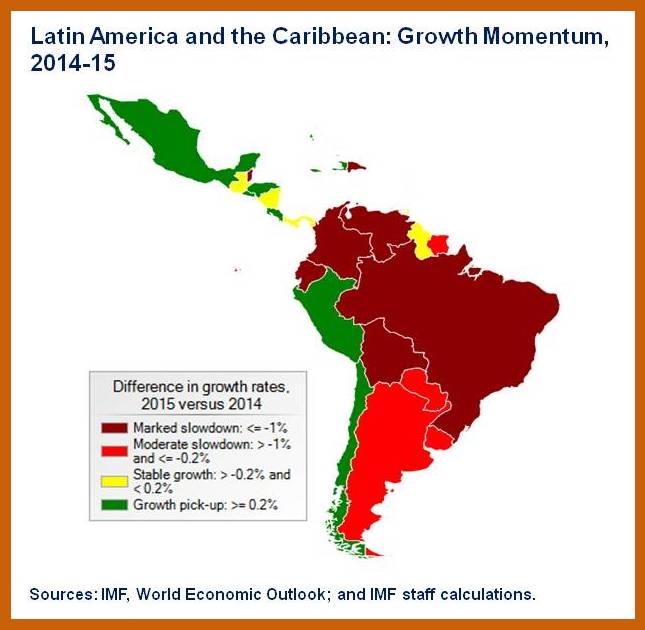
- Regional growth is now expected to dip below 1 percent in 2015—down from 1.3 percent in 2014.
- Apart from a short-lived recession during the global financial crisis, this would be the slowest rate of growth since 2002.
External drivers
- Two external factors play a key role:
- The solid recovery in the U.S. economy, where growth is projected to reach 3 percent in 2015.
- The persistent weakness of global commodity markets, including the collapse in oil prices since mid-2014.
- For many Central American and Caribbean economies, these developments are beneficial via trade, remittance, and tourism channels.
- Cheaper oil is cutting import bills by 3-4 percentage points of GDP on average for many countries.
Regional divergence: Signs of spring up North, chills in the South
- Northern (Mexico, Central America, parts of the Caribbean)
- Benefit from stronger U.S. demand and cheaper oil.
- Mexico’s economy is projected to pick up pace; lower oil prices create some revenue losses but headwinds to growth should be limited.
- Long-standing domestic problems (weak fiscal positions, competitiveness challenges in tourism-dependent Caribbean) continue to weigh on activity.
- Southern (South America)
- Recent external developments have been mostly unfavorable; trade linkages with the U.S. are relatively modest.
- Continued decline in commodity prices has hit heavyweight commodity exporters; terms of trade have plunged for major oil and gas exporters (Venezuela, Bolivia, Ecuador, Colombia).
- Country-specific challenges (very weak private sector confidence in Brazil; intensifying economic crisis in Venezuela) further weigh on outlook.
- Growth is projected to slow further in most of South America as corporate investment weakness spreads to consumer spending.
- Three of the largest economies (Argentina, Brazil, and Venezuela) are expected to see contractions in 2015.
- Chile and Peru are expected to see growth rebound, helped by supportive fiscal and monetary policies and buffers built up during good times.
- Uruguay’s terms of trade have recently improved as gains from cheaper oil imports outweigh losses from lower agricultural export prices.
- Flexible exchange rates can facilitate adjustment by shifting demand toward locally produced goods; Colombia’s marked depreciation of the peso is expected to boost demand for its (noncommodity) exports.
Macro-financial conditions and constraints
- Even with low growth, unemployment remains at historically low levels in most large economies.
- Inflation is above midpoint targets.
- Current account deficits have generally widened further.
- These facts suggest limited economic slack; forecasts for medium-term growth have been revised down further.
- Policy space has eroded in many countries: fiscal buffers diminished and depreciating exchange rates reduce scope for further monetary easing.
- Financial sector risks:
- After several years of strong credit growth, capital inflows, and increasing issuance of corporate bonds in international markets, firms and households face a tighter financing environment as corporate earnings and employment weaken.
- Faster-than-anticipated normalization of U.S. monetary policy or other global shocks could prompt fresh turbulence in financial markets.
- Marked appreciation of the dollar might hurt borrowers with unhedged dollar debt.
Policy recommendations and priorities
- Avoid excessive macroeconomic policy stimulus given limited slack and reduced policy space.
- Focus on addressing structural weaknesses in:
- Infrastructure
- Education
- Governance
- The business environment
- Maintain vigilance to financial risks; ensure sound balance sheets and credible policy commitments to provide insurance against financial disruptions.
- Central banks should:
- Maintain a clear focus on keeping inflation on target.
- Be ready to forestall excessive exchange rate volatility or disorderly market dynamics with targeted interventions.
- Use the current better external environment (for northern economies) as an opportunity to address long-standing domestic problems.
Key projections and facts (exact figures preserved)
- Regional growth expected to dip below 1 percent in 2015—down from 1.3 percent in 2014.
- U.S. growth projected to reach 3 percent in 2015.
- Oil import bills cut by 3-4 percentage points of GDP on average for many countries.
- Three of the largest South American economies (Argentina, Brazil, and Venezuela) expected to see contractions in 2015.
- Upcoming Regional Economic Outlook release date: April 29.
Alejandro Werner — April 17, 2015
Content in this bundle
- O Norte se recupera, enquanto o Sul ainda espera: Perspectivas para a América Latina e o Caribe