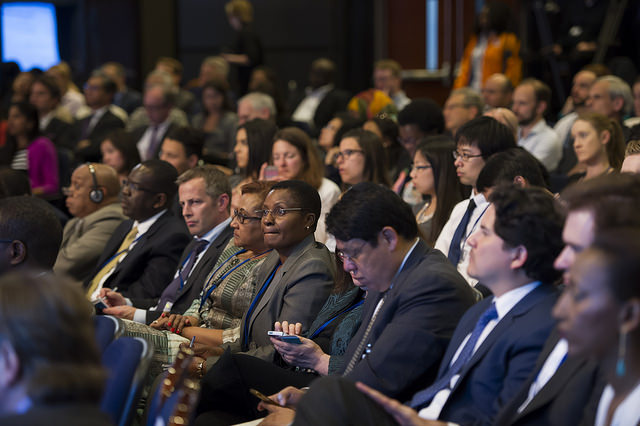
Tolstoy & Billionaires: Overheard at the IMF's Spring Meetings
IMF Blog, April 21, 2015
Source details
- Canonical URL
- Tolstoy & Billionaires: Overheard at the IMF's Spring Meetings
Other formats
Bibliographic details
- Authors: we forecast an average growth of 6 percent for about 55 countries, ” said Jakkie Cilliers from the Institute for Security Studies based in South Africa.
- Published: April 21, 2015
Development assistance / Overview
- Most countries are recovering but face lower potential growth and a “new mediocre” becoming a “new reality.”
- The IMF editors reported on officials and civil society discussions about how to help countries “pave their own path to happiness.”
- Opening aphorism (variation on Tolstoy): “All happy countries are alike; each unhappy country is unhappy in its own way.”
Infrastructure
- Infrastructure spending is presented as good for jobs now and growth in the future.
- Key implementation challenge: “Money is only part of the problem. Implementing something that makes sense is a huge problem,” said Rajiv B. Lall (Infrastructure Development Finance Company, India).
- Public-private financing is a commonly advocated approach:
- Joaquim Vieira Ferreira Levy, Finance Minister of Brazil: “Most of our infrastructure projects have had participation from the private sector. We need to differentiate infrastructure investments with markets returns, and those with social returns like public housing.”
- Alonso Segura, Peru’s finance minister: “In Peru, we are increasingly using public-private partnerships for infrastructure projects because of their medium term benefits. If you only rely on public procurement, you will move very slowly.”
- IMF coverage included two detailed seminars: slower growth in Asia, and low inflation.
Finance and fragility
- Debate continues on how to align the financial system to support the real economy; Islamic finance highlighted for its potential role.
- Zeti Akhtar Aziz, Governor, Bank Negara Malaysia: “Islamic finance has no disconnect between finance and [a country’s] real economy.”
- Islamic finance can be used to finance infrastructure via investor-financed construction with returns until maturity (analogous to public-private partnerships).
- Expansion of Sukuk and Islamic finance:
- Pierre Gramegna (Minister of Finance, Luxembourg) noted Luxembourg issued the first government Sukuk denominated in Euros: “We wanted to diversify our activities and to innovate.”
- Other issuers: Hong Kong SAR, South Africa, and the United Kingdom.
- Global Sukuk market growth: “increased twentyfold for over a decade to reach $119.7 billion in 2013.”
- Fragility outlook and governance:
- Jakkie Cilliers (Institute for Security Studies): “By 2030, we forecast an average growth of 6 percent for about 55 countries. But despite Africa’s sterling growth trajectory, about 10 of the continent’s countries will be trapped in syndrome of fragility.”
- Rwanda's Finance Minister Claver Gatete on political inclusion: “Building a national consensus and ensuring that all groups are represented in an inclusive political arrangement embedded in the constitution is the first step in the way out of fragility.”
- Anecdote on urgency of needs in fragile states: “If you offer someone in a fragile state $10 today versus $100 at the month’s end, he will take the $10. Why? Because he doesn’t know if he’ll survive.”
Trade
- Emphasis that trade remains central to growth and needs rethinking in light of changing composition.
- Arvind Subramanian, Chief Economic Advisor to the Government of India: “Trade is moving from stuff to fluff,” highlighting the rising importance of services.
- Negotiating services trade is difficult:
- Mari Elka Pangestu (former Indonesian Minister of Trade): “70 percent of what goes into making a loaf of bread is services, yet it’s the most difficult part to agree.”
Commodities, climate change, and public debt
- Commodity price slump, especially oil, produces winners and losers and prompts policy responses.
- Ngozi Okonjo-Iweala, Finance Minister of Nigeria: while vulnerable to falling oil prices, the slump is “an opportunity to diversify the economic base away from oil and implement structural reforms to improve the country’s prospects.” “Instead of moaning we should see this as a good opportunity to really make those tough choices,” she said.
- Lower commodity prices create scope to cut fuel subsidies and to advance climate goals.
- David Wessel (Brookings Institution and The Wall Street Journal): carbon pricing can be an opportunity to reduce high public debt.
- On debt and policy memory:
- Maria Luís Albuquerque, Portugal’s Finance Minister: “If this crisis tells us anything, it’s that we should keep the memory of how difficult it is to adjust, which would have been much easier in other circumstances.”
Financing development
- 2015 marked the year of the Sustainable Development Goals (SDGs), replacing the Millennium Development Goals.
- SDG structure highlighted: “17 goals and 169 targets.”
- Financing ambitions noted as large; Jeffrey Sachs (Earth Institute, Columbia University) suggested philanthropy targeting:
- “There are 1,800 billionaires in the world who are worth $7.1 trillion,” Sachs said. ”We have their names, we know where they live, and I have a lot of their emails. Let’s give them a call.”
Reporting by: Maureen Burke, Jacqueline Deslauriers, Bruce Edwards, Lika Gueye, Claire Lazarus, and Carmen Rollins.
References
- seminars
- IMF’s Spring Meetings
- lower potential growth
- “new mediocre” becoming a “new reality.”
- Infrastructure
- https://www.imf.org/wp-content/uploads/2015/04/17002102998_8833ab4758_z.jpg
- infrastructure
- slower growth in Asia
- inflation
- Finance
- fragility
- https://www.imf.org/wp-content/uploads/2015/04/17169917325_b1897ebd2b_z.jpg
- Islamic finance
- Middle East and North Africa
- Trade
- trade
- https://www.imf.org/wp-content/uploads/2015/04/17180650435_c420b6e672_z.jpg
- Commodities
- cut fuel subsidies
- high public debt
- Financing development
- https://www.imf.org/wp-content/uploads/2015/04/17180886935_76b7d733f6_z.jpg
- how to finance development