Multi-Track Monetary Policies in Advanced Economies: What This Means for Asia
IMF Blog, April 27, 2015
Source details
- Canonical URL
- Multi-Track Monetary Policies in Advanced Economies: What This Means for Asia
Other formats
Bibliographic details
- Authors: James Daniel, Rachel van Elkan
- Published: April 27, 2015
External position and stability
- Publication: James Daniel, Rachel van Elkan — April 27, 2015
- Since mid-2014, diversity and divergence in countries’ economic situations, policies and performance have dominated global economic discussions, producing divergent monetary policies among major advanced economies.
- Major policy actions:
- Bank of Japan and the European Central Bank have started significant expansions of their balance sheets.
- U.S. Federal Reserve has ended its bond-buying program and is expected to start raising rates.
- Exchange rate outcome highlighted: these actions contributed to a sharp depreciation of the Yen and the Euro against the U.S. dollar (see chart 1).
Impact on the region
- Overall effects of advanced-economy monetary divergence:
- Actions by the Bank of Japan and European Central Bank would tend to create capital inflows into Asia (excluding Japan) and appreciation pressure.
- Prospective action by the Fed would tend to create the opposite (capital outflows and depreciation pressure).
- Recent capital flow pattern:
- Most countries in the region have experienced capital outflows rather than inflows in recent months.
- Main exception: India, which has received substantial inflows.
- Currency movements:
- Most currencies in the region have appreciated in real effective exchange rate (REER) terms, but depreciated against the U.S. dollar.
- Chart 2 groupings and observations:
- China/Hong Kong SAR/India/Indonesia/Philippines/Thailand — large REER appreciation and little depreciation versus the U.S. dollar.
- The increase for China (15%) has been particularly sharp, reflecting its link to the U.S. dollar, and follows on from a trend 5% annual appreciation for the last 10 years.
- Note: Indonesia’s REER appreciation is inflated by the recent reduction in fuel subsidies.
- Korea/Singapore — little REER change and some depreciation versus the U.S. dollar.
- Australia/New Zealand/Malaysia — large depreciation versus the U.S. dollar and, for Australia and Malaysia, significant REER depreciation.
- External position vs. REER outcomes:
- Countries with external positions stronger than implied by fundamentals have tended to see REER appreciation (example: China).
- Conversely, countries with weaker external positions have tended to see REER depreciation (example: Australia).
- Exceptions noted:
- Group 2 countries (Korea, Singapore) and Malaysia have seen little or no REER appreciation despite strong external positions.
- Some Group 1 countries (Indonesia, India, Hong Kong SAR, Thailand) have seen significant REER appreciation despite having balanced, or weaker, external positions.
- Role of commodity prices and trade balances:
- Since June, the sharp fall in the price of oil and most other commodities has raised many countries’ trade balances.
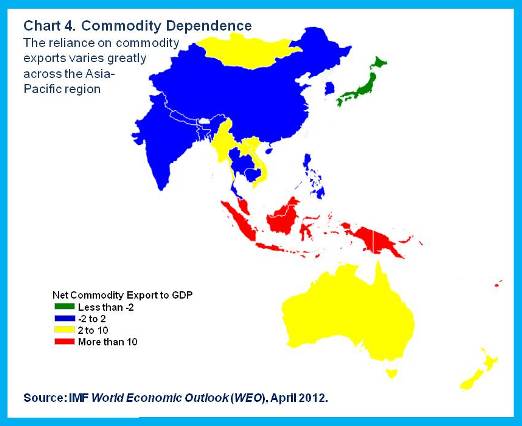
- Malaysia, Indonesia, Australia, and New Zealand have lost significant export revenue from lower commodity prices (helping explain, for example, Malaysia’s currency depreciation).
- Inflation impact:
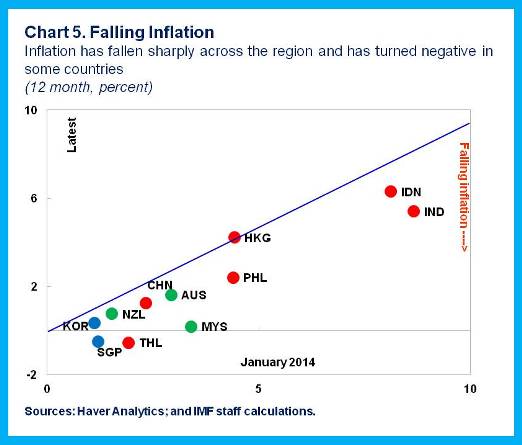
- The fall in commodity prices together with REER appreciations across most economies is pushing down inflation (see chart 5).
- Inflation outcomes by country: very low levels in China, Korea, New Zealand; negative inflation in Thailand, Singapore.
- Core inflation has tended to move less, but generally in the same direction.
The potential tensions
- Main tensions from advanced-economy policy actions:
- Weakening exports
- Expectation: export volume growth to hold up across the region overall.
- Risk: stronger currencies could weaken external demand, lower overall economic growth, and exacerbate internal imbalances.
- Country-specific effects on internal imbalances (measured by the output gap):
- Only Australia and the Philippines: recent REER movements go in the direction of reducing internal imbalances.
- Thailand, China, Hong Kong SAR: output projected to remain well below potential, which strong REER appreciation will tend to exacerbate (see chart 6).
- Financial instability
- Risks vary greatly across the region.
- Example risks:
- Many corporates have borrowed in U.S. dollars (example: Indonesia); a stronger U.S. dollar will make debt service more costly.
- India’s large capital inflows could lead to significant financial volatility if they reverse (as during the 2013 “taper tantrum”).
- Policy concern: if countries significantly loosen monetary policy to offset the contractionary impact of stronger currencies, this could foster excessive credit growth.
Need for flexible monetary policy response
- Recent policy responses:
- Many countries have cut interest rates (see chart 7).
- Several countries have taken other measures, for example, India accumulated international reserves to strengthen buffers ahead of potential increased global financial volatility.
- Recommended policy stance:
- Monetary policy should generally continue to respond flexibly if exchange rate and capital flow pressures persist.
- Macro-prudential policy should be the first line of defense for addressing financial stability concerns.
- The specific response should depend on individual country circumstances.
IMF blog post: Multi-Track Monetary Policies in Advanced Economies: What This Means for Asia — James Daniel, Rachel van Elkan — April 27, 2015
References
- https://www.imf.org/wp-content/uploads/2015/04/asia-central-banking-multi-track-central-banking_1.jpg
- https://www.imf.org/wp-content/uploads/2015/04/asia-central-banking-multi-track-central-banking_2.jpg
- https://www.imf.org/wp-content/uploads/2015/04/asia-central-banking-multi-track-central-banking_3.jpg
- https://www.imf.org/wp-content/uploads/2015/04/asia-central-banking-multi-track-central-banking_4.jpg
- https://www.imf.org/wp-content/uploads/2015/04/asia-central-banking-multi-track-central-banking_5.jpg
- https://www.imf.org/wp-content/uploads/2015/04/asia-central-banking-multi-track-central-banking_6.jpg
- https://www.imf.org/wp-content/uploads/2015/04/asia-central-banking-multi-track-central-banking_7.jpg