Act Local, Solve Global: The $5.3 Trillion Energy Subsidy Problem
IMF Blog, May 18, 2015
Source details
- Canonical URL
- Act Local, Solve Global: The $5.3 Trillion Energy Subsidy Problem
Other formats
Bibliographic details
- Authors: Benedict Clements, Vitor Gaspar
- Published: May 18, 2015
Key summary and scale
- US$5.3 trillion; 6½ percent of global GDP is the IMF’s 2015 estimate of the cost of energy subsidies.
- These estimates likely exceed government health spending across the world, estimated by the World Health Organization at 6 percent of global GDP (for the different year of 2013).
- Energy subsidies correspond to one of the largest negative externalities ever estimated and have adverse effects on economic efficiency, growth, and inequality.
What are energy subsidies (definition and components)
- Energy subsidies are defined as the difference between what consumers pay for energy and its “true costs,” plus a country’s normal value added or sales tax rate.
- “True costs” of energy consumption include:
- supply costs; and
- damages from energy consumption to people and the environment arising from:
- carbon emissions and hence global warming;
- health effects of air pollution;
- effects on traffic congestion, traffic accidents, and road damage.
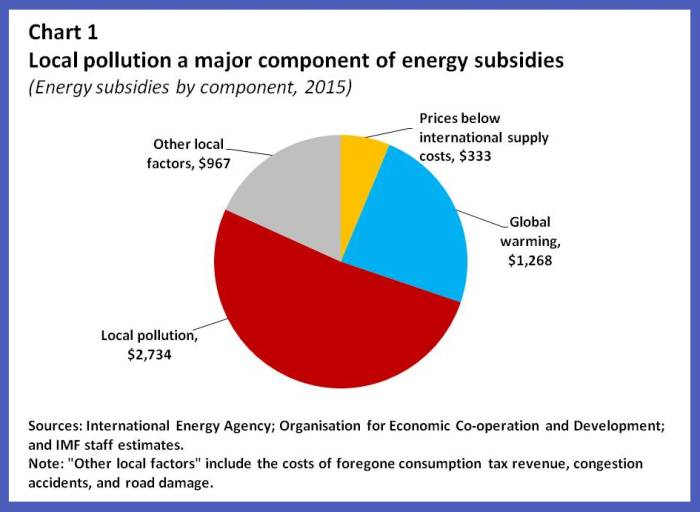
- Most of these externalities are borne by local populations, with the global warming component of energy subsidies only a fourth of the total (Chart 1).
Magnitude and geographic distribution
- Energy subsidies are large and widespread across advanced and developing countries.
- Regional and country breakdown highlights:
- Emerging Asia accounts for about half of the total.
- Advanced economies account for about a quarter.
- Largest subsidies in absolute terms: China (US$2.3 trillion), the United States (US$699 billion), Russia (US$335 billion), India (US$277 billion), Japan (US$157 billion).
- For the European Union, subsidies are US$330 billion.
Why the 2015 estimate is larger than earlier work
- The 2015 figure (US$5.3 trillion) is more than double the US$2 trillion estimate for 2011.
- Over half of the increase is explained by more refined country-level evidence on the damaging effects of energy consumption on air quality and health.
- The large size reflects extensive health impacts; for example, in China the World Health Organization estimates there are over one million premature deaths per year due to outdoor air pollution from polluting fuels, particularly coal, and other sources.
Recent reform progress and country examples
- Several countries narrowed the gap between domestic and international prices, reducing subsidy spending by US$ 190 billion between 2011 and 2015.
- Countries that have reformed subsidies include: Angola, Cameroon, Cote d’Ivoire, Egypt, India, Indonesia, Jordan, Malaysia, Mauritania, Mexico, Morocco, Sudan, Thailand, Tunisia, and Yemen.
- India example:
- October 2014: diesel prices were fully liberalized following gradual subsidy reform.
- January 2015: expansion of a direct cash benefit scheme to replace access to subsidized LPG, protecting low income households while reducing budgetary cost of subsidies.
Fiscal, economic, and environmental implications of getting prices right
- Increasing energy prices gradually and predictably to reflect their true costs would generate fiscal gains of about 3½ percent of GDP.
- Fiscal gains are less than the total amount of subsidies (6½ percent of GDP) because higher prices reduce energy consumption.
- Potential uses of fiscal gains:
- reduce some taxes (such as those on labor) that weigh down growth;
- raise growth-enhancing public expenditure (infrastructure, health, education);
- finance targeted cash transfers for the poor.
- Reform would create incentives for investment in green technology by removing artificially low prices for dirty energy.
- Local co-benefits (for example, reduced pollution) would overwhelmingly accrue to local populations.
Global effects of nationally motivated reforms and timing
- Even reforms motivated purely by domestic considerations (without adding a global-warming correction) would help reduce global C02 emissions by about 17 percent.
- Conditions are favorable for decisive energy taxation and subsidy reform due to lower international oil prices and low inflation.
- National-level steps could hasten progress ahead of the Paris climate change summit in December.
Policy recommendation (headline)
- Act local, solve global: national energy price reforms undertaken in countries’ own interest can yield large fiscal gains, improve public health, support inclusive growth, and materially reduce global emissions.
Benedict Clements, Vitor Gaspar, May 18, 2015 — Act Local, Solve Global: The $5.3 Trillion Energy Subsidy Problem