Don’t Rule it Out: Simplifying Fiscal Governance in Europe
IMF Blog, May 29, 2015
Source details
- Canonical URL
- Don’t Rule it Out: Simplifying Fiscal Governance in Europe
Other formats
Bibliographic details
- Authors: Petya Koeva Brooks, Gerd Schwartz
- Published: May 29, 2015
Context and motivation
- The 2008 global financial crisis and its aftermath tested the European Union’s (EU) fiscal governance framework—the rules, regulations, and procedures that influence how budgetary policy is planned, approved, carried out, and monitored.
- The framework aims to discipline national fiscal policies to prevent adverse spillovers to other countries and distortions to the conduct of the euro area’s common monetary policy.
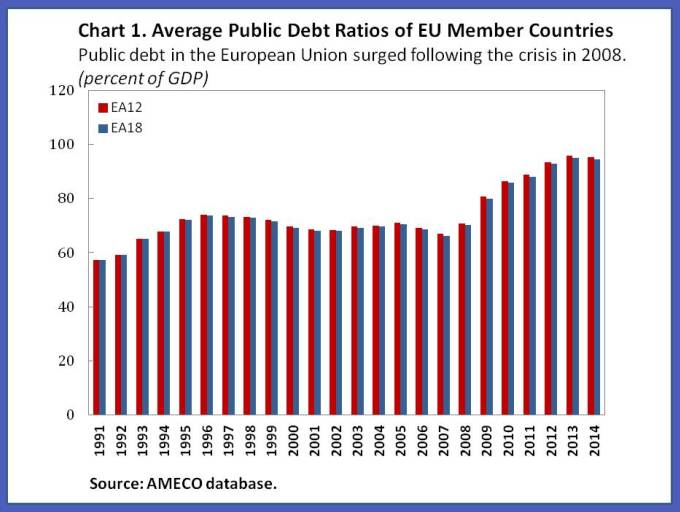
- Public debt in the European Union soared following the crisis in 2008 to an average of around 95 percent in 2014—almost 30 percentage points above its average pre-crisis level.
Assessment of past reforms and current problems
- Successive reforms rooted in the EU treaties and the 1997 Stability and Growth Pact (SGP) include the 2005 reforms, the 2011 Six Pack, the 2012 Fiscal Compact, and the 2013 Two Pack.
- Positive elements from reforms:
- Stronger economic underpinning to the rules-based system.
- Better alignment of fiscal targets with debt objectives.
- Improved coordination and conduct of fiscal policy.
- Problems identified:
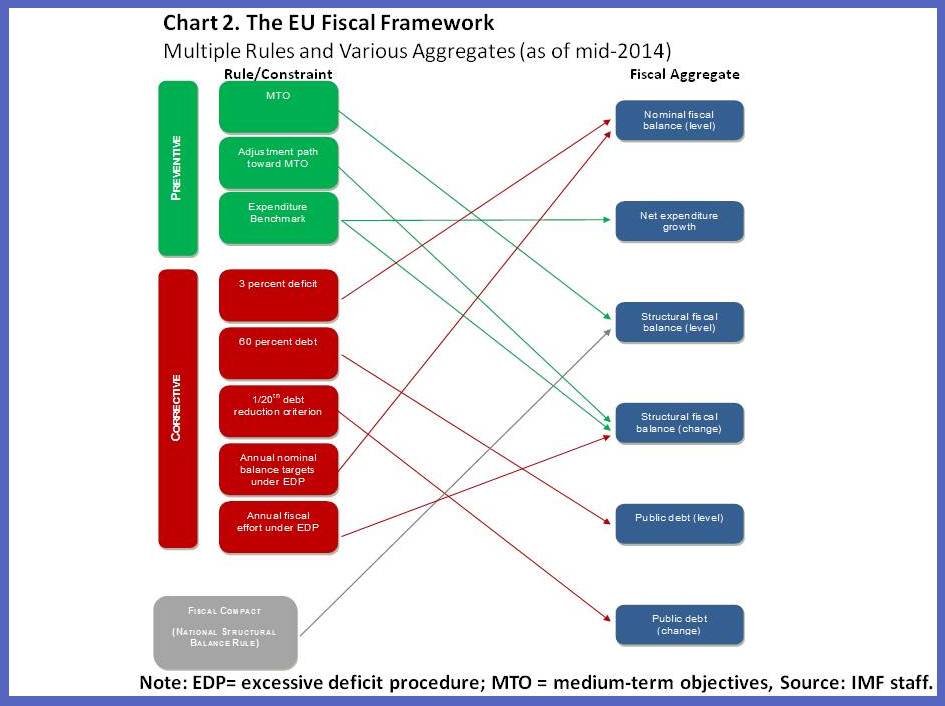
- Increased complexity due to multiple intricate rules that hamper effective monitoring and public communication.
- Compliance with the framework could be improved.
Proposal: a two-pillar approach (single anchor + single operational rule)
- Rationale: Dual objectives of safeguarding fiscal sustainability and maintaining simplicity suggest a two-pillar approach: a single fiscal anchor and a single operational rule that acts as the lever that moves the anchor.
- Debt as the anchor
- The ultimate objective of the fiscal governance framework should be to ensure fiscal sustainability in the form of public debt sustainability.
- Public debt-to-GDP ratio is presented as the natural anchor for capturing repeated (cumulative) fiscal slippages that flow variables, like the budget deficit, would not capture.
- Acknowledged caveats: public debt can be affected by factors other than fiscal actions (for example, financing operations unrelated to budget deficits such as financial sector bailouts or valuation effects), but no good alternative to using the public debt-to-GDP ratio as the fiscal anchor is identified.
- An expenditure growth rule as the operational rule
- Desired properties of a good operational rule:
- Supports countercyclical fiscal policy (economic stabilization).
- Provides a strong link to the fiscal anchor.
- Offers operational guidance (is under the control of policymakers and has a direct link to discretionary budgetary measures).
- Is transparent (easy to communicate to the public).
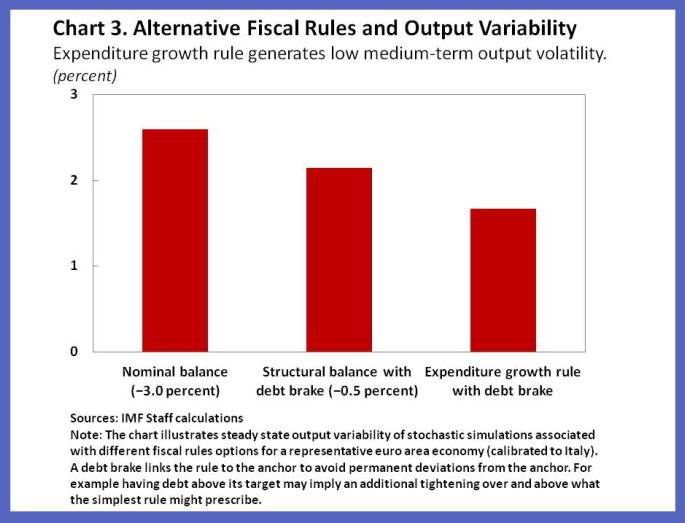
- The expenditure growth rule (possibly with an explicit debt correction mechanism or debt brake) is argued to satisfy these requirements:
- Generates low medium-term variability of output.
- Has a clear link to budgetary actions by constraining real expenditures.
- Is more straightforward to communicate.
Improving compliance and enforcement
- Suggested reform elements to improve implementation and support compliance:
- Merge the preventive and corrective arms of the Stability and Growth Pact or, at minimum, harmonize the rules in the two arms.
- Make the gradual step-up of monitoring and constraints more automatic to improve enforcement.
- Formulate corrective actions and sanctions to better reflect economic realities (for example, monetary fines in a downturn are not credible).
Transition considerations
- The transition towards a reformed fiscal framework would take time.
- Some reforms may face legal obstacles, and in some cases, wholesale treaty changes may be needed.
- Working for a simpler and more robust fiscal framework is presented as a strong response to recent skepticism about the European project.
Don’t Rule it Out: Simplifying Fiscal Governance in Europe — Petya Koeva Brooks, Gerd Schwartz; May 29, 2015.
Content in this bundle
- Staff Discussion Note