Raising Long-Run Growth in Latin America and the Caribbean—A Complex(ity) Issue
IMF Blog, June 9, 2015
Source details
- Canonical URL
- Raising Long-Run Growth in Latin America and the Caribbean—A Complex(ity) Issue
Other formats
Bibliographic details
- Authors: Fabiano Rodrigues Bastos, Ke Wang
- Published: June 9, 2015
Overview and context
- Authors: Fabiano Rodrigues Bastos, Ke Wang
- Date: June 9, 2015
- Main problem: Growth in Latin America and the Caribbean has weakened significantly over the last few years; part of this weakness appears to be persistent and IMF economists have marked down medium-term growth projections.
- Historical note: Abstracting from the “golden decade” from 2003 to 2011, when rising commodity prices powered a strong expansion, the region has struggled to sustain sufficiently high growth rates to catch up with more advanced economies.
Economic complexity: concept and regional status
- Definition: Economic complexity captures the productive knowledge of a country, inferred from the breadth and sophistication of goods that a country exports.
- Empirical relationship: More complex economies on average have higher levels of income per capita.
- Regional standing:
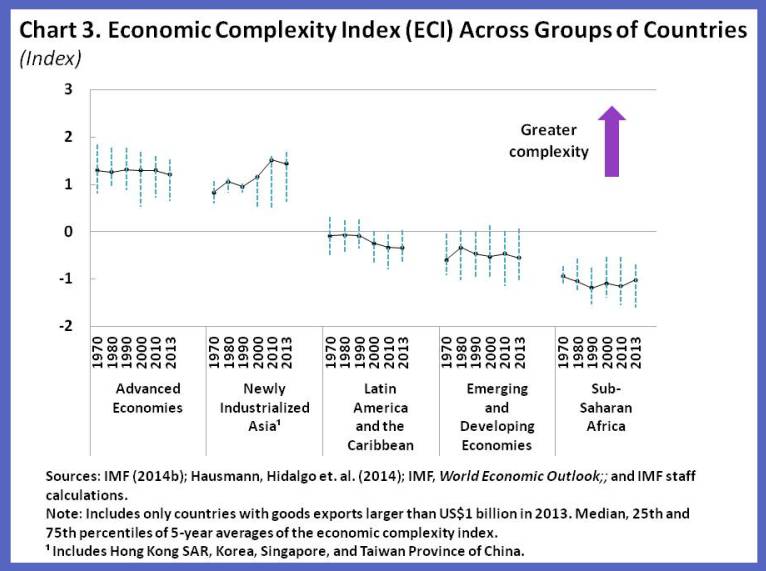
- Latin America and the Caribbean are far less complex than advanced economies or the newly industrialized Asian economies.
- Complexity in Latin America and the Caribbean has been stagnant or trending down since 1970.
- The region’s complexity looks no worse than the broader group of emerging economies, despite heavy reliance on commodity exports.
Predictive evidence and quantitative implications
- Data and methods: Analysis revisited Hausmann and coauthors’ findings using several econometric extensions and a large panel of more than 100 countries between 1970 and 2010.
- Key finding: Complexity helps predict long-run growth of GDP per capita alongside demographics, commodity exports, and indicators of macroeconomic stability.
- Quantitative implications for the region:
- Variation in complexity levels across the region can account for differences of almost a full percentage point in annual per capita growth.
- If other determinants are abstracted from, the most complex economies in the region (like Mexico and Brazil) would outpace the less complex ones by a full percentage point every year.
- Offsetting factors:
- Each year of macroeconomic instability can reduce GDP per capita growth by a cumulative 2 percentage points over the course of a decade.
- Higher dependency ratios can meaningfully reduce growth, highlighting demographic risks over the coming decades.
Policy takeaways and recommendations
- Complexity matters but is not sufficient on its own; maintaining macroeconomic stability is essential.
- Structural reforms should remain a priority, especially in areas closely associated with economic complexity:
- Infrastructure
- Education
- Market openness
- Caution on activist development policies:
- A renewed push for activist development policies needs careful handling.
- A more systematic understanding of costs and risks is necessary before scaling up such policies.
- Past experiences with industrial policies are cautionary, particularly where governance and institutional quality lag.
- Use of complexity research:
- Complexity analysis can help countries better understand comparative advantages and assess potential for knowledge upgrading.
- Cross-country insights can inform trade and investment negotiations to better leverage a country’s knowledge base.
Conclusion
- Complexity appears to be an important determinant of long-run economic growth and a useful lens for analyzing the development of countries’ productive capacity, but gains from increasing complexity depend critically on macroeconomic stability, demographic trends, and implementation of supportive structural reforms.
Source: IMF blog post — Raising Long-Run Growth in Latin America and the Caribbean—A Complex(ity) Issue (Fabiano Rodrigues Bastos, Ke Wang; June 9, 2015).
Content in this bundle
- Elevar o crescimento a longo prazo na América Latina e no Caribe: Uma questão de complexidade
- REO_WHD-2015_FM.indd