Addition by Subtraction: How Diasporas Can Boost Home-Country Growth
IMF Blog, May 18, 2016
Source details
- Canonical URL
- Addition by Subtraction: How Diasporas Can Boost Home-Country Growth
Other formats
Bibliographic details
- Authors: Pritha Mitra
- Published: May 18, 2016
Overview
- Author: Pritha Mitra
- Date: May 18, 2016
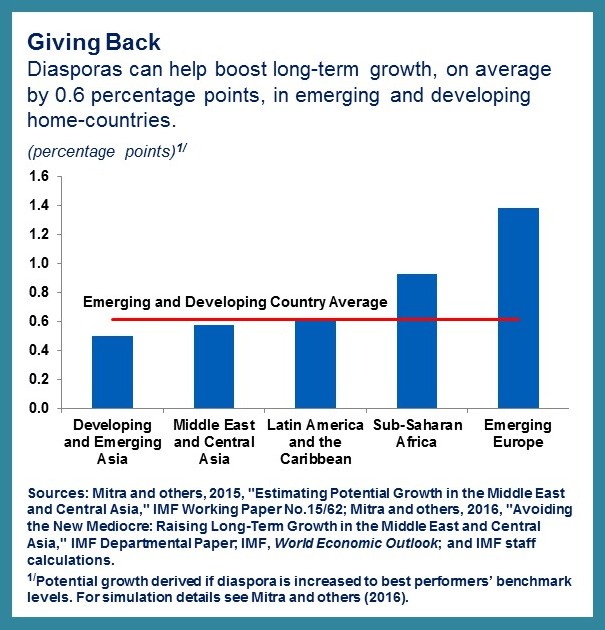
- Thesis: With the right policies, home countries can leverage diaspora communities—including emigrants and their descendants—to raise long-term economic growth, on average, by 0.6 percentage points in emerging and developing home countries.
How diaspora communities boost home-country growth
- Remittances:
- Migrants from emerging and developing countries sent home $430 billion last year—three times more money than their home countries receive in financial assistance from other countries or international financial institutions.
- Remittances as a percent of GDP: 37 percent in Tajikistan, 30 percent in Nepal, around 25 percent in Tonga, Liberia, and Haiti, and 16 percent in Lebanon.
- High cost of sending remittances ranges from 5 percent of the amount being sent in South Asia to 12 percent in Sub-Saharan Africa; these figures could be even higher if costs were lowered.
- Uses: when spent on goods and services, remittances support immediate economic activity; when invested, they boost home-country capital (fund new businesses, increase bank lending capacity, direct diaspora investment in businesses and government bonds).
- Knowledge, skills, and networks:
- Diaspora networks convey knowledge and expertise—raising productivity through curriculum and training design, professional development, leadership training, and advising businesses and governments.
- Diasporas combine skills, contacts, and know-how with insights into global opportunities and local customs to help home-country businesses overcome hurdles, raise efficiency, and expand into new markets.
- Example: Indian-born executives in U.S.-based technology companies played a critical role in giving their companies the confidence to outsource work to India.
Catalyzing diaspora engagement
- Factors outside policy influence:
- Culture, a sense of identity, prevalence of extended families, and security conditions affect diaspora involvement and are often beyond policymakers’ control.
- Policy levers governments can use:
- Develop networks:
- Reach out to highly educated and motivated parts of their diasporas to encourage participation.
- Provide forums for information sharing, from simple websites to large-scale conferences.
- Example: Globalscot, a diaspora network created and managed by the Scottish government, elevated global knowledge circulation in Scotland.
- Encourage investment:
- Relax legal barriers and capital flow restrictions faced by diasporas when investing in home-country property and business opportunities.
- Appeal to patriotism by marketing bonds catered to diaspora interests; example: infrastructure bonds sold by Israel.
- Improve the business environment, governance, institutional quality, and reduce perceptions of corruption to facilitate investment from diasporas and other foreign entities.
- Reduce remittance costs and improve financial access:
- Enhance the integrity of money transfer systems and improve infrastructure for domestic and cross-border payments.
- Remove legal barriers to the development of sound remittance markets and foster market competition.
- Recent reforms: Indonesia, Liberia, Nicaragua, and Samoa implemented policy reforms, technical improvements, and regulatory changes aimed at enhancing the remittance market for consumers.
- Communications strategy:
- Implement a strong communications strategy on the benefits of diaspora networks to mobilize support from elites in home countries, who may view diasporas as competition but influence institutions that partner with diasporas.
Key findings and implications
- Average long-term growth effect: diasporas can help raise long-term economic growth by 0.6 percentage points in emerging and developing home countries.
- Scale of remittances: $430 billion sent home by migrants from emerging and developing countries in the most recent year referenced.
- Remittances often exceed official financial assistance and can constitute substantial shares of GDP in some countries (examples: 37 percent, 30 percent, around 25 percent, 16 percent).
- Reducing remittance costs (current ranges: 5 percent to 12 percent) and improving financial and regulatory frameworks can increase the developmental impact of diasporas.
Source: Addition by Subtraction: How Diasporas Can Boost Home-Country Growth, Pritha Mitra, May 18, 2016