How Lowering Trade Barriers Can Revive Global Productivity and Growth
IMF Blog, June 20, 2016
Source details
- Canonical URL
- How Lowering Trade Barriers Can Revive Global Productivity and Growth
Other formats
Bibliographic details
- Authors: Era Dabla-Norris, Romain Duval
- Published: June 20, 2016
Overview and context
- Publication: Era Dabla‑Norris, Romain Duval — June 20, 2016.
- Central message: Easing barriers to international trade and foreign direct investment (FDI) could boost productivity and output, helping address weak productivity growth since the global financial crisis.
- Recent policy momentum: Trans‑Pacific Partnership (TPP) and ongoing Transatlantic Trade and Investment Partnership (TTIP) negotiations highlight productivity and growth on policymakers’ agendas.
- Empirical scope: New research uses a unique database of effective tariffs in 18 sectors across 18 advanced countries spanning more than two decades.
Mechanisms: How trade and FDI liberalization lift productivity and output
- Increased competition:
- Lower trade and FDI barriers on final goods strengthen competition in liberalized sectors.
- Effects include exploitation of economies of scale, improved efficiency, absorption of foreign technology, and innovation.
- Enhanced variety and quality of inputs:
- Trade liberalization increases the quality and variety of intermediate inputs used in final goods production.
- Relative importance:
- Productivity gains from tariff cuts on intermediate inputs outweigh gains from cutting “output tariffs” (tariffs on final goods).
- Trade liberalization in upstream industries that use intermediate inputs matters more for sector‑level productivity than liberalization in the sector itself.
- Quantitative finding: A one per cent reduction in input tariffs raises total factor productivity levels by about two percent.
- Timing: Productivity gains materialize within 1-5 years, with effects leveling off thereafter.
Size of estimated productivity gains
- Historical contribution:
- For countries in the sample, input tariffs fell on average by 0.5 percentage point over the decade 1997-2007, translating into an average productivity gain of about 1 percent.
- Potential gains from eliminating remaining tariffs (back‑of‑the‑envelope):
- Aggregate productivity could rise by around 1 percent, on average, across advanced economies.
- Country variation: potential gains range from a 0.2 percent gain in Japan to a 5 percent gain in Korea.
- Larger estimated potential gains for Ireland and Korea:
- Korea: higher remaining effective tariffs than other advanced countries in the sample.
- Ireland: strong reliance on imported inputs, especially in chemical and pharmaceutical sectors.
- Caveat: These estimates are lower bounds because they do not account for gains from reallocation across industries or reduction of non‑tariff barriers.
Complementarities with FDI and other policies
- FDI amplifies tariff liberalization effects:
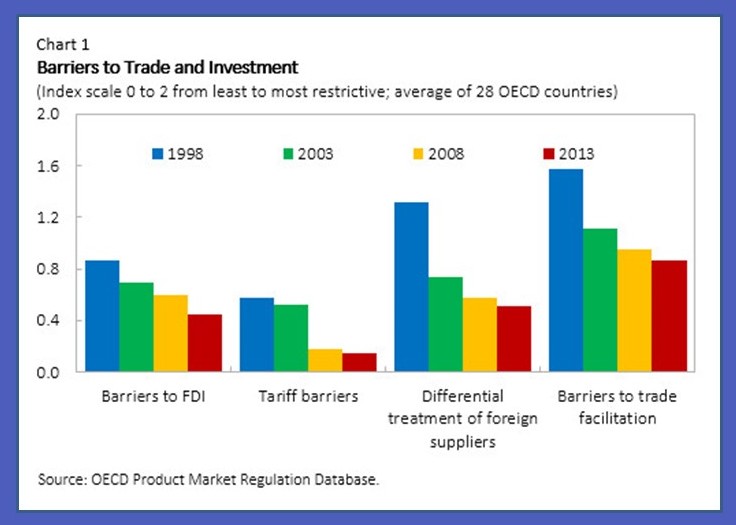
- Productivity gains from reductions in both “output” tariffs and input tariffs tend to be higher in countries with less restrictive FDI regimes.
- Possible mechanism: foreign firms use imported inputs more effectively and pay a lower fixed cost for importing, magnifying the input channel.
- Quantitative interaction:
- When the FDI restrictiveness index is at the 75th percentile, the impact of a 1 percentage point drop in input tariffs on total factor productivity ranges from zero to -1 percent.
- When FDI restrictiveness is at the 25th percentile, the same 1 percentage point drop in input tariffs yields an impact ranging from 3 percent to 4 percent.
- Broader complementarities:
- Gains from trade liberalization may be larger alongside reforms in labor and product markets and reductions in “behind‑the‑border barriers.”
- Non‑tariff barrier reduction, especially in services and customs procedures, is an increasingly important channel.
Policy takeaways and recommendations
- Case for further liberalization:
- Further reduction of tariffs and non‑tariff barriers can raise productivity and output; estimates understate potential gains by overlooking non‑tariff liberalization benefits.
- Emerging and low‑income countries, with comparatively higher barriers, could achieve even higher productivity gains.
- Parallel reforms to amplify benefits:
- Reduce barriers to FDI in parallel with tariff and non‑tariff liberalization.
- Consider reforms in labor and product markets and reductions in domestic regulatory barriers to increase the productivity dividend.
- Compensating policies for distributional effects:
- Recognize potential costs: reallocation can cause wage cuts, job losses, and sectoral or geographic dislocation.
- Implement supportive labor market policies (e.g., education and training) and other interventions to compensate displaced workers and promote equitable adjustment.
- Include labor standards or other labor provisions in trade agreements to help distribute benefits more widely.
Source: How Lowering Trade Barriers Can Revive Global Productivity and Growth — Era Dabla‑Norris, Romain Duval, June 20, 2016.