The Overwhelming Case for a Carbon Tax in China
IMF Blog, July 27, 2016
Source details
- Canonical URL
- The Overwhelming Case for a Carbon Tax in China
Other formats
Bibliographic details
- Authors: Ian Parry, Philippe Wingender
- Published: July 27, 2016
Key findings
- A carbon tax—an upstream tax on the carbon content of fossil fuel supply—could dramatically cut greenhouse gases, save millions of lives, soothe the government’s fiscal anxieties, and boost green growth.
- A tax on carbon dioxide (CO2) emissions, rising by $5 per year between 2017 and 2030, could reduce CO2 emissions by 30 percent in 2030.
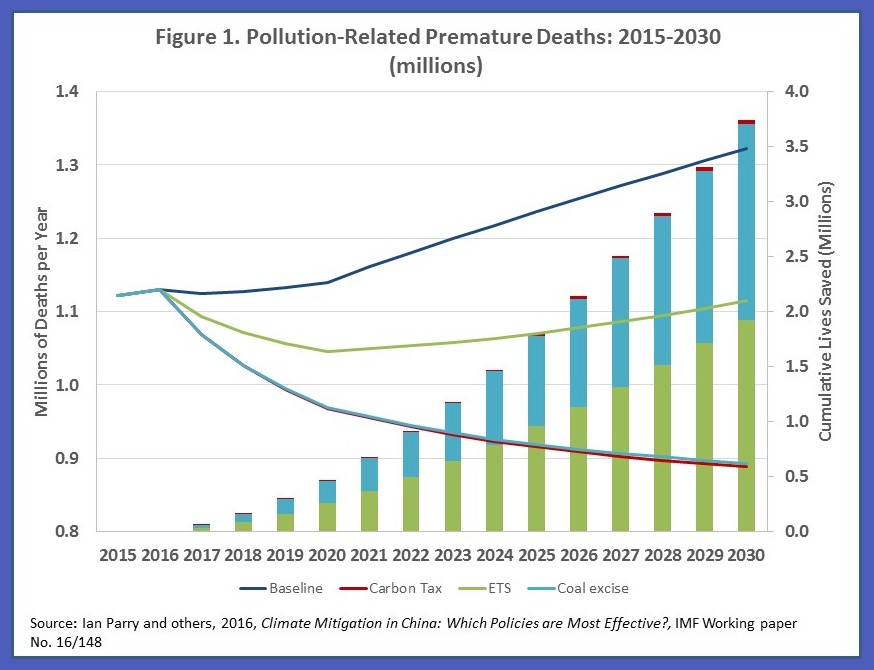
- The carbon tax could save close to 4 million lives during this 14-year period, principally by deterring use of coal, the main source of the fine particulates that elevate the risk of strokes, heart, and lung diseases.
- The tax would raise well over 2 percent of GDP in new revenue by 2030, representing more than enough to double government spending on healthcare.
- China contributed 25 percent to the global CO2 total in 2013, compared with 16 and 6 percent from the United States and India, respectively.
Methods and projection assumptions
- Findings are based on a new spreadsheet tool developed at the IMF for projecting future fuel use by economic sector.
- Projections use assumptions about how fuel demand responds to price changes and previous IMF estimates of local air pollution deaths from fuel combustion for China.
- The central policy scenario specifies a carbon tax rising by $5 per year between 2017 and 2030.
- The future is inherently uncertain; the numbers provide a broad indication of likely impacts rather than precise forecasts.
Public health and fiscal impacts
- Estimated lives saved: close to 4 million over 2017–2030.
- Estimated fiscal revenue: well over 2 percent of GDP by 2030.
- Example consumer impact: in 2020 the carbon tax raises electricity prices by around 5 percent.
Distributional impacts and compensation options
- The carbon tax imposes a disproportionately large burden on low income households: 50 and 25 percent larger for the lowest 20 percent of income earners, compared with the top ten percent of income earners.
- Only about 5 percent of carbon tax revenues would be needed to compensate the bottom twenty percent, for example through reduced social security contributions and increased welfare and social spending.
Sectoral impacts and export considerations
- Exporting sectors do not bear a disproportionate share of the tax burden compared with other sectors.
- Compensation for export industries would use at most 10 percent of carbon tax revenues and should be temporary to allow uncompetitive firms to exit or adapt.
- Needed compensation could be smaller if more countries adopt comparable emissions pricing.
Implementation notes and administrative feasibility
- Administering a carbon tax is straightforward: levy at point of entry with rates based on tons of CO2 produced per unit of fuel.
- Possible collection points: mine mouth for coal (where royalties are already collected), coal processing plants, refineries for petroleum products, and the border for imported fuel products.
- Downsides are manageable; the most difficult challenge is addressing higher energy prices for vulnerable groups.
Carbon tax versus emissions trading system (ETS)
- China committed to introducing a nationwide ETS in 2017 for large industrial sources.
- A carbon tax, by comprehensively covering fuels and emissions, has about twice the environmental and revenue impacts of an equivalently scaled ETS.
- The tax can be introduced in tandem with the ETS for the interim (for example, allowing carbon tax refunds for entities required to obtain emissions permits).
- The priority is establishing a robust and far-reaching emissions price to realize health and fiscal benefits while addressing the global environmental challenge.
Source: The Overwhelming Case for a Carbon Tax in China, Ian Parry and Philippe Wingender, July 27, 2016.