The Euro Area Workforce is Aging, Costing Growth
IMF Blog, August 17, 2016
Source details
- Canonical URL
- The Euro Area Workforce is Aging, Costing Growth
Other formats
Bibliographic details
- Authors: Shekhar Aiyar, Christian Ebeke, Xiaobo Shao
- Published: August 17, 2016
Aging of the workforce
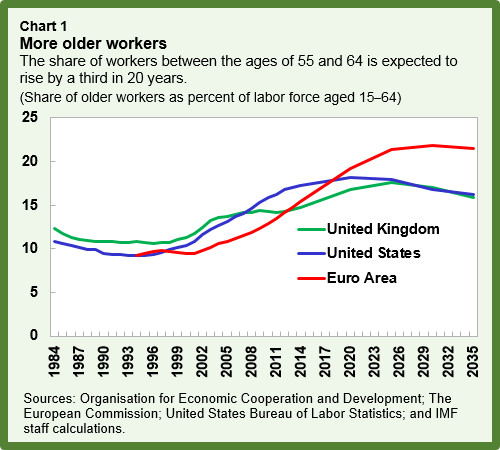
- The share of workers aged 55–64 is forecast to increase by a third, from 15 percent to 20 percent, over the next two decades.
- In parallel to population aging, the average age within the labor force is rising, which can affect average productivity depending on age-cohort productivity profiles.
- Literature consensus cited: productivity increases with age at first, peaking sometime in the 40s or 50s, and then diminishes.
Empirical estimates
- Sample and period: a sample of European countries from 1950 to 2014 was used to examine the relationship between workforce aging and labor productivity.
- Main estimate: A five percentage point increase in the share of workers aged 55–64 is associated with a decrease in labor productivity of about three percent.
- Decomposition: Changes in output per worker reflect physical and human capital and total factor productivity (TFP); TFP is identified as the principal long-run driver of growth.
- TFP channel: A five percentage point increase in the share of workers aged 55–64 is associated with a decrease in total factor productivity of somewhere between two and four percent.
Implications for euro area countries
- Medium- to long-term toll: Workforce aging will take a considerable toll on productivity growth.
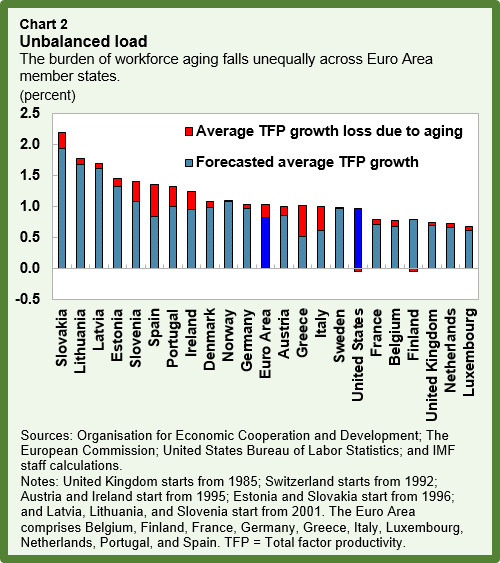
- Baseline TFP growth: Average total factor productivity growth in the euro area is forecast to be around 0.8 percent per year.
- Counterfactual without aging effect: TFP could be higher by a quarter—that is to say, total factor productivity could increase to about one percent per year—if the effect of workforce aging were shut down.
- Cross-country unevenness: The burden of workforce aging will fall unequally across euro area member states; some of the largest adverse effects are projected for Greece, Spain, Portugal, and Italy, which already face elevated debt levels and limited fiscal space.
Policy responses and mitigation
- Health improvements:
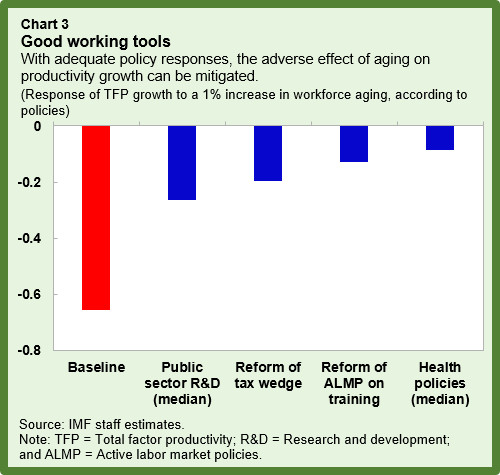
- Health conditions—measured in the study by the availability of doctors—are particularly important.
- Sufficient improvements in this indicator have the potential to substantially reduce the negative effects of aging on productivity.
- Older age groups are likely to use medical services to a greater extent and thus benefit disproportionately from public interventions to improve healthcare.
- Active labor market policies:
- Worker training or re-training programs can mitigate the impact of aging, being disproportionately beneficial to senior workers whose skills may lag evolving technologies and job requirements.
- Other public policies:
- Reducing the difference between gross income and after-tax income by cutting the rate of tax on marginal employment.
- Investing in research and development.
Source: Shekhar Aiyar, Christian Ebeke, Xiaobo Shao — August 17, 2016.