China's Rebalancing Explained in 6 Charts
IMF Blog, September 6, 2016
Source details
- Canonical URL
- China's Rebalancing Explained in 6 Charts
Other formats
Bibliographic details
- Authors: Longmei Zhang
- Published: September 6, 2016
The Scorecard: mixed progress
- Rebalancing denotes a structural transformation across four inter-related dimensions: external, internal, environmental, and distributional.
- Overall progress since the global financial crisis has been mixed:
- Strong on external rebalancing (switching from external demand to domestic demand).
- Uneven on internal, environmental, and distributional dimensions.
- Key statistic: the current account surplus fell from the pre-crisis peak of 10 percent of GDP to around 3 percent in recent years.
- Exports are no longer driving growth.
Consumers growing in importance
- Until 2011, reduction in the external imbalance coincided with a growing internal imbalance as the investment to GDP ratio rose due to strong fiscal stimulus.
- Since 2012, internal rebalancing from investment to consumption has made headway.
- Notable acceleration in 2015: consumption is now contributing more than two thirds of GDP growth.
Deindustrialization: speedy transition
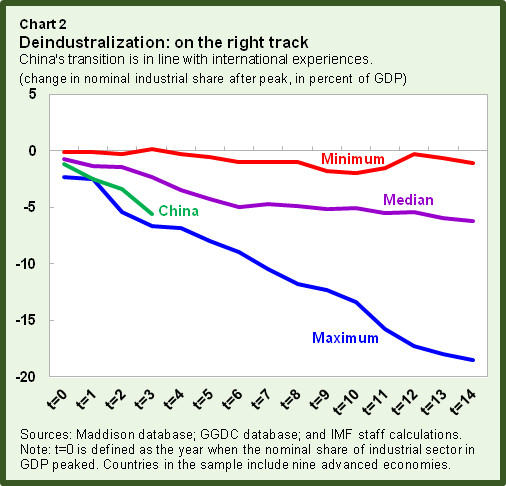
- China has made substantial progress switching from industry to services.
- The speed of the transition is in line with international experience.
Credit: China’s Achilles’ heel
- Progress has lagged on reducing reliance on credit.
- Credit intensity (the amount of new lending provided for each additional unit of output) has more than doubled since the global financial crisis.
- Risk highlighted: absent decisive corporate restructuring and reform of state-owned enterprises, credit to the nonfinancial private sector will likely rise continuously, increasing the risk of disruptive adjustment.
Pollution and inequality: on the high side
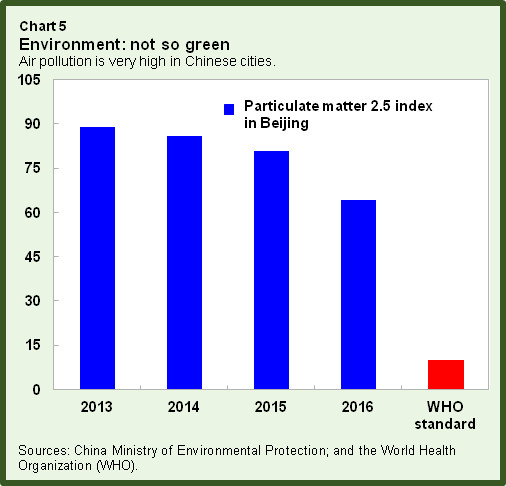
- Energy intensity of output has fallen, but air pollution remained very high in cities.
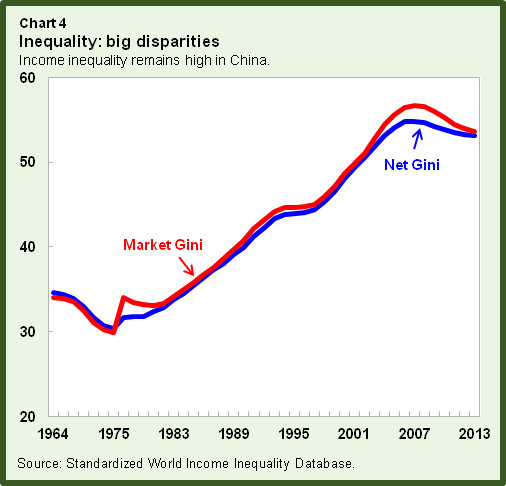
- Income inequality remains very high.
- Labor’s share of GDP is rising.
Falling savings and implications
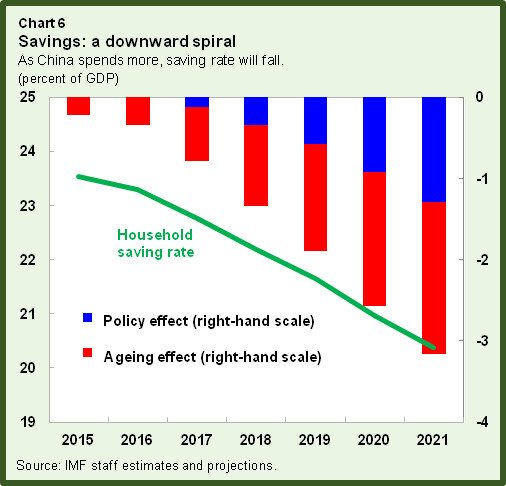
- With population ageing and envisaged strengthening of social safety nets, household savings are expected to fall gradually and consumption to rise.
- Expected outcome: investment can moderate while keeping the current account balance broadly stable.
- The services sector is likely to increase in importance, helping reduce environmental pressure and increase labor’s share in national income.
Source: China’s Rebalancing Explained in 6 Charts — Longmei Zhang, September 6, 2016.
Content in this bundle
- 用六张图解释中国的再平衡; iMFdirect博客; 2016年9月6日
References
- paper
- https://www.imf.org/wp-content/uploads/2016/09/china-rebalancing-scorecard.jpg
- https://www.imf.org/wp-content/uploads/2016/09/china-rebalancing-chart1.jpg
- https://www.imf.org/wp-content/uploads/2016/09/china-rebalancing-chart2.jpg
- https://www.imf.org/wp-content/uploads/2016/09/china-rebalancing-chart3.jpg
- https://www.imf.org/wp-content/uploads/2016/09/china-rebalancing-chart4.jpg
- https://www.imf.org/wp-content/uploads/2016/09/china-rebalancing-chart5.jpg
- https://www.imf.org/wp-content/uploads/2016/09/china-rebalancing-chart6.jpg