The Calculus of Conflict in the Middle East
IMF Blog, September 16, 2016
Source details
- Canonical URL
- The Calculus of Conflict in the Middle East
Other formats
Bibliographic details
- Authors: Christine Lagarde
- Published: September 16, 2016
Overview
- As world leaders convene at the United Nations General Assembly, the Middle East and North Africa face persistent conflict, massive displacement, and severe humanitarian and economic consequences.
- Within the region, "more than 20 million people are displaced, and a further 10 million are refugees—a scale not seen since the end of World War II."
- Conflicts have destroyed productive capital, reduced personal wealth and income, and eroded human capital through lack of jobs and education.
- The IMF examined the economic challenges of conflict and options for post-conflict recovery; three key findings were highlighted.
Key findings on economic costs
- Conflicts impose massive economic costs in addition to humanitarian losses:
- In Syria, "school dropout rates reached 52 percent in 2013" and "life expectancy fell to 56 years from 76 years before the conflict."
- After four years of intense fighting, "Syria’s output is now estimated to be less than half its level in 2010."
- Inflation in Syria "surged by almost 300 percentage points in May 2015, the latest available month of data."
- "Yemen lost an estimated 25-35 percent of its GDP in 2015 alone."
- With a "relatively high annual growth rate of 4.5 percent, it would take Syria more than 20 years just to rebound to its 2010 pre-conflict GDP level."
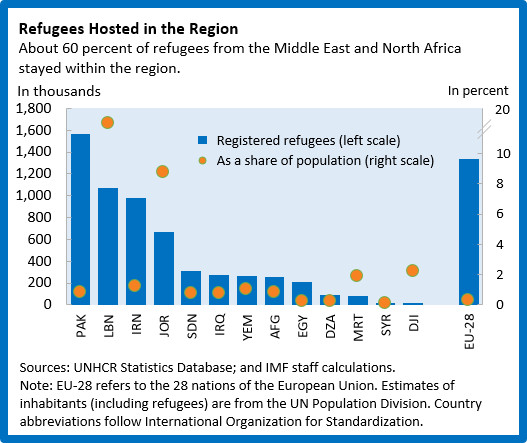
- Conflicts produce regional spillovers affecting neighboring countries (e.g., Jordan, Lebanon, Tunisia, and Turkey) through refugee hosting, weaker confidence and security, and declining social cohesion, which undermine institutions and reform capacity.
Policies that can limit immediate impact
- Protecting economic institutions:
- Keeping core government institutions functioning—such as fiscal agents and central banks—is key to maintaining life-saving services, wages and salaries, health, and other services.
- Prioritizing spending:
- Conflicts raise fiscal pressures; security and military spending rise while revenues fall, making spending prioritization critical to maintain essential services and protect vulnerable groups.
- Ensuring macroeconomic stability:
- Fiscal and external imbalances increase during conflicts; central banks often finance governments and facilitate activity (as in Yemen and Libya), leading to inflation and reserve losses.
- Nontraditional tools and administrative measures may be required to maintain some degree of macroeconomic control.
Role of external partners and the IMF
- Immediate priority: alleviate human suffering and meet immediate needs of those affected by conflicts.
- The IMF’s contributions:
- Accommodating refugee or security-related outlays in programs with Iraq, Jordan and Tunisia.
- Providing policy advice and capacity building across the region.
- Offering a macroeconomic toolkit and post-conflict experience for scaled-up rebuilding and resilience efforts.
- Donor financing:
- At the London Conference for Supporting Syria and the Region in February, donors committed "$5.9 billion and $5.5 billion for 2016 and 2017–20, respectively" for humanitarian and development activities.
- Even if fully delivered, these pledges "would not be enough given the magnitude of the crisis."
- Any financing should come through grants and concessional loans to reduce the financial burden on recipient countries.
Long-term priorities
- Scale up development aid to rebuild infrastructure and institutions and strengthen economic and social resilience across the region.
- International community bears major responsibility; the IMF stands ready to assist with policy support, financing advice, and capacity building.
Source: The Calculus of Conflict in the Middle East, Christine Lagarde, September 16, 2016.
Content in this bundle
- 中东冲突分析, 作者:克里斯蒂娜• 拉加德, iMFdirect, 2016年9月16日
- 中東の紛争に関する算法; クリスティーヌ・ラガルド; 2016年9月16日
- Конфликт на Ближнем Востоке в цифрах, Кристин Лагард, 16 сентября 2016 года