A Sea Change: The New Migration from sub-Saharan Africa
IMF Blog, November 2, 2016
Source details
- Canonical URL
- A Sea Change: The New Migration from sub-Saharan Africa
Other formats
Bibliographic details
- Authors: Jesus Gonzalez-Garcia, Montfort Mlachila
- Published: November 2, 2016
Population and demographic trends
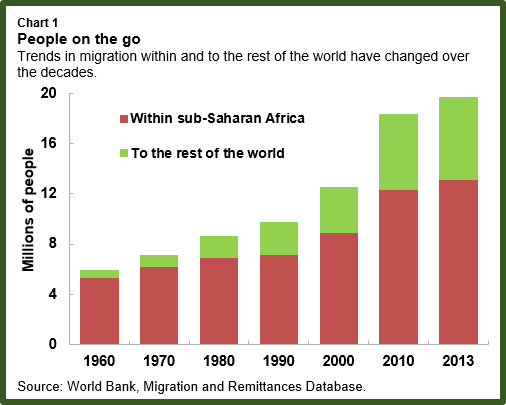
- Migration from sub-Saharan Africa doubled since 1990 to reach about 20 million in 2013.
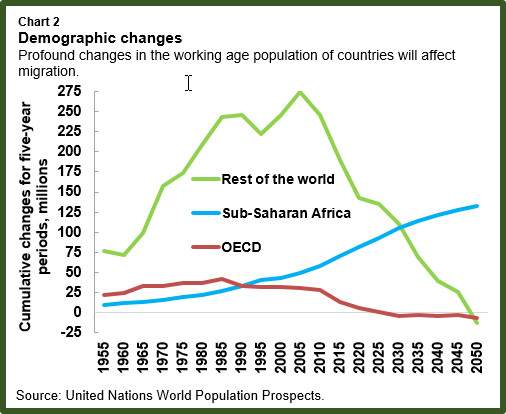
- The region’s population is projected to increase from about 900 million in 2013 to 2 billion in 2050.
- The working-age population is set to increase from about 480 million in 2013 to 1.3 billion in 2050.
- As a result of demographic expansion and persistent income gaps with advanced countries, the ratio of sub-Saharan African migrants to the population of their new homes in OECD countries is projected to increase from about 0.4 percent in 2010 to 2.4 percent by 2050.
Migration patterns and drivers
- Two dominant trends:
- The number of refugees has decreased considerably since 1990. In 1990 about half of total migrants were refugees, declining to only about 10 percent by 2013.
- The share of migrants who move outside the region for economic reasons has increased sixfold between 1990 and 2013—from about 1 million to 6 million. Economic migrants within the region increased threefold—from 4 million to 12 million.
- Migration within Africa is predominantly driven by:
- geographic proximity,
- income differences,
- wars in the home country,
- relative political stability in the host country,
- cultural links,
- environmental factors such as droughts or floods.
- Major in-region recipients include Cote d’Ivoire and South Africa.
- Migration to the rest of the world is driven mainly by the search for better economic opportunities. About 85 percent of the sub-Saharan African diaspora in the rest of the world is in countries belonging to the Organization for Economic Cooperation and Development (OECD).
- The United States, the United Kingdom, and France host about 50 percent of sub-Saharan African migrants in the rest of the world.
Economic effects and benefits
- Migrant workers can have a positive impact on growth in receiving countries, particularly where populations are aging rapidly.
- Benefits in receiving countries include:
- a boost to the labor force that helps compensate for aging and declining domestic populations,
- additional tax revenues,
- social contributions to support retired workers.
- Benefits for origin countries include:
- remittances that support living standards of relatives,
- remittances that help alleviate poverty and serve as a stable source of foreign earnings.
Policy implications and recommendations
- Because migration within and outside the region will likely continue to expand in coming decades, countries need to design policies that facilitate the rapid social and economic integration of migrant workers so all can benefit.
- Proper integration policies can:
- support economic growth and public finances in receiving countries,
- minimize social tensions associated with immigration stemming from concerns about displacement of native workers and fiscal costs,
- ensure remittances continue to play a role in poverty alleviation and external earnings for origin countries.
Source: A Sea Change: The New Migration from sub-Saharan Africa (Jesus Gonzalez-Garcia, Montfort Mlachila), November 2, 2016.
Content in this bundle
- Mudança radical: A nova migração da África Subsariana