A Field Guide to Exchange Rate Regimes in Central, Eastern and Southeastern Europe
IMF Blog, November 29, 2016
Source details
- Canonical URL
- A Field Guide to Exchange Rate Regimes in Central, Eastern and Southeastern Europe
Other formats
Bibliographic details
- Authors: Philip Gerson, Johannes Wiegand
- Published: November 29, 2016
Overview
- Authors: Philip Gerson, Johannes Wiegand
- Date: November 29, 2016
- Region examined: Central, Eastern and Southeastern Europe (CESEE)
- Context: CESEE experienced a capital-flow-fueled boom in the early and mid-2000s, a sharp recession after the 2008 global financial crisis, and a gradual recovery over the past 15 years or so. The region exhibits almost every type of exchange rate regime: floating and inflation targeting, various pegs, unilateral use of the euro, and full euro area membership.
Key findings
- Flexible versus fixed regimes and boom-bust dynamics:
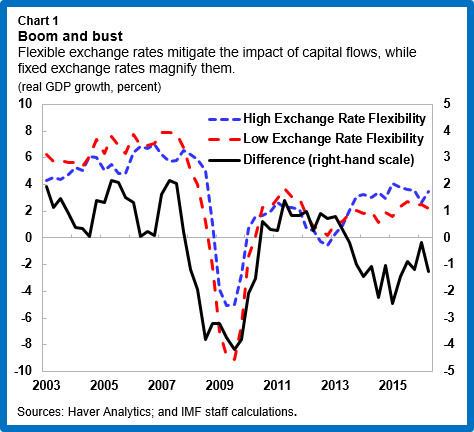
- Economies with flexible exchange rates experienced a more muted pre-2008 boom, a shorter and shallower recession, and a more robust recovery compared with economies with fixed exchange rates.
- Flexible exchange rates tended to mitigate the impact of capital in- and outflows, while fixed exchange rates magnified them (see Chart 1).
- Fixed exchange rates can amplify capital flows through pro-cyclical credit booms, a pattern clearly visible in CESEE.
- Long-term effects on potential growth:
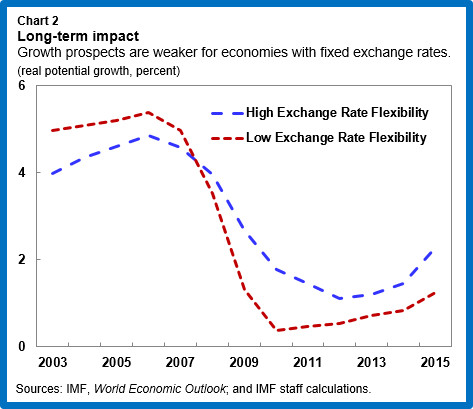
- Excessive boom and bust continues to affect economies long after episodes end.
- Potential growth in economies with fixed exchange rates is now, on average, almost a percentage point below that of economies with flexible exchange rates, as high private sector debt accumulated during the boom weighs on investment (see Chart 2).
- Historical drivers of regime choice:
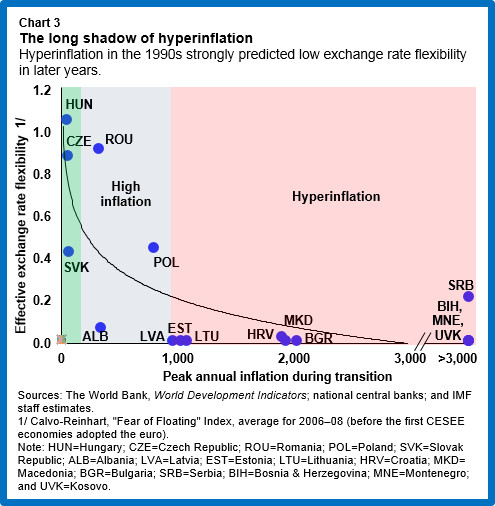
- Fixed exchange rates in CESEE are often rooted in experiences with hyperinflation during the 1990s (see Chart 3).
- Where populations suffered hyperinflation, distrust of local currencies persists; depositors are much more likely to hold bank deposits in euros.
- In such environments, tying the currency to a strong anchor like the euro can provide stability and instill confidence, which can be more important than better management of credit cycles.
Policy options and recommendations
- For countries with flexible exchange rates:
- Little need for reorientation; flexible regimes have generally served them well.
- Continued emphasis on good economic management across monetary, fiscal and structural policies remains critical.
- For countries with fixed exchange rate regimes: two broad strategies
- Strategy 1 — Gradually increase exchange rate flexibility:
- Preconditions and measures: strong macroeconomic policies; regulatory measures that encourage the use of the domestic currency; an extended period of low inflation, solid growth and exchange rate appreciation to solidify confidence in the domestic currency.
- Feasibility: depends on country circumstances; some CESEE countries may now have sufficiently strong institutions to transition, others may need the fixed exchange rate as a stability anchor for some time.
- Considerations for euro adoption: for countries expecting to adopt the euro soon, the upfront costs of transitioning to more flexibility may not be worthwhile.
- Role for European institutions:
- Greater acceptance of prudential measures that promote the use of local currencies, rather than interpreting these as quasi-capital controls inconsistent with European treaties.
- A financial safety net during the transition to flexibility—for example in the form of unsecured European Central Bank swap lines—could help overcome populations’ entrenched distrust in floating currencies.
- Strategy 2 — Make existing fixed regimes work better:
- Required elements: high wage flexibility; much stronger use of countercyclical fiscal and macro-prudential policies.
- Implementation challenges:
- Running countercyclical fiscal policy is challenging for emerging economies because of low fiscal multipliers, financing constraints, and political economy pressures.
- Macro-prudential policies that restrict bank lending suffer from evasion, with banks circumventing regulations in one country by providing loans cross-border from another.
- Therefore, effective macro-prudential measures require a coordinated European anti-evasion effort.
Synthesis and outlook
- No single exchange rate regime is inherently superior; suitability depends on local conditions and historical legacies.
- Regimes need to evolve as conditions change; failure to adapt risks economies falling behind.
- The trade-off for CESEE policymakers is balancing stability (often provided by fixed regimes anchored to the euro) against greater shock absorption and potentially less pronounced boom-bust cycles under more flexible regimes.
Source: A Field Guide to Exchange Rate Regimes in Central, Eastern and Southeastern Europe — Philip Gerson, Johannes Wiegand, November 29, 2016
Content in this bundle
- BROWN—The Euroization of Bank Deposits in Eastern Europe
- Wp1241
- Wp1629