Global House Prices: Time to Worry Again?
IMF Blog, December 8, 2016
Source details
- Canonical URL
- Global House Prices: Time to Worry Again?
Other formats
Bibliographic details
- Authors: Hites Ahir, Prakash Loungani
- Published: December 8, 2016
Overview
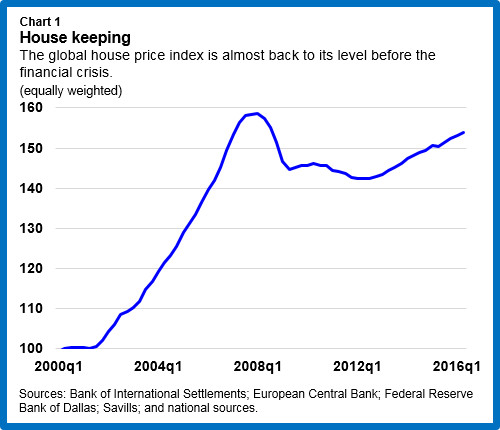
- The IMF’s Global House Price Index is a simple average of real house prices for 57 countries and is now almost back to its level before the crisis.
- Context: During 2007-08, house prices in several countries collapsed, marking the onset of a global financial crisis.
- Central question raised: Is it time to worry again about a global fall in house prices?
- Judgment in the piece: The present conjuncture is a time for vigilance but not panic.
Lack of synchronicity
- The current house-price boom is not synchronized across countries, and within countries booms are often restricted to one or a few cities.
- Three clusters identified in the Global House Price Index:
- Gloom: 18 economies in which house prices fell substantially during the global financial crisis and have remained on a downward path.
- Bust and boom: 18 economies in which housing markets have rebounded since 2013 after falling sharply during 2007-12.
- Boom: 21 economies in which the drop in house prices in 2007–12 was quite modest and was followed by a quick rebound.
- City-level variation example (China):
- Beijing: prices have increased in inflation-adjusted terms by about 25 percent a year in Beijing over the past decade.
- Xian: prices have increased by under 10 percent a year in Xian over the past decade.
- Other city examples where local price increases exceed national averages: Amsterdam, Oslo, Vienna.
Supply constraints
- Unlike many past housing booms driven by excessive credit growth, supply constraints appear to be playing a big role in some current price booms.
- Evidence:
- Residential permits have grown only modestly in the "boom" and "bust and boom" country clusters.
- In Copenhagen and Stockholm, the increase in the housing stock has not kept up with population growth, contributing to price increases.
- The IMF has flagged supply constraints in some cities in Australia and Canada, and in many European countries—France, Germany, the Netherlands, Norway, and the United Kingdom.
- Implication: Even when price increases reflect supply constraints, their impact on household indebtedness could have adverse implications for financial stability.
Increased vigilance and macroprudential policy
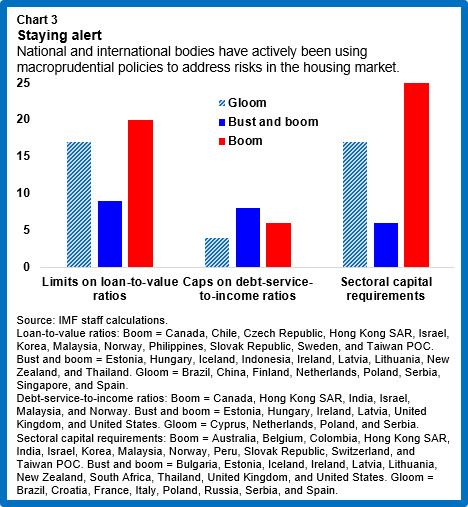
- National and international regulators are more active in monitoring house price booms and using macroprudential policies than in the pre-crisis period.
- Use of macroprudential policies has been quite extensive since the crisis, particularly in the "gloom" and "boom" clusters.
- The IMF has been urging macroprudential measures, alongside measures to boost supply, in many countries including Australia, Canada, and several European countries.
- Example of regulatory vigilance: The European Systemic Risk Board published country-specific warnings on medium-term vulnerabilities in the residential sector for eight member states: Austria, Belgium, Denmark, Finland, Luxembourg, the Netherlands, Sweden, and the United Kingdom.
- Quotation underscoring policy shift: former Deputy Managing Director Min Zhu — “The era of benign neglect of house price booms is over.”
Source: Global House Prices: Time to Worry Again? — Hites Ahir, Prakash Loungani, December 8, 2016
Content in this bundle
- Global House Prices: Time to Worry Again?
- 全球住房价格:再次担心的时候到了吗?; IMF博客; 2016年12月8日
- 世界の住宅価格: 再び懸念すべき時か; ヒテス・アイール, プラカシュ・ラウンガニ; iMFdirect ブログ2016年12月8日掲載
- Цены на жилье в мире — пора ли вновь беспокоиться? 8 декабря 2016 года
References
- عربي
- Global House Price Index
- https://www.imf.org/wp-content/uploads/2016/12/res-globalhouseprices-chart1.jpg
- era of benign neglect of house price booms is over
- China
- https://www.imf.org/wp-content/uploads/2016/12/res-globalhouseprices-chart2.jpg
- Australia
- Canada
- France
- Germany
- the Netherlands
- Norway
- United Kingdom
- https://www.imf.org/wp-content/uploads/2016/12/res-globalhouseprices-chart3.jpg