A Shifting U.S. Policy Mix: Global Rewards and Risks
IMF Blog, December 20, 2016
Source details
- Canonical URL
- A Shifting U.S. Policy Mix: Global Rewards and Risks
Other formats
Bibliographic details
- Authors: Maurice Obstfeld
- Published: December 20, 2016
Key market developments and immediate observations
- The Fed raised interest rates for just the second time in a decade; the decision was widely anticipated by markets.
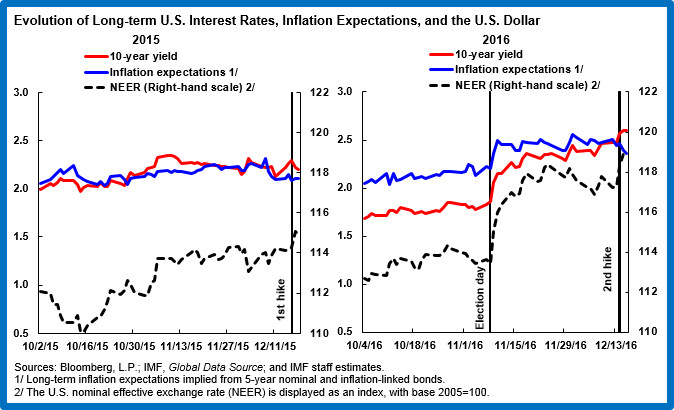
- Sharp post-election moves occurred in:
- longer-term U.S. interest rates,
- the dollar (which "has risen further in the days following the Fed’s recent move"),
- market-based measures of long-term inflation expectations.
- These abrupt market reactions following the November 8 U.S. presidential and congressional elections contrasted with the absence of comparably abrupt reactions before the December 2015 rate hike.
- Timing of asset-price movements suggests the market response reflected a shift in expectations about the future interest rate path and future demand in the U.S. economy, not only the imminent December rate hike.
Causes and expectations for U.S. monetary policy
- Longer-term nominal interest rates are strongly influenced by expectations of the future path of the Fed’s policy rate, which responds to U.S. inflation pressures and the economy’s underlying strength.
- Federal Open Market Committee members now anticipate a steepened future path of interest rates that "suggests three interest rate hikes in each of the next two years."
- The post-election shift in expectations is linked to the end of six years of divided U.S. government with the election of Donald Trump and continued Republican congressional control.
Fiscal policy shift in the United States and domestic implications
- Congressional Republicans have long advocated lower personal and corporate tax rates; President-elect Trump campaigned on substantial tax cuts plus increases in some government spending, notably defense and infrastructure.
- Expected fiscal stance: "it will turn more expansionary through some combination of more spending and lower tax rates."
- Potential macro effects:
- Increased U.S. aggregate demand → rise in real output and upward pressure on inflation.
- With the unemployment rate at 4.6 percent and other labor market distress measures largely recovered, there may be "little remaining slack in the U.S. economy."
- Unless labor force participation and overtime work rise significantly, inflation pressure could "rise noticeably."
- Faster-receding slack and inflation concerns underpin the Fed’s expectation of more rapid rate increases.
- Additional dollar pressures:
- Tax incentives for U.S. corporations to repatriate past profits held abroad, estimated at $2.5 trillion, could push the dollar up.
- Faster demand growth and dollar appreciation would contribute to a widening U.S. current account deficit and "more borrowing from abroad."
- The extent to which foreign borrowing finances a growing Federal fiscal deficit depends on the fiscal package’s design, offsets, government borrowing rates, and the economy’s growth response.
- Growth and inflation trade-offs:
- U.S. growth will respond more strongly, with lower inflation, if infrastructure spending "is carefully designed to boost potential output," and tax measures "encourage investment, labor supply, and inclusion."
International challenges and spillovers
- Advanced economies with currencies that depreciate against the dollar will benefit from higher U.S. growth and more competitive exchange rates; for many (struggling with below-target inflation), resultant inflationary pressure may initially be welcome.
- Risks for advanced economies:
- Upward pressure on interest rates could pose fiscal challenges for highly indebted countries that do not sufficiently benefit from positive demand spillovers.
- Emerging market economy implications:
- Benefits: more competitive currencies and higher U.S. demand.
- Vulnerabilities remain for some despite improved buffers (e.g., foreign reserves), reduced currency mismatches, and better financial oversight frameworks.
- Historical role: U.S. interest rates have been key drivers of net capital flows into emerging markets.
- Flexible exchange rates can help rebalance international portfolios and limit reserve losses, but:
- Rising dollar interest rates combined with domestic currency depreciation could reduce liquidity or worsen balance sheets.
- Importance of dollar borrowing by residents and non-resident corporates raises balance-sheet and inflation risks.
- Policymakers in emerging markets "therefore will remain vigilant."
- Trade and political economy risks:
- If sharp exchange rate shifts and growing global imbalances follow the U.S. policy regime change, protectionist pressures become a major risk.
- Emerging market economies are likely targets for higher trade barriers erected by advanced economies seeking to maintain manufacturing.
- Protection is likely to be counterproductive domestically because of the integration of advanced economies into global supply chains.
- In an environment of sharply divergent policy mixes, "the rules of the global trading system will be more important than ever."
Policy recommendations and considerations
- For U.S. policymakers:
- Design infrastructure spending to boost potential output.
- Structure tax measures to encourage investment, labor supply, and inclusion.
- Consider the implications of repatriation incentives for the dollar and external balances.
- For emerging market policymakers:
- Maintain or strengthen policy buffers (e.g., foreign reserves) and financial oversight.
- Use flexible exchange rates as a buffer against rapid outflows where feasible.
- Be vigilant about balance-sheet vulnerabilities linked to dollar borrowing and potential inflation from currency depreciation.
- For advanced-economy policymakers:
- Manage fiscal exposure to rising global interest rates, especially if highly indebted.
- Acknowledge that protectionist measures are likely to be counterproductive given global supply-chain integration.
- For the global community:
- Reinforce and rely on the rules of the global trading system to manage risks from divergent policy mixes.
Source: A Shifting U.S. Policy Mix: Global Rewards and Risks — Maurice Obstfeld, December 20, 2016
Content in this bundle
- 美国政策组合的 变化;全球收益与风险; IMF博客
- 米国の変化するポリシーミックス: 世界への恩恵とリスクは : モーリス・オブストフェルド; iMFdirect ブログ2016年12月20日掲載
- Поворот в экономической политике США: глобальные выгоды и риски; 20 декабрь 2016 года