OPEC's Rebalancing Act
IMF Blog, March 15, 2017
Source details
- Canonical URL
- OPEC's Rebalancing Act
Other formats
Bibliographic details
- Authors: Rabah Arezki, Akito Matsumoto
- Published: March 15, 2017
Overview
- Authors: Rabah Arezki, Akito Matsumoto
- Date: March 15, 2017
- Key premise: OPEC shifted from maintaining output in November 2014 to committing on November 30, 2016 to a production cut intended to rebalance the oil market and stabilize prices.
The OPEC agreement
- Agreement details:
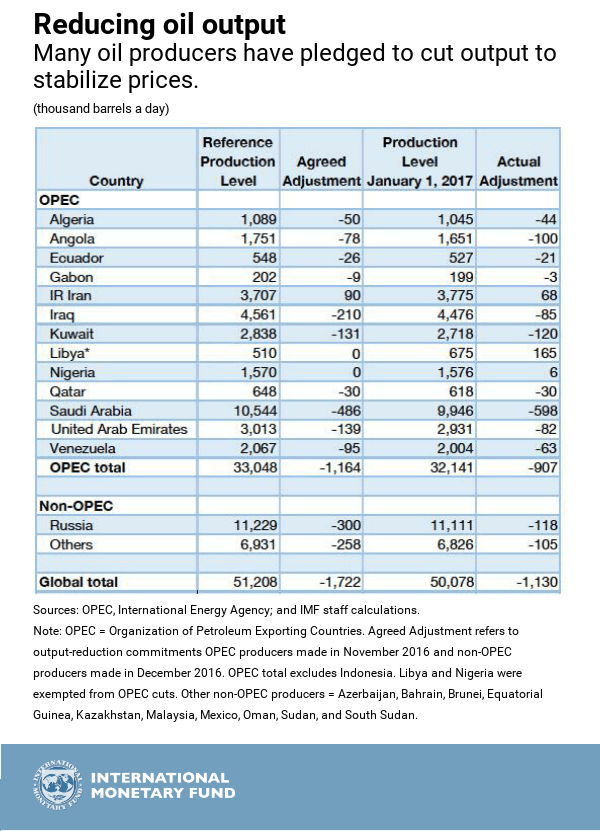
- Six-month, 1.2 million barrel a day (3.5 percent) reduction in OPEC crude oil output to 32.5 million barrels per day, effective in January 2017.
- Some OPEC members exempted (for example, Nigeria and Libya).
- Non-OPEC producers agreed to cut about 600,000 barrels a day: Russia committed to cut 300,000 barrels, and 10 other non-OPEC oil producing countries agreed to cut the remaining 300,00 barrels a day.
- Distribution of cuts:
- Saudi Arabia, Iraq, the United Arab Emirates, and Kuwait are bearing the brunt of the OPEC cuts.
- Compliance and reported effects:
- OPEC reported that compliance was close to 90 percent in January.
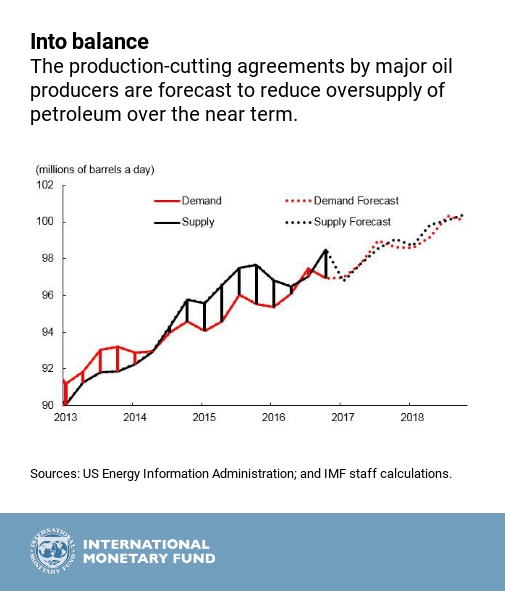
- Result observed: a small price increase and some price stability, with supply and demand appearing to be in balance at a price just above $50 a barrel.
- Reports of lower compliance exist; Saudi Arabia signaled it will do whatever it takes to enhance credibility and has cut production more than required.
- Short-term threats to effectiveness:
- Some OPEC members—Iraq, Libya, and Nigeria—have increased their production since October.
- Non-OPEC producers have made smaller reductions than OPEC and are not required to reach targets as soon; Russia had cut only 120,000 of the 300,000 barrels a day it promised as of the report.
- Some targeted reductions may be "phantom," reflecting natural declines rather than active cuts.
Shale oil threat
- Price responsiveness and investment:
- The $6-a-barrel increase in spot oil prices after hints of an OPEC agreement is expected to stimulate oil production investment in 2017.
- US shale wells can begin production within a year of the initial investment, unlike conventional oil investments which take a number of years.
- Historical precedent:
- In early 2014, expectations of OPEC support kept prices around $100 a barrel, stimulating non-OPEC production (including shale); oversupply later built up and prices fell precipitously after the November 2014 OPEC meeting.
- Recent indicators:
- US shale oil investment declined sharply after the 2014 price drop, and production declined within a few months.
- The oil price rebound in 2016 and the September 2016 announcement in Algeria that OPEC intended to cut production helped boost investment.
- By February 2017, US oil investment, as measured by the number of drilling rigs in operation, reached its highest level since November 2015.
- Structural change in shale production:
- US producers have become more efficient with improved operations and increased selectivity in wells.
- Although ultimate shale capacity is uncertain, shale’s fast responsiveness to price changes is now a central feature of the oil market and will lead to more limited and shorter production and price cycles.
Bottom line / Implications
- The OPEC agreement has hastened the rebalancing of the oil market and should reduce excess supply at least temporarily.
- Futures markets suggest expectations are firmly anchored at around $50 a barrel.
- The forces unleashed by the OPEC agreement—especially responsive shale production—will limit the agreement’s effectiveness over the next few years.
Source: OPEC's Rebalancing Act — Rabah Arezki, Akito Matsumoto, March 15, 2017
Content in this bundle
- Перебалансировка нефтяного рынка ОПЕК, Рабах Арецки и Акито Мацумото, 15 марта 2017 года