Two Things That Keep Central Banks' Reserve Managers Awake at Night
IMF Blog, March 29, 2017
Source details
- Canonical URL
- Two Things That Keep Central Banks' Reserve Managers Awake at Night
Other formats
Bibliographic details
- Authors: Veronica Bacalu, Vincent Fleuriet, Asad Qureshi
- Published: March 29, 2017
Overview and authorship
- Title: Two Things That Keep Central Banks' Reserve Managers Awake at Night
- Authors: Veronica Bacalu, Vincent Fleuriet, Asad Qureshi
- Date: March 29, 2017
- Focus: central bank management of international reserves and the main concerns of reserve managers.
Role and investment objective of reserve managers
- Primary role: manage a country’s international reserves.
- Overarching investment objective: help preserve the external value of the domestic currency.
- Three main pillars supporting the objective:
- preserving the capital of the investments,
- ensuring the liquidity of assets—how tradable they are,
- earning a return.
Survey of reserve managers
- Sample: 63 central banks from advanced, emerging, and low-income countries.
- Purpose: understand reasons behind reserve managers' worries and collect their top concerns.
Finding 1 — Low interest rates
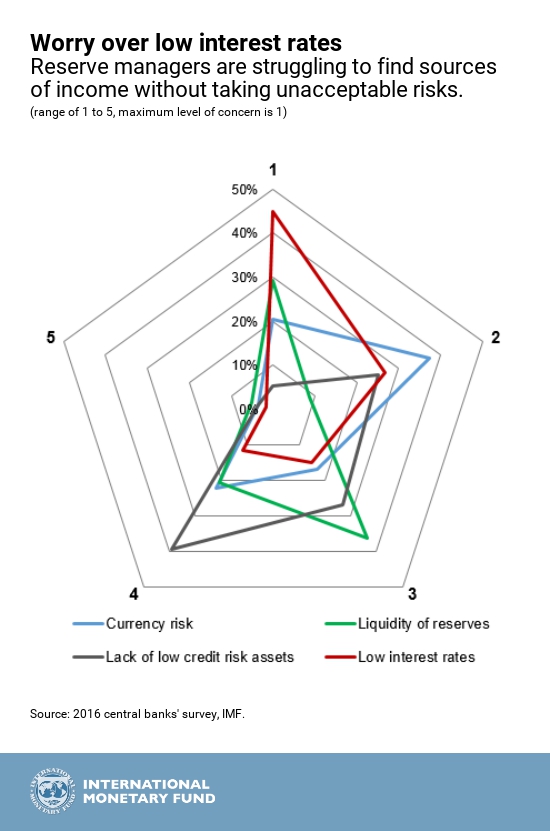
- Low interest rates identified as the main concern among reserve managers.
- Consequences noted:
- Returns on international reserves are low, and in some cases even turned negative.
- Reserve managers struggle to find sources of income without taking unacceptable risks.
- Pre-crisis environment: safe and liquid assets (such as government bonds) generally provided good returns and allowed the three pillars to be relatively easily achieved.
- Post-crisis environment: that tradeoff is no longer straightforward.
- Actions taken and tradeoffs:
- Some managers invested in higher-yielding currencies to increase returns, but this introduced additional foreign exchange volatility and currency risk.
- Investing in emerging market or corporate bonds may increase short-term income but may not provide a steady stream of investment income.
- Core dilemma: what risks to take, how to take them, and whether new solutions will deliver desired results.
Finding 2 — Communicating choices
- Communication practice: asset managers have started to communicate their choices more, but many central banks still find it hard to convey the choices they make and why.
- Specific observation from survey: the majority of central banks surveyed do not publish their reserve management guidelines.
- Purpose of clear communication:
- Helps financial markets and the public understand reserve management choices.
- Clarifies that managing international reserves is not about making a profit but about preserving the external value of the domestic currency and prioritizing stability.
Practical approach and policy implications
- Observed strategy: most reserve managers emphasize the first two pillars—capital preservation and a high level of liquidity—at the expense of return.
- Recommendation for stakeholders: support a strategy prioritizing capital preservation and liquidity, especially in times of increased financial volatility and low interest rates.
Source: IMF blog post "Two Things That Keep Central Banks' Reserve Managers Awake at Night," Veronica Bacalu, Vincent Fleuriet, Asad Qureshi, March 29, 2017.