Emerging Economy Consumers Drive Infrastructure Needs
IMF Blog, May 4, 2017
Source details
- Canonical URL
- Emerging Economy Consumers Drive Infrastructure Needs
Other formats
Bibliographic details
- Authors: Paolo Mauro
- Published: May 4, 2017
Income, consumption patterns, and Engel’s Law
- Reference to Engel’s Law: household expenditure on food rises with income and family size, but the proportion of income spent on food falls.
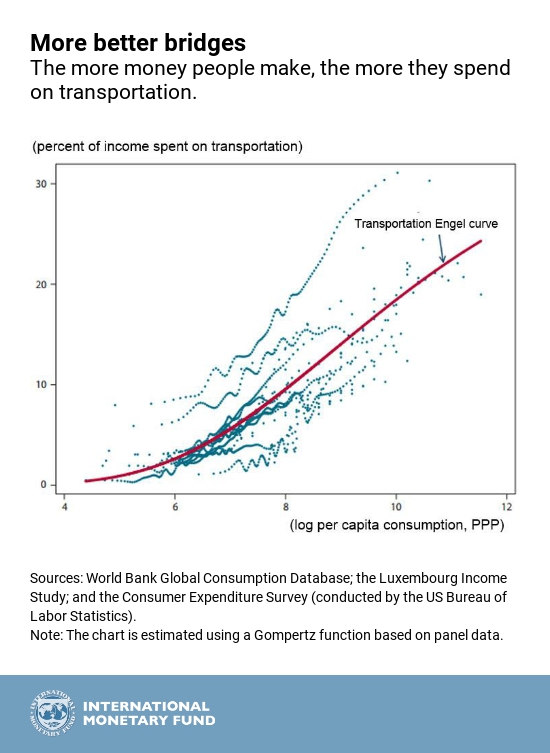
- Evidence from household surveys for 20 advanced and emerging market economies shows a strong and positive relationship between personal income and transportation spending.
- Exact numerical relationship highlighted:
- People making $200 a year devote 1 percent of their income to transportation.
- People making $20,000 a year devote 18 percent of their income to transportation.
Projected changes in incomes and transport demand
- Over the next 20 years:
- The number of people earning between $6,000 and $20,000 worldwide will rise by a little more than a billion, and many of these will purchase their first car.
- The number of people earning more than $20,000 will increase by almost 800 million, and many of these will begin to fly for leisure.
- Regional projections:
- Consumer spending on transportation is projected to quadruple by 2035 in India, China, and other parts of emerging Asia, as well as in sub-Saharan Africa.
- Infrastructure cost estimate:
- Merely building the paved roads and railroads needed to accommodate growing world demand for transportation could cost some $48 trillion over the next 20 years.
- Emerging market and developing economies will need the bulk of that investment.
Financing needs and the role of the private sector
- Public financing options:
- Altering government spending priorities or raising money through taxes could finance some infrastructure investment.
- Private sector imperative:
- The only realistic way to meet the large and growing infrastructure gap in emerging markets is through the private sector, including pension funds and life insurance companies worldwide.
- Conditions to unlock private capital:
- Changes to prudential requirements to allow investors to hold internationally diversified portfolios of infrastructure projects.
- Use of public-private partnerships with multilateral and regional development banks to provide the approval required by these investors.
- Stable regulatory environments free from arbitrary political interference are necessary to attract private investors.
- Fiscal risk and disclosure:
- Calls on government guarantees of public-private partnerships have occasionally imposed budgetary costs equivalent to one or more percentage points of GDP in many countries, including Colombia, Indonesia, and Portugal.
- To reduce these risks, governments will need to monitor and disclose fiscal obligations stemming from projects involving private participation.
- Several countries, including Chile, now regularly monitor and disclose such obligations.
Transparency, governance, and project effectiveness
- Core governance priorities:
- Transparency and an independent media are critical to monitor and report on projects and to allow citizens to pressure policymakers to pursue the public interest.
- Publication of tenders and key contract features, good record-keeping, and quality control during procurement (project evaluation, tendering) and contract performance are essential.
- Anti-corruption and accountability measures:
- These procurement and disclosure practices help ensure financing is put to productive uses and not illicitly siphoned off or directed to low-value-added projects favored by political supporters.
- To deter fraud, governments must offer whistleblowers rewards and protection from retaliation.
- Institutional weaknesses:
- Many emerging economies score poorly on indicators of the quality of the institutional setup for project selection and implementation.
- Corruption afflicts all countries; advanced economies also need to protect infrastructure investment projects from undue private influence and arbitrary political interference.
Environmental and long-term policy choices
- Green construction and modal choices:
- Citizens would benefit from new “green” construction choices.
- Favoring metro-railways and other public transportation over roads in new transportation networks will help reduce carbon emissions for decades.
- Overarching recommendation:
- Infrastructure investment holds enormous promise and potential, but realizing benefits requires policymakers to adopt and safeguard appropriate checks and balances to make sure citizens benefit from the right choices.
Source: Emerging Economy Consumers Drive Infrastructure Needs, Paolo Mauro, May 4, 2017.
Content in this bundle
- 新兴经济体消费者驱动基础设施需求, 作者: Paulo Mauro, 2017年5月4日
- 新興市場国の消費者がインフラニーズの原動力; IMF ブログ 2017年5月4日掲載
- В странах с формирующимся рынком потребители определяют потребности в инфраструктуре