Every Woman Counts: Gender Budgeting in G7 Countries
IMF Blog, May 13, 2017
Source details
- Canonical URL
- Every Woman Counts: Gender Budgeting in G7 Countries
Other formats
Bibliographic details
- Authors: Christine Lagarde
- Published: May 13, 2017
Context and purpose
- Finance ministers and central bank governors from the G7 countries met in Bari, Italy, to consider global economic issues, including steps to maintain economic stability and improving gender equality.
- The IMF prepared a paper, "Gender Budgeting in G7 Countries," as a contribution to the G7 discussion under the Italian Presidency.
- The IMF has incorporated gender-related considerations into policy advice and completed consultations with 22 countries.
Why women’s economic empowerment matters
- Women’s economic empowerment yields broad societal benefits, including boosting GDP growth, helping economies diversify, and tackling income inequality.
- The IMF’s recent programs—with Egypt, Jordan, and Niger—contain specific measures to help empower women economically.
Key findings on gender gaps (G7 and advanced economies)
- Women’s labor market participation rate is about 17 percentage points lower than men’s.
- The wage gap between women and men amounts to roughly 14 percent.
- The share of male managers is almost double that of women.
- Almost 70 percent of unpaid work is performed by women.
Role of budgets and policies
- National budgets can be used more actively to support gender equality.
- Tax policies in advanced economies play an important role in addressing disincentives for secondary earners to work.
- Spending policies (for example, supporting childcare facilities) can facilitate higher female labor force participation.
- Example cited: the Canadian child benefit scheme helps families with the cost of childcare through a tax-free, income-tested benefit.
Current institutional practices in G7 countries
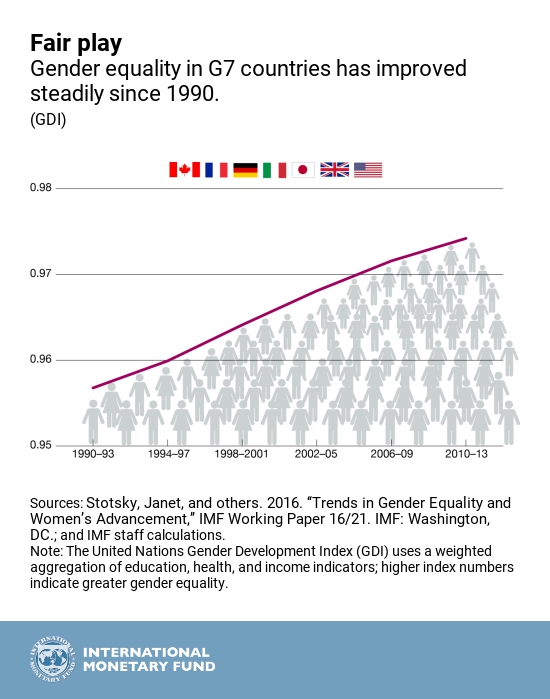
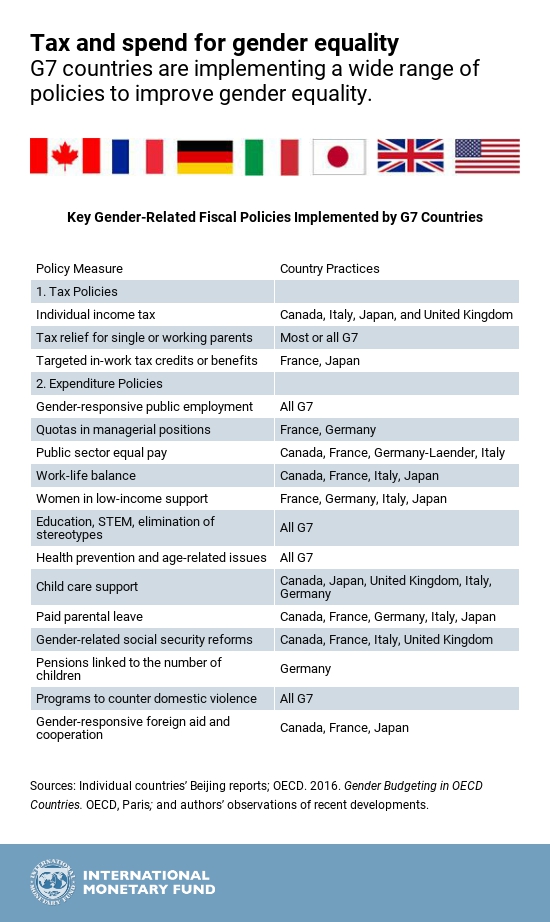
- G7 countries have used a wide range of fiscal and nonfiscal policies to reduce gender inequality, but have generally made less progress in developing broad-based budgetary institutions to mainstream gender policies.
- Only Canada, France, and Japan publish a gender budget statement.
- While most G7 countries undertake a gender impact assessment of new policy proposals, approaches and methodologies vary widely.
Policy recommendations and institutional reforms
- Mainstream gender budgeting:
- Embed gender issues in the annual dialog between ministers on budget priorities and in other budget routines.
- Improve monitoring and accountability:
- Monitor budget execution for its impact in a transparent way.
- Involve legislatures and civil society, and ensure proper auditing to secure accountability.
- Develop long-term gender strategies across the budget process:
- Use budget statements and guidelines to set priorities for gender-related expenditures.
- Ensure adequate medium-term funding for gender-related priorities.
- Assess the gender impact of policies systematically.
IMF role and ongoing work
- The IMF will continue to work on gender budgeting as part of broader efforts to promote inclusive growth.
- The IMF provides technical assistance to over 120 countries.
- Recent representative technical-assistance work includes Cambodia’s financial information systems, the Medium-Term Budget Framework in Ukraine, and the Fiscal Transparency Evaluation in Austria.
- The IMF remains committed to helping women make the most of their economic potential and calls on G7 policymakers to strengthen gender budgeting to promote women’s economic empowerment and global economic stability.
Source: Every Woman Counts: Gender Budgeting in G7 Countries (IMF blog post by Christine Lagarde)
References
- https://www.imf.org/wp-content/uploads/2017/05/BLOG-1099x500-MTEVEREST-JunkoTabei-Japanese-First-Woman-at-Summit_GettyImages-542640090.jpg
- Gender Budgeting in G7 Countries
- https://www.imf.org/wp-content/uploads/2017/05/IMF.MDGender_chart.jpg
- https://www.imf.org/wp-content/uploads/2017/05/IMF.MDGender_table.jpg