How Trade with China Boosts Productivity
IMF Blog, May 24, 2017
Source details
- Canonical URL
- How Trade with China Boosts Productivity
Other formats
Bibliographic details
- Authors: JaeBin Ahn, Romain Duval
- Published: May 24, 2017
Key findings on productivity effects
- Productivity growth has been faster in countries and industries that have been more exposed to China’s opening to trade, all else equal.
- As much as 12 percent of the increase in productivity over the 12 years from 1995 through 2007 can be attributed to China’s integration into world trade.
- For the typical sector in advanced economies, exports and imports with China may have accounted for about 1.9 percent out of the total 15.6 percent rise in total factor productivity in the period 1995 to 2007.
- Exposure to Chinese imports and access to China’s market each contributed about half of this gain.
- Trade improves productivity through three channels:
- Imports: greater competitive pressure and access to more and better inputs.
- Exports: learning from overseas customers and exposure to competition from foreign producers.
- Reallocation: resources shifting toward the most productive firms, alongside within-firm productivity gains.
Employment and distributional effects
- The productivity gains from trade with China have been accompanied by net job losses.
- Job losses in advanced economies resulting from rising imports from China more than offset gains from growing exports to China.
- Net job losses of about 0.8 percent of total employment for the typical sector over the period 1995–2007 were estimated.
Scope and data
- The research quantifies all three productivity channels simultaneously using data on productivity and employment as well as exports (by destination country) and imports (by source country).
- Data covered 18 manufacturing and non-manufacturing sectors across 18 advanced countries.
- The sectors studied were in broad categories such as textiles, and transportation equipment.
Dynamics of trade with China
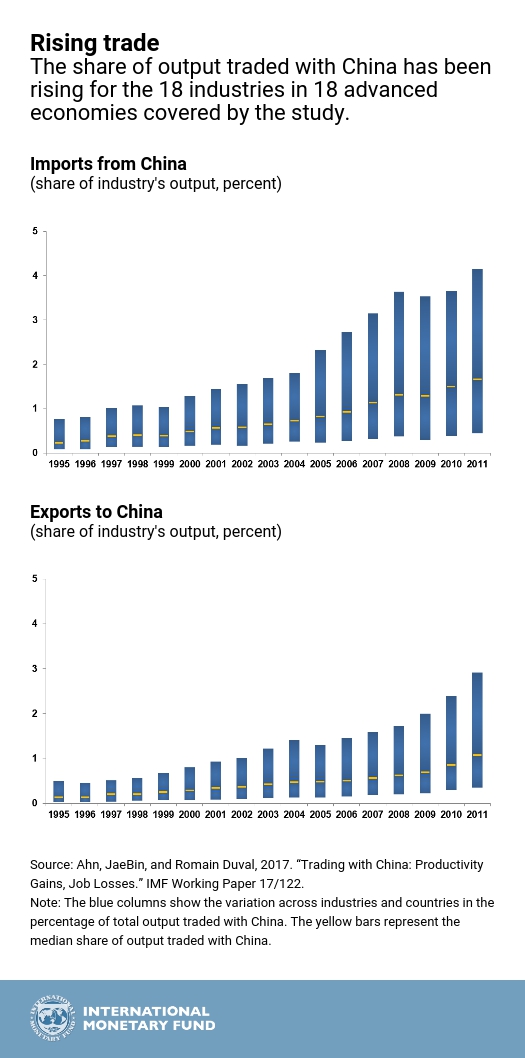
- Trade with China grew steadily between the mid-1990s and the mid-2000s, then declined as a result of the global financial crisis, and has recovered only slowly since then, particularly on the import side.
- Today, China’s trade with advanced economies is cooling as it becomes more fully integrated into the global economy; as a result, the productivity gains advanced economies are reaping from trade with China are waning—and so are those reaped by Chinese firms.
Methodological approach to identify causality
- The study addresses potential reverse causality in two steps:
- First, isolate the part of rising trade with China driven by China’s opening-up to trade rather than by demand from advanced economies (for example, widespread penetration of Chinese textile exports across advanced markets suggests shifts driven by China’s competitiveness rather than Italian demand).
- Second, estimate the impact of that liberalization-driven integration of China into world trade on productivity in advanced economies’ industries.
- Using this approach, both exports to and imports from China were found to increase sectoral productivity in advanced economies.
Policy implications and recommendations
- Advanced economies should keep opening up trade to help revive dismal productivity growth—the key source of progress in living standards.
- Policymakers should act more forcefully to address associated labor market dislocations by easing the transition of displaced workers to new jobs and industries.
- Recommended measures include carefully-designed active labor market policies:
- Retraining programs.
- Job search assistance.
- Relocation support.
- Lifelong learning programs to strengthen workers’ adaptability to changing labor market needs—whether driven by trade, technological change, or other factors.
- Cutting remaining trade barriers in both advanced economies and emerging markets—including China—would provide a boost to firm-level productivity in both country income groups.
- New trade restrictions would risk a partial reversal of the productivity gains achieved so far.
Source: How Trade with China Boosts Productivity, JaeBin Ahn and Romain Duval, May 24, 2017.
Content in this bundle
- 与中国的贸易如何起到提高生产率的作用; IMF博客
- 対中貿易がいかに生産性を向上させるか; ジェビン・アン、ロメイン・デュバル IMFブログ, 2017年5月24日掲載
- Каждая женщина на счету: составление бюджетов в странах Группы семи с учетом гендерных факторов
- Как торговля с Китаемспособствует роступроизводительности