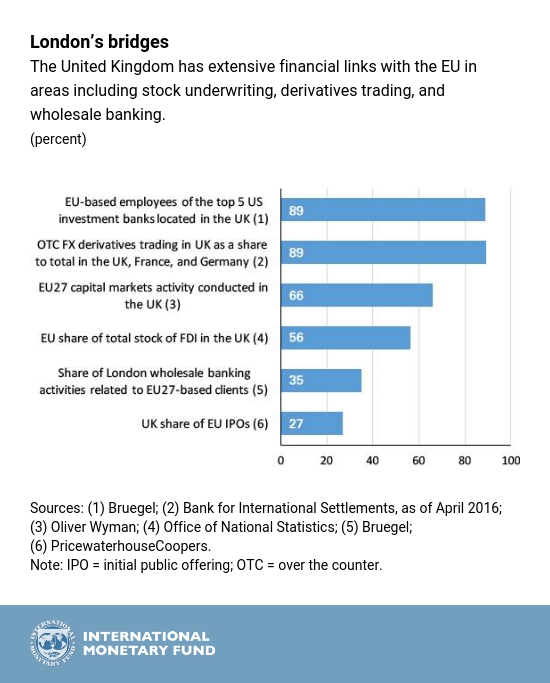
Chart of the Week: Brexit and The City
IMF Blog, May 29, 2017
Source details
- Canonical URL
- Chart of the Week: Brexit and The City
Other formats
Bibliographic details
- Authors: The Editors
- Published: May 29, 2017
Overview
- Publication: drawn from the IMF’s latest Global Financial Stability Report.
- Date and author line as on the page: The Editors, May 29, 2017.
- Central point: Brexit is likely to alter the relationship that UK-based financial firms have with the European Union, with negotiations only just beginning.
Key linkages and statistics
- Of the over-the-counter trading in foreign exchange derivatives in the United Kingdom, Germany and France, the UK share comes to 89 percent.
Passports and market access
- Currently, financial firms based in Britain have “passports” allowing them to do business in any of the other EU countries on the same terms as firms based in any of those countries.
- This passporting regime is a key reason why the UK is an attractive headquarters for international firms doing business in the EU.
- Risk: these “passports” might lapse when Britain withdraws from the EU, requiring negotiation of alternative arrangements for EU access.
Equivalency agreements and uncertainty
- One alternative frequently discussed is equivalency agreements applicable to different lines of business, such as insurance, asset management and banking.
- There remains large uncertainty about the feasibility and advantages of such agreements in the new post-Brexit context.
Transition risks, operational impacts, and firm responses
- The transition to a post-Brexit world needs to be carefully managed to minimize disruption in market services and activities, and to maintain sound and effective supervision of financial activities.
- Operating costs may increase during the transition as banks may have to duplicate operations and relocate staff.
- Many banks have begun to draw contingency plans and explore various relocation alternatives.
- Some institutions may opt to exit or scale back specific business lines.
Source: IMF blog page "Chart of the Week: Brexit and The City" (The Editors, May 29, 2017).