Migration and Remittances in Latin America and the Caribbean: Brain Drain Versus Economic Stabilization
IMF Blog, June 29, 2017
Source details
- Canonical URL
- Migration and Remittances in Latin America and the Caribbean: Brain Drain Versus Economic Stabilization
Other formats
Bibliographic details
- Authors: Svetlana Cerovic, Kimberly Beaton
- Published: June 29, 2017
Patterns of migration and remittances
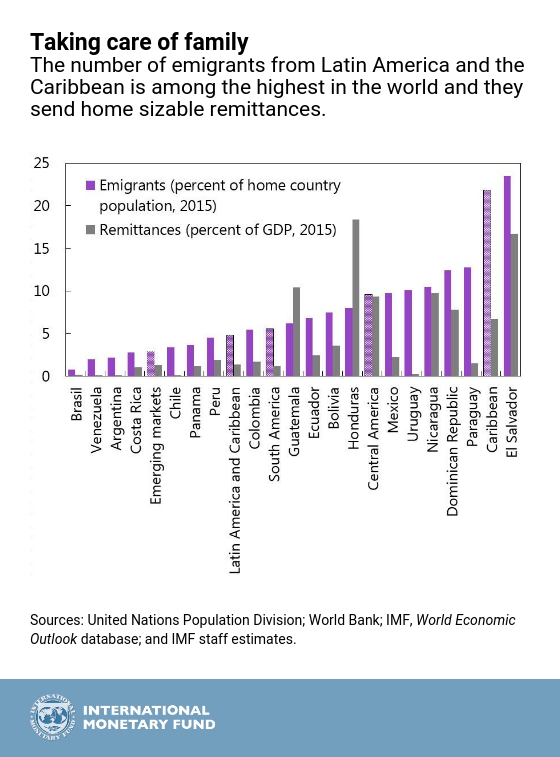
- Outward migration has been an important phenomenon for the Caribbean; Central America, Panama, and the Dominican Republic; and Mexico.
- In these countries, emigrants account for close to 10 percent of the population—compared with about 2 percent, on average, worldwide for emerging market and developing economies.
- Emigrants send substantial sums of money, averaging about 6 percent of GDP, to support family members back home.
- Some South American countries such as Paraguay and Uruguay have sizable emigrant populations, but remittance receipts in these countries are dwarfed by those to Central American and Caribbean neighbors.
- The United States is by far the most important destination for Latin American and Caribbean migrants, with about two thirds of them living and working in the United States.
- High dependence on a single destination country makes migrant remittances susceptible to economic ups and downs and immigration policy changes in the United States.
Who are these emigrants?
- Emigrants from Mexico and Central America:
- Tend to be younger (on average, about 20 years old).
- Have lower levels of education compared with those from South America and the Caribbean.
- Tend to work in lower-skilled occupations and have lower wages.
- Send a higher share of their income back to their families.
- Emigrants from South America and the Caribbean:
- About 40 percent have attended college (or beyond).
- A higher share are skilled workers (such as doctors, nurses, or engineers).
- The Caribbean in particular has been suffering from “brain drain” due to a high share of skilled workers leaving their home countries.
Effects on growth
- Departure of people of working age reduces the labor force and weakens growth in the home country; this effect is likely to be strongest where brain drain is significant.
- Remittances bring benefits to families and provide financial resources for trade and investment.
- Net effects depend on the profile of migrants and the amount of money they send home:
- For countries with highly skilled emigrants (Caribbean countries and, to a lesser extent, South American countries), the negative impact on growth from emigration is not fully compensated by remittances.
- For Central American countries, the negative effects of emigration seem to be broadly (or more than) offset by gains from their higher remittance receipts.
Remittances as a source of stability
- Remittances are an important source of income and can support consumption when the domestic economy is not doing well.
- Emigrants tend to send more money home following natural disasters, particularly to the Caribbean—the region most exposed to large natural disasters.
- Remittances can support financial stability by strengthening borrowers’ capacity to repay their loans.
- Remittances help generate revenues for the government, which taxes the spending from remittances.
- In the Mexican case, migration and remittances can help reduce both poverty and inequality, as remittances go mostly to lower-income households.
Policy recommendations — tilting the balance in a favorable direction
- Reduce outward migration while supporting remittances and encouraging productive usage by recipient families.
- Structural policies to make it more attractive for people to stay and for emigrants to return:
- Recognize professional qualifications earned abroad.
- Reforms to limit brain drain, for example, by developing a medical tourism industry.
- Policies to boost labor supply, in particular by raising women’s participation in the labor force, to offset adverse impacts of emigration on productivity.
- Support development of formal financial channels for migrants to send money home and reduce the costs of sending money, including through new solutions like mobile money.
- Improve the security situation in many Central American and Caribbean countries to relieve bottlenecks to productive use of remittances and encourage greater use for investment in small businesses.
- For countries highly dependent on remittance inflows, ensure adequate financial buffers—such as central bank reserves—to compensate for a potential loss in remittances associated with negative economic shocks or shifts in immigration policy in host countries.
Source: Migration and Remittances in Latin America and the Caribbean: Brain Drain Versus Economic Stabilization (Svetlana Cerovic, Kimberly Beaton, June 29, 2017).