Global Imbalances: Avoiding a Tragedy of the Commons
IMF Blog, July 28, 2017
Source details
- Canonical URL
- Global Imbalances: Avoiding a Tragedy of the Commons
Other formats
Bibliographic details
- Authors: Gustavo Adler, Luis Cubeddu
- Published: July 28, 2017
Overview
- Authors: Gustavo Adler, Luis Cubeddu
- Date: July 28, 2017
- The IMF released assessments of external positions for the 29 largest economies.
- Excess current account imbalances in 2016 were broadly unchanged and "represented about one-third of total actual surpluses and deficits, with only small shifts in 2016."
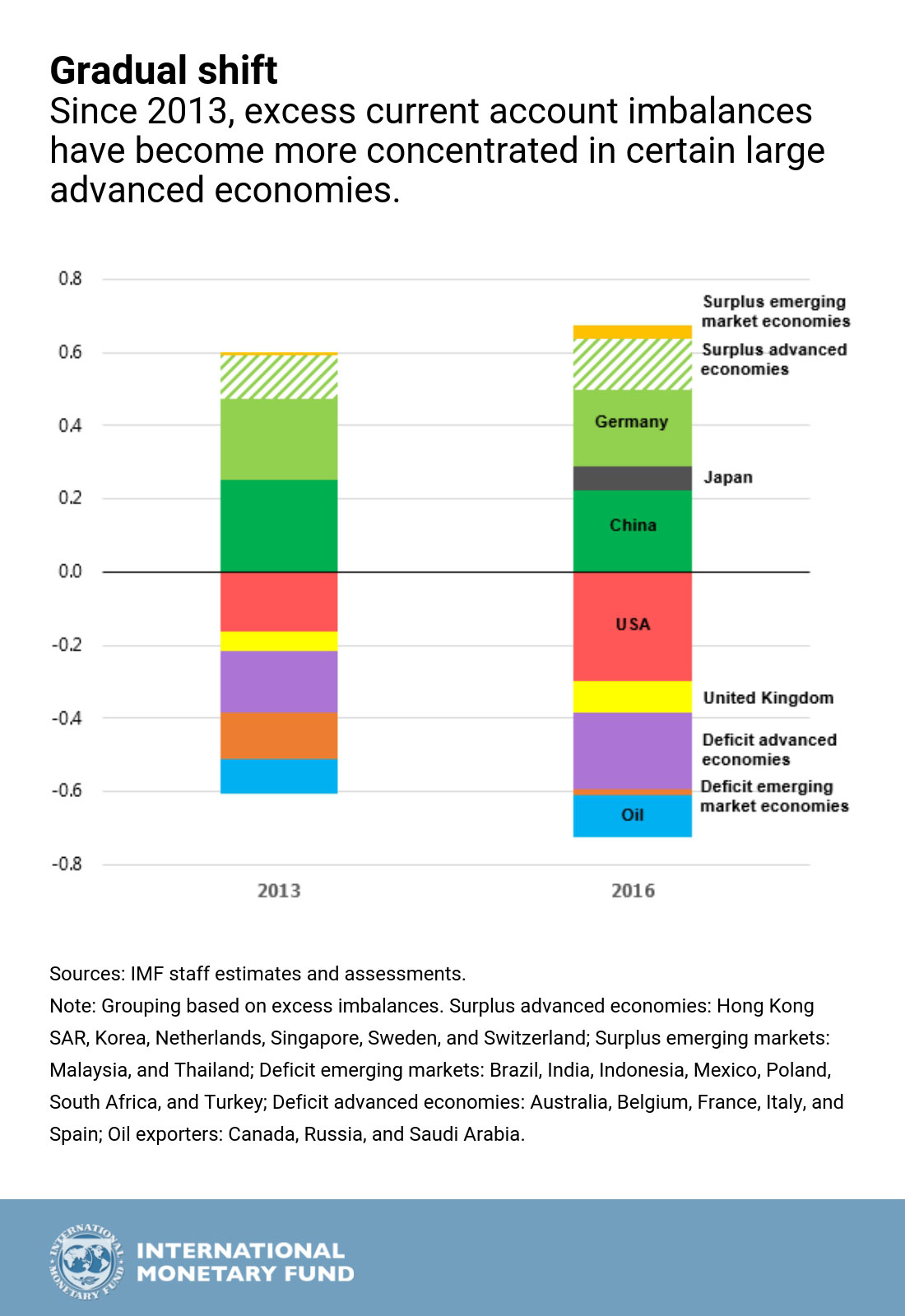
- Since 2013 there has been a rotation of excess imbalances toward advanced economies.
Key findings
- Excess imbalances:
- Were broadly unchanged in 2016.
- Represented about one-third of total actual surpluses and deficits.
- Have rotated since 2013 toward advanced economies, creating new risks and policy challenges.
- Emerging market developments:
- Excess imbalances narrowed in key emerging market economies.
- Narrowing was led by a smaller excess surplus in China and smaller excess deficits in Brazil, Indonesia, South Africa, and Turkey.
- Adjustment in these emerging markets was supported as prospects of U.S. monetary policy normalization became more evident and external financing conditions tightened.
- Advanced economy developments:
- Excess imbalances widened in several advanced economies.
- Large and persistent excess surpluses continued in Germany, Korea, the Netherlands, Singapore, and Sweden.
- Historical analysis indicates these large and persistent surpluses (outside oil-exporting countries and financial centers) are a fairly recent phenomenon; when reversals occurred, policy actions on multiple fronts played a role.
- Risks from current constellation:
- Weak automatic adjustment mechanisms: prices and saving and investment decisions are not adjusting fast enough.
- Rigid currency arrangements and structural features (for example, inadequate social safety nets and barriers to investment) contribute to undesirable saving and investment levels.
- Concentration of excess deficits in a few advanced economies (mainly the United States and United Kingdom) could:
- Reduce deficit-financing risks in the near term.
- Raise the likelihood of protectionist measures.
- Risk derailing the global recovery if continued reliance on debtor-country demand persists, increasing the chances of a disruptive adjustment later.
Policy implications and recommendations
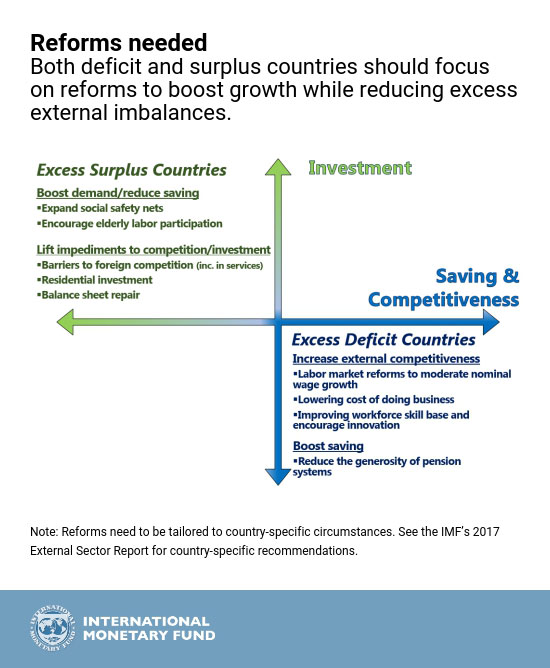
- Shared responsibility: Addressing external imbalances in a way that supports global growth requires recalibration of the policy mix in both deficit and surplus economies.
- For excess deficit countries:
- Move forward with fiscal consolidation.
- Gradually normalize monetary policy in tandem with inflation developments.
- Implement policies directed at improving external competitiveness and overall saving.
- Emphasize reforms that boost education outcomes and strengthen the business climate.
- For excess surplus countries:
- If there is fiscal space, reduce reliance on easy monetary policy and allow for greater fiscal stimulus.
- Focus structural policies on lifting distortions that constrain domestic demand or limit trade competition and investment.
- For countries where monetary policy is constrained (for example, individual euro area members):
- Use fiscal and structural policies to facilitate relative price adjustments.
- Exchange rate policy:
- Allow exchange rates to move in line with fundamental levels.
- Limit interventions to addressing disorderly market conditions (consistent with recent practice for most countries).
- Structural policy emphasis:
- Excess surplus countries: lift distortions that constrain domestic demand or limit trade competition.
- Excess deficit countries: improve external competitiveness and overall saving, with emphasis on education and the business climate.
- Protectionism:
- Protectionist policies should be avoided because they are unlikely to meaningfully address external imbalances and would be detrimental to domestic and global growth.
Purpose and mandate
- Assessing countries’ external positions is a core IMF mandate.
- These assessments are an analytical tool to determine, on a multilaterally-consistent basis, when external imbalances are appropriate or signal risks.
- Imbalances can be appropriate: developing economies that need to invest should generally run deficits; aging countries (for example, Japan and Germany) may need to run surpluses to meet future obligations.
- The focus of the exercise is identifying the undesirable portion of imbalances and discussing policies to address them.
- Goal: avoid a tragedy of the commons in which countries acting independently in their own self-interest undermine the common good of supporting global growth and stability.
IMF Blog — "Global Imbalances: Avoiding a Tragedy of the Commons", Gustavo Adler and Luis Cubeddu, July 28, 2017.
References
- https://www.imf.org/wp-content/uploads/2017/07/BLOG-1024x600-GERMANY-ESR-cranes-over-trailors-Caro-Oberhaeuser-Newscom-carophotos138589.jpg
- External Sector Report
- https://www.imf.org/wp-content/uploads/2017/07/ENG_Jul_27_ESR_1-4-002.jpg
- https://www.imf.org/wp-content/uploads/2017/07/ENG_Jul_27_ESR_2-6-002.jpg
- assessments are an analytical tool