More Action Needed on European Bank Profitability
IMF Blog, August 30, 2017
Source details
- Canonical URL
- More Action Needed on European Bank Profitability
Other formats
Bibliographic details
- Authors: John Caparusso, Rohit Goel, Will Kerry
- Published: August 30, 2017
Key findings on profitability and risks
- European banking has made considerable progress: banks have built up capital, regulation is stronger and supervision has been enhanced.
- Profitability remains weak, posing risks for financial stability.
- In a sample of more than 170 large European lenders with combined assets of $35 trillion:
- roughly half generated a weak return on equity in 2016,
- banks representing only 15 percent of assets generated a healthy return on equity, defined as more than 10 percent.
- Weak profitability is also shown in a low return on assets for domestic banks in many European countries.
- Drivers of weak returns reflect varying combinations of low income, high costs, or provisions needed to build buffers against non-performing assets.
- Almost three-quarters of these banks in our sample, by assets, had weak returns on equity in 2016, compared with less than 40 percent for internationally focused peers.
Impact on financial stability
- The economic upturn in Europe should boost profitability as interest rates rise, loan-loss provisions fall, and lending opportunities increase.
- The October 2016 Global Financial Stability Report found that a cyclical recovery is unlikely to be enough to fully restore bank profitability.
- Why low profitability is a threat:
- Consistently unprofitable banks are unable to build up reserves against unexpected losses and often find it difficult to raise capital in times of need.
- Weak returns limit banks’ ability to expand lending.
- Weak returns may induce banks to drive up returns by taking greater risks.
Structural challenges and over-banking
- Profitability problems reflect both weak business models and structural features of banking systems.
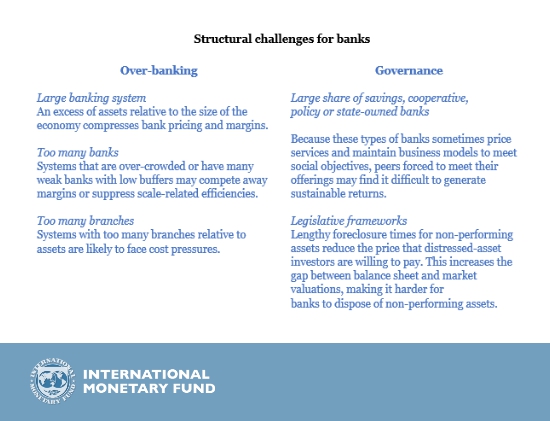
- The IMF’s April 2017 Global Financial Stability Report discusses structural challenges, including over-banking.
- Over-banking (no common definition) refers here to a set of structural factors that affects profitability across the system; causes vary by country and no single aspect explains profitability concerns across countries.
- Other structural challenges:
- A large proportion of savings, cooperative, policy banks (such as development banks), and state-owned institutions can reduce the profitability of other banks in the system.
- Problems in resolving non-performing loans (for example, lengthy foreclosure times) delay disposal of non-performing assets and act as a drag on profitability.
Examples of reforms and consolidation
- Country actions noted:
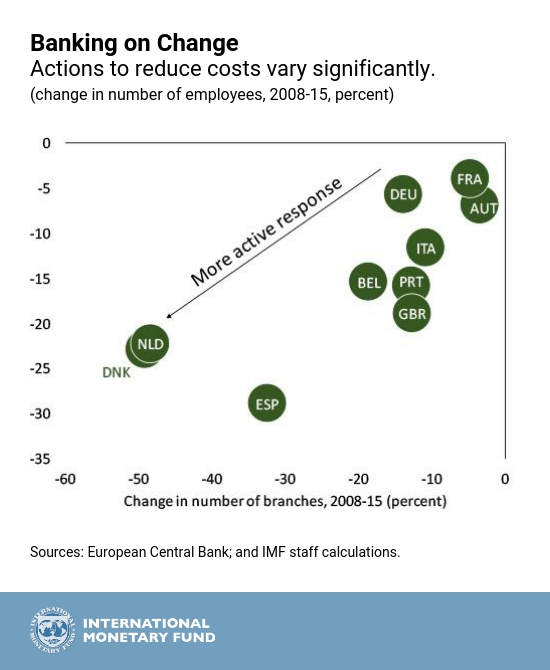
- Denmark, the Netherlands and Spain: banks have sharply cut branches.
- Spain: substantial consolidation in 2009-12, accompanied by reforms to strengthen governance.
- Italy: banks have merged, and governance reforms for cooperative banks have been legislated.
- Germany: some banks have merged.
- Measures have been taken in some countries to amend legal frameworks and help banks address the burden of non-performing loans.
- More progress is needed in banking systems with the biggest challenges.
Policy recommendations and supervisory roles
- Individual banks:
- Continue restructuring businesses for higher returns.
- Invest in technology to increase efficiency.
- Supervisors:
- Assess business-model sustainability and ensure banks do not respond to profitability pressures by taking excessive risks.
- Ensure banks adopt ambitious, time-bound strategies for the disposal of bad assets.
- Authorities in over-banked systems:
- Encourage consolidation among small and medium-sized banks, combined with governance reforms where needed.
- Consolidation can mean small or mid-sized banks combine forces to become stronger, not just making large banks bigger.
- In systems with significant asset quality challenges:
- Consider targeted asset quality reviews for banks that have not undergone such an exercise.
- Regulators should resolve unviable institutions to remove excess capacity from banking systems.
- Cross-border and legal framework actions:
- Further harmonizing national supervisory practices and legal frameworks across countries should enhance banks’ effectiveness.
- Measures are needed to fully resolve the burden of non-performing assets.
- Completing the regulatory reform agenda is vital to ensure weaknesses are addressed and uncertainty is reduced.
Overall assessment
- Banks’ efforts to adapt business models to changing regulatory and market challenges are necessary but may not be sufficient.
- Policy actions to improve system structures can foster conditions for banks to generate sufficient profitability with acceptable risk, making them both safer and better able to support the economy.
Source: More Action Needed on European Bank Profitability, John Caparusso, Rohit Goel, Will Kerry, August 30, 2017.
Content in this bundle
- Für die Ertragsstärke der europäischen Banken muss mehr getan werden
References
- https://www.imf.org/wp-content/uploads/2017/08/BLOG-1024x600-European-banking-Martin-Moxter-imageBROKER-Newscom.jpg
- Global Financial Stability Report
- https://www.imf.org/wp-content/uploads/2017/08/CHART-1.jpg
- Global Financial Stability Report
- https://www.imf.org/wp-content/uploads/2017/08/Structural-Challenges-CHART-Table.jpg
- structural issues
- https://www.imf.org/wp-content/uploads/2017/08/Chart-2-banking-on-change.jpg