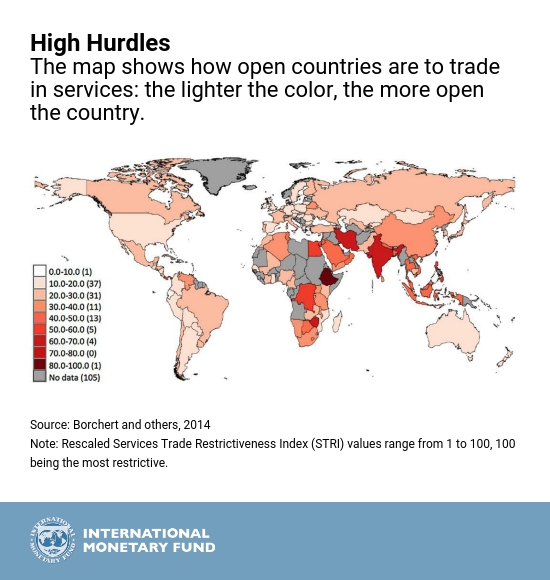
Chart of the Week: High Hurdles for Trade in Services
IMF Blog, September 25, 2017
Source details
- Canonical URL
- Chart of the Week: High Hurdles for Trade in Services
Other formats
Bibliographic details
- Authors: The Editors
- Published: September 25, 2017
Services sector size and employment
- The service sector accounts for some two-thirds of economic activity.
- The service sector accounts for roughly the same share of jobs around the world.
- In Sweden, 62 % of jobs in the country are in the services sector.
Barriers to trade in services
- Barriers take the form of policies that restrict a country’s suppliers, both firms and professionals, from selling their services to others.
- Restrictions on cross-border trade in services and on the entry, ownership, and operations of foreign service providers are common.
- The IMF, World Trade Organization and World Bank paper underpinning this Chart of the Week provides a global picture of countries’ relative openness to trade in services.
Cross-country openness (map highlights)
- The lighter the shaded country on the referenced map, the more open it is to trade in services.
- Examples given: the United States, Argentina, and Australia are among the most open.
- Examples given: India and Iran are among the least open.
- Examples given: China, Russia, Brazil and Canada fall somewhere in between.
Trade share and value-added perspective
- Trade in services is about a quarter of total global trade.
- When estimates take into account engineering, financial, transport, and other services that go into producing manufactured goods that are later exported, services already account for half of global trade (measured on a value-added basis—“value-added trade”).
Employment links to trade
- In Sweden, 29 percent of workers owe their jobs, directly or indirectly, to exports; most of them—62 percent—work in the service sector.
Productivity and manufacturing effects
- New research finds that full services trade liberalization could boost manufacturing productivity by over 20 percent.
- International competition and efficient service sectors are vital to a competitive manufacturing sector.
Policy implications and recommendations
- Opening trade in services between countries matters for policymakers because trade has been a strong engine of growth—raising global living standards, reducing poverty and creating millions of new jobs.
- Countries can do more to increase growth and productivity; more open and connected global trade in services is one way to help accomplish that goal.
Source: Chart of the Week: High Hurdles for Trade in Services, The Editors, September 25, 2017.