The Unequal Burden of Rising Temperatures: How Can Low-Income Countries Cope?
IMF Blog, September 27, 2017
Source details
- Canonical URL
- The Unequal Burden of Rising Temperatures: How Can Low-Income Countries Cope?
Other formats
Bibliographic details
- Authors: Sebastian Acevedo, Mico Mrkaic, Evgenia Pugacheva, Petia Topalova
- Published: September 27, 2017
Warming at an unprecedented rate
- Over the past four decades, the global average surface temperature has increased at a pace that is unprecedented in the past 20,000 years.
- Temperatures are set to rise further, at a scale very much dependent on our ability to restrain greenhouse gas emissions, the key human driver of global warming.
- Extreme weather events, such as heat waves, droughts, and floods, are likely to become more frequent, and sea levels will rise.
Hurting the poorest the most — empirical findings
- Analysis covers historical patterns across 180 countries over the past 65 years and reveals a non-linear relationship between temperature and growth, confirming previous findings by Burke, Hsiang, and Miguel (2015) in an expanded database.
- This relationship implies that in countries with a relatively hot climate, a rise in temperature lowers per capita output in a long-lasting manner.
- Key quantitative estimates:
- A 1°C increase in temperature in a country with an average annual temperature of 25°C would reduce per capita output by up to 1.5 percent, a loss that persists for at least 7 years.
- If no global efforts are made to curb emissions, the resulting projected increase in temperature would erase close to one-tenth of the per capita output of the median low-income country by the end of the 21st century, relative to a scenario of unchanged temperature.
- Channels through which higher temperatures hurt economic activity in hot countries:
- Lower agricultural output.
- Reduced productivity of workers exposed to heat.
- Slower investment.
- Damaged health.
- Population exposure:
- Close to 60 percent of the world’s population currently resides in countries where an increase in temperature would likely lead to such pernicious effects.
- By the end of the 21st century, this number is projected to rise to more than ¾ of the global population.
Domestic solutions can help — but only to some extent
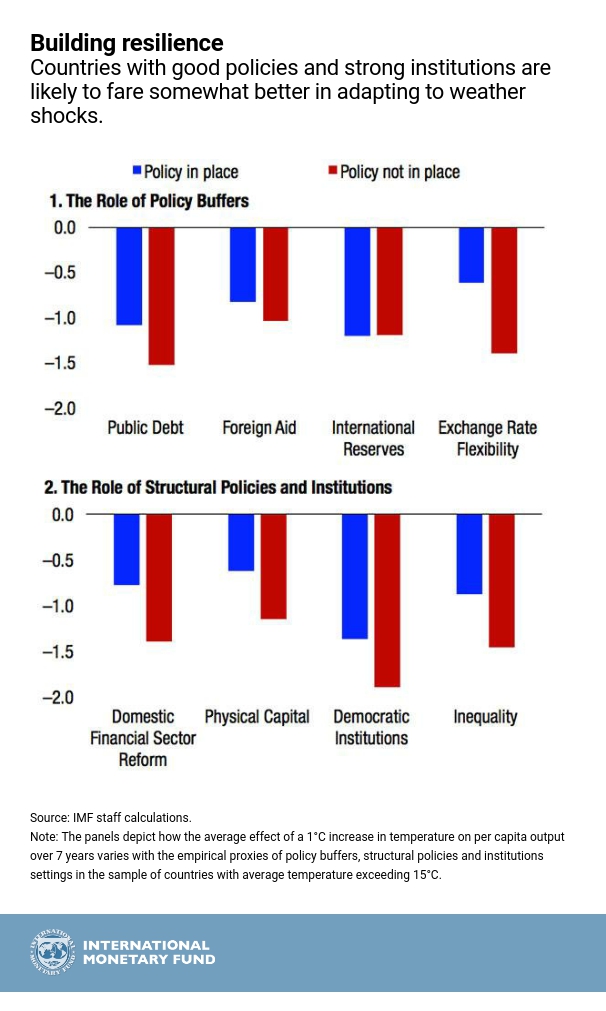
- Sound domestic policies, institutions, and development can partially curb the damage from weather shocks.
- Empirical suggestions (causal interpretation is difficult):
- Countries with policy buffers—such as lower public debt and flexible exchange rates—tend to experience somewhat smaller output losses from temperature shocks in the short run.
- Countries with settings that ease movement of labor and capital across sectors and regions, and that foster development—such as better access to finance, high-quality infrastructure, and stronger institutions—tend to recover somewhat faster from temperature shocks.
- Examples of adaptation strategies:
- Ethiopia’s Productive Safety Net Program combines well-targeted support to affected households with environmental and infrastructure projects and programs to diversify income sources.
- Adoption of appropriate technology, such as air conditioning, can limit productivity and health consequences from rising temperature.
- Investment in climate-smart infrastructure, such as the dual-purpose “smart” tunnel in Kuala Lumpur, Malaysia, can enhance resilience to various weather risks.
Needed: A global solution — policy recommendations and rationale
- Many low-income countries face huge spending needs and limited resources; making the required investments to cope will be challenging.
- Domestic policies alone cannot fully insulate vulnerable countries from climate change consequences, which may push biophysical limits of ecosystems, trigger more frequent natural disasters, and fuel migration pressures and conflict risk.
- Cross-border spillovers from climate impacts could be very sizable; advanced economies will not be immune.
- The international community must play a key role in supporting low-income countries’ efforts to cope with climate change.
- Advanced and emerging market economies have contributed the lion’s share to actual and projected warming.
- Helping low-income countries cope is both a moral duty and sound global economic policy that helps offset countries’ failures to fully internalize the costs of greenhouse gas emissions.
- Only a global effort to contain carbon emissions to levels consistent with much lower increases in temperature than are now projected can limit the long-term risks; climate change threatens all countries.
Source: IMF blog post “The Unequal Burden of Rising Temperatures: How Can Low-Income Countries Cope?” by Sebastian Acevedo, Mico Mrkaic, Evgenia Pugacheva, Petia Topalova, September 27, 2017.
Content in this bundle
- 持续升温造成的负担不均:低收入国家如何应对?IMF博客; 2017年9月27日
- 地球温暖化の不公平な重荷 ― 低所得国が取れる対策は何か
- 092717r
References
- عربي
- https://www.imf.org/wp-content/uploads/2017/09/BLOG-1024x600-Global-warming-blog-leolintang-iStock-gettyImages.jpg
- October 2017 World Economic Outlook
- https://www.imf.org/wp-content/uploads/2017/09/ENG_WEO_ch3_map.jpg
- https://www.imf.org/wp-content/uploads/2017/09/ENG_WEO_ch3_chart2.jpg
- https://www.imf.org/wp-content/uploads/2017/09/ENG_WEO_ch3_chart3.jpg