Corruption in Latin America: A Way Forward
IMF Blog, September 28, 2017
Source details
- Canonical URL
- Corruption in Latin America: A Way Forward
Other formats
Bibliographic details
- Authors: David Lipton, Alejandro Werner, S Pelin Berkmen
- Published: September 28, 2017
Overview
- Despite recent progress, corruption in Latin America remains high.
- Lasting solutions require sustained action on many fronts to create a major shift in societal expectations and to push countries out of the corruption trap.
- Improving institutions and lowering corruption go hand in hand; progress on paper (a better legal framework) does not translate into results on the ground without stronger enforcement.
Renewed priority
- Latin America has been an international front runner in adopting an anti-corruption convention by the Organization of American States.
- Many countries in the region have either upgraded or are in the process of upgrading their legal and judicial frameworks (for example, Argentina, Brazil, Chile, Ecuador, Guatemala, Mexico, Paraguay, and Peru).
- Several countries have introduced and enhanced asset declaration requirements, although their coverage and public access vary from country to country.
- Several countries are taking measures to enhance fiscal transparency, including with IMF support.
- Concrete results are already palpable:
- Brazil’s Operation Car Wash reflects a more efficient judiciary, independent and adequately resourced prosecutors, and decisive support from the media and society.
- Guatemala’s International Commission Against Impunity unveiled cases of tax evasion, money laundering, and illegal funding.
- Peru and the Dominican Republic have forcefully pursued allegations against former high-level officials associated with the Odebrecht scandal.
- What these changes imply for progress “on the ground” will depend heavily on enforcing upgraded legal frameworks.
Learning from others
- Combatting entrenched corruption requires ending a corruption trap where the existing structure of incentives are self-perpetuating.
- Breaking this inefficient equilibrium requires solving a collective action problem (putting up a fight against vested interests) and overcoming formidable political economy hurdles.
- International experience suggests effective anti-corruption strategies require:
- strong legal frameworks,
- intensity of enforcement and clean-up,
- perseverance,
- strong national ownership and leadership to sustain broad public support over a long fight.
- Key elements of a multifaceted strategy include measures described below.
Role of task forces
- Opposition from well-organized vested interests and complicit public officials or political parties may necessitate independent special task forces.
- Examples: Guatemala and more recently Ecuador have used task forces to pursue anti-corruption investigations.
Raising transparency and accountability
- Greater transparency increases the chances of detection for a given level of law enforcement.
- Traditional measures include:
- freedom of information laws,
- income and asset declarations,
- random audits,
- strengthening public management and fiscal transparency, especially in resource rich economies,
- improving governance of state-owned enterprises.
- Additional measures to push transparency and accountability boundaries:
- Collect beneficial ownership information for firms and make it available through centralized corporate registries to end corporate secrecy.
- Public and private entities involved in public procurement and investment could create internal anti-corruption committees reporting directly to the Board, Comptroller, or Auditor General to foster partnerships between internal stakeholders and external auditors.
- Address conflicts of interest by suspending business activities of elected officials where suspension is not currently required.
- Federal governments can provide incentives for sub-national units to implement transparency best practices.
- The IMF is focusing on promoting fiscal transparency.
Strengthening public procurement and investment processes
- Ongoing corruption probes highlight loopholes in public procurement, state-owned enterprises, and public-private partnerships, even under otherwise sound legal frameworks.
- Measures to close fiscal loopholes and establish a Transparency Framework could include:
- stronger contractual frameworks and implementation,
- eliminating ad hoc exceptions,
- possibly ruling out contract renegotiations in the short term,
- ensuring competitive auctions,
- mandatory bidding for any additional public spending needs,
- providing full information on awarded contracts and modifications,
- tracking procurement spending,
- developing policies to minimize rent-seeking corrupt practices in land tenure and zoning.
Eliminating unnecessary rules
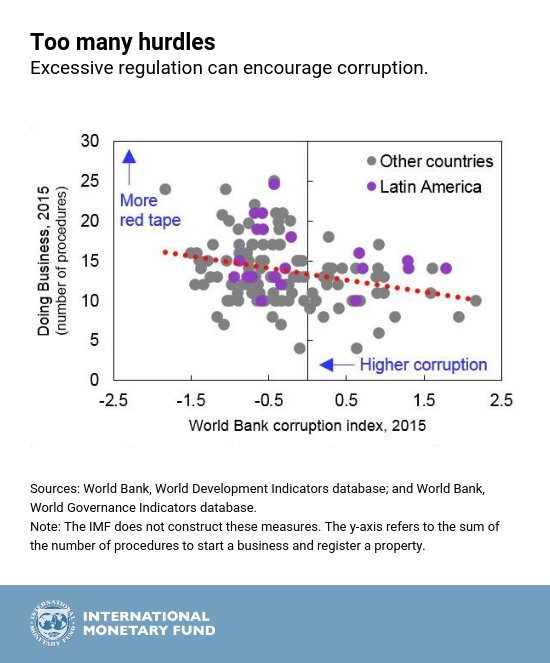
- Excessive regulation creates artificial sources of revenues (for instance, rationed import licenses) that provide fertile ground for corrupt behavior.
- Enhancing competition and lowering red tape are key ingredients to fighting corruption (example: Ukraine).
Dealing with the short run costs
- Uncovering corruption can create short-term uncertainty that hinders public sector decision making and may forestall investment.
- Measures to curtail transition costs and support reform include:
- improving judicial frameworks to avoid lengthy legal procedures,
- a clear framework to handle leniency agreements and plea bargaining,
- a flexible and efficient bankruptcy law—ensuring that assets remain operational,
- carefully designed lending facilities to soften a credit crunch during periods of heightened uncertainty.
A way forward
- Breaking corruption requires standing up against powerful vested interests—both private and government—who benefit from the status quo.
- A big push on multiple fronts could overcome many hurdles, though there is no fixed formula and learning by doing will be important.
- The IMF, through legal and financial experts, will continue to provide advice to the region on ways to combat corruption and contribute to international cooperation.
- Recent popular pressures have opened a rare window of opportunity in Latin America to maintain reform momentum; measures are also needed to tackle transition costs toward achieving a more just society and stronger economy for all.
Source: Corruption in Latin America: A Way Forward (IMF blog), September 28, 2017.
Content in this bundle
- Corrupção na América Latina: um caminho para o futuro