Global Economic Upswing Creates a Window of Opportunity
IMF Blog, October 10, 2017
Source details
- Canonical URL
- Global Economic Upswing Creates a Window of Opportunity
Other formats
Bibliographic details
- Authors: Maurice Obstfeld
- Published: October 10, 2017
Overview
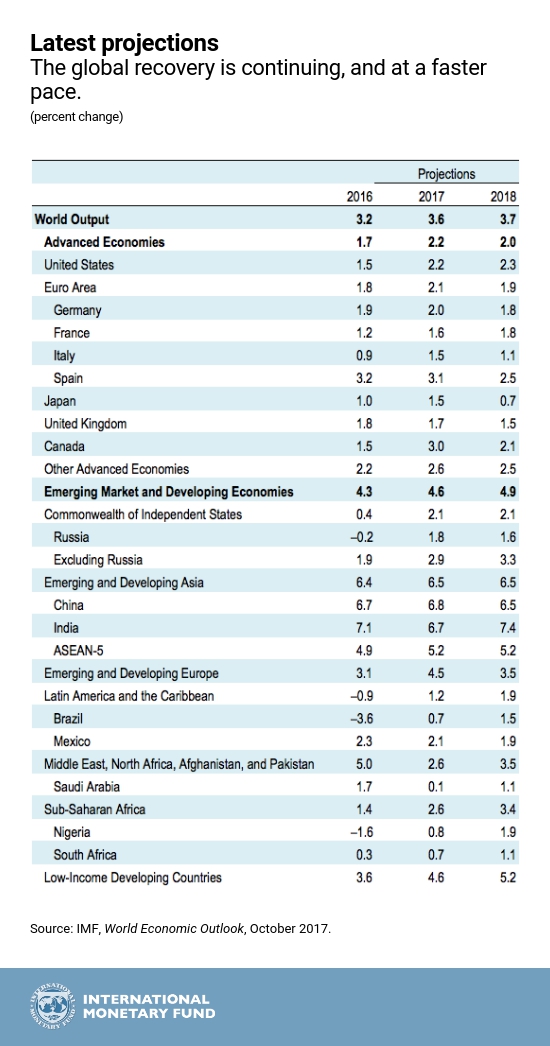
- The global recovery is continuing, and at a faster pace.
- The latest World Economic Outlook has upgraded global growth projections to 3.6 percent for this year and 3.7 percent for next—in both cases 0.1 percentage point above our previous forecasts, and well above 2016’s global growth rate of 3.2 percent.
- The current acceleration is broad-based, boosting Europe, China, Japan, the United States, and emerging Asia.
- For 2017, most of the upgrade owes to brighter prospects for the advanced economies; for 2018’s positive revision, emerging market and developing economies play a relatively bigger role.
- Notably, sub-Saharan Africa is expected to improve overall in 2018 after growth in per capita incomes stalled on average for the past two years.
Why the recovery is still incomplete
- The recovery is incomplete within countries:
- Even as output nears potential in advanced economies, nominal and real wage growth have remained low.
- Median real incomes have grown much more slowly than incomes at the top, or even stagnated.
- Technological advances and trade have had uneven effects, contributing to higher income and wealth inequalities and political disenchantment.
- The recovery is incomplete across countries:
- Emerging market and low-income commodity exporters, especially energy exporters, continue to face challenges.
- Several countries experiencing civil or political unrest—mostly in the Middle East, North and sub-Saharan Africa, and Latin America—remain troubled.
- Many small states have been struggling.
- About a quarter of all countries saw negative per capita income growth in 2016, and nearly a fifth of them are projected to do the same in 2017.
- The recovery is incomplete over time:
- The cyclical upswing masks subdued longer-run trends of productivity and demographics.
- For advanced economies, per capita output growth is now projected to average only 1.4 percent a year during 2017–22 compared with 2.2 percent a year during 1996–2005.
- Fully 43 emerging market and developing economies are projected to grow even less in per capita terms than the advanced economies over the coming five years, indicating divergence rather than convergence.
Key statistics and projections
- Global growth projections: 3.6 percent (this year), 3.7 percent (next year).
- Upgrade magnitude: 0.1 percentage point above previous forecasts for both years.
- 2016 global growth rate: 3.2 percent.
- Advanced economies: per capita output growth projected to average 1.4 percent a year during 2017–22.
- Historical comparison: 2.2 percent a year during 1996–2005.
- Number of emerging market and developing economies projected to underperform advanced economies in per capita growth: 43.
- Share of countries with negative per capita income growth in 2016: about a quarter.
- Share of countries projected to see negative per capita income growth in 2017: nearly a fifth.
Window for action: policy priorities
- Overall approach:
- Act now while the cyclical upswing and broad-based recovery present a window of opportunity.
- Complete and refine financial stability reforms undertaken since the global crisis, without weakening them.
- Structural reforms are easier to implement when the economy is strong.
- Fiscal policy:
- For some countries near full employment: consider gradual fiscal consolidation to reduce swollen public debt levels and build buffers against the next recession.
- For countries with fiscal space: higher infrastructure and educational spending can boost potential output and global demand.
- A multilateral mix of consolidation and stimulus can help reduce excess global imbalances.
- Structural and human-capital policies:
- Invest in people at all life cycle stages, especially the young.
- Better education, training, and retraining can ease labor market adjustment to long-term economic transformation and raise productivity.
- Address excessive youth unemployment as an urgent short-term priority.
- Investing in human capital can help push labor’s income share upward; governments should consider correcting distortions that have reduced workers’ bargaining power excessively.
- Combined structural and fiscal policy should promote conditions conducive to sustainable and more inclusive real wage growth.
- Monetary policy:
- Deflation threats in advanced economies have receded, but inflation has remained puzzlingly low even as unemployment rates have come down.
- Clear central bank communication and smooth execution of monetary policy normalization, where and when appropriate, remain crucial to prevent market turbulence and sudden tightening of financial conditions.
- Emerging market and developing economies should, where possible, continue to use exchange rate flexibility as a buffer against external shocks while paying attention to price stability.
Multilateral priorities
- Mutually beneficial cooperation should focus on:
- Strengthening the global trading system.
- Further improving financial regulation.
- Enhancing the global financial safety net.
- Reducing international tax avoidance.
- Fighting famine and infectious diseases.
- Mitigating greenhouse gas emissions and helping poorer countries adapt to climate change.
Conclusion
- The breadth and strength of the current upswing create an ideal moment for domestic reforms and multilateral cooperation.
- Policymakers should seize the window of opportunity now, because it will not remain open forever.
Source: Maurice Obstfeld, "Global Economic Upswing Creates a Window of Opportunity", October 10, 2017.
Content in this bundle
- 全球经济复苏创造了全球机遇; IMF博客; 2017年10月10日
- 世界的な景気回復は世界経済の改革実施にとって絶好のチャンス; モーリス・オブストフェルド IMF ブログ 2017年10月10日掲載
- Мировой экономический подъем открывает глобальное окно возможностей