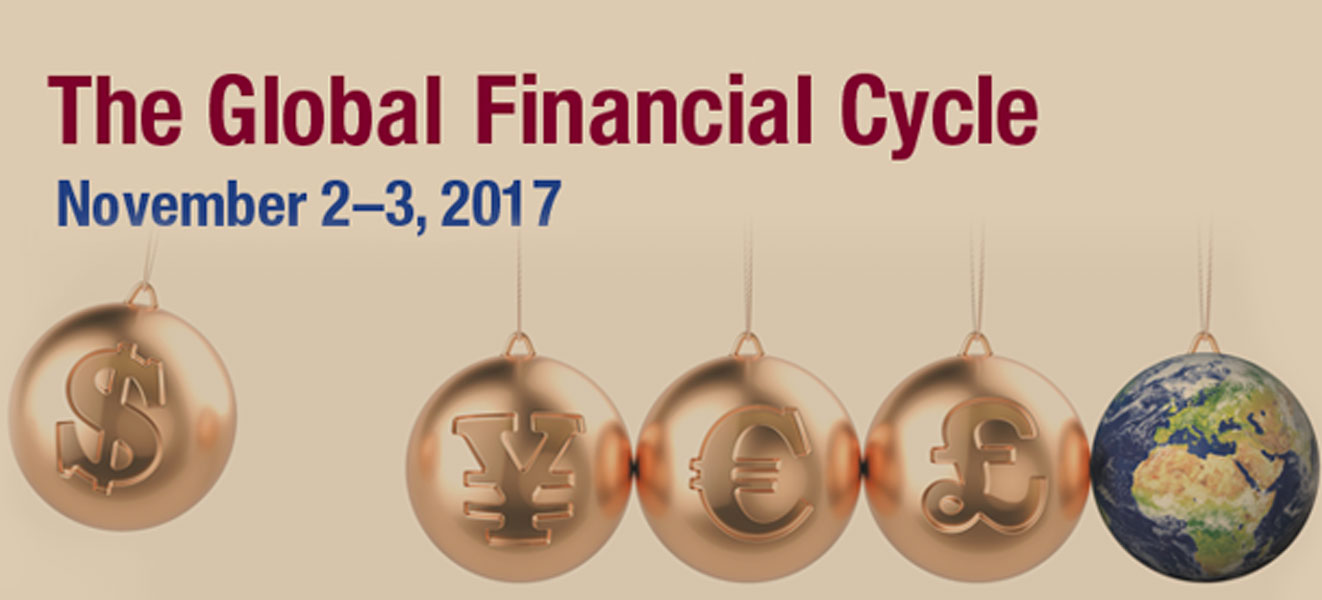
Understanding the Global Financial Cycle
IMF Blog, October 27, 2017
Source details
- Canonical URL
- Understanding the Global Financial Cycle
Other formats
Bibliographic details
- Authors: Maurice Obstfeld, Mahvash S Qureshi
- Published: October 27, 2017
Overview and context
- Authors: Maurice Obstfeld, Mahvash S. Qureshi
- Publication date: October 27, 2017
- Theme: The existence, causes, consequences, and policy implications of a “global financial cycle” in the context of cross-border capital flow booms and busts around the global financial crisis and its aftermath.
- Event: IMF Jacques Polak Annual Research Conference on November 2–3, theme “The Global Financial Cycle.”
Central issues and framing
- Traditional trilemma (Mundell-Fleming): trade-offs among exchange rate stability, free capital mobility, and independent monetary policy.
- If a country chooses exchange rate stability and free capital mobility, it must give up monetary policy autonomy.
- An independent monetary policy with free capital flows is possible through exchange rate flexibility.
- Challenge raised: repeated surges and reversals in capital flows—even in countries with flexible exchange rate regimes—call into question the degree of autonomy flexible exchange rates confer and the ability of open economies to escape the global financial cycle amid rising financial integration.
Conference objectives and topics
- Improve understanding of:
- Causes and consequences of the global financial cycle.
- Transmission channels of global financial shocks.
- Role of domestic policies in dampening the impact of global shocks.
- Topics highlighted for investigation:
- Historical perspective on global financial cycles and synchronicity of financial and real cycles.
- Importance of macroeconomic policies in major economies as drivers of cycles.
- Role of the exchange rate in transmitting global financial shocks.
- Real and distributional effects of financial openness.
- Policy tools available to small open economies to manage financial cycles and balance benefits of financial openness with risk minimization.
Key speakers and sessions
- Mundell-Fleming Lecture (keynote): Barry Eichengreen, titled “Trade Policy and the Macroeconomy,” analyzing effects of trade policy in a world of high financial integration and flexible exchange rates for both short-term fluctuations and long-term growth.
- Opening remarks: Christine Lagarde, IMF Managing Director.
- Luncheon speech: Richard Berner, Director, Office of Financial Research, U.S. Department of the Treasury; talk titled “Globalization and Financial Stability,” focusing on designing the financial stability toolkit in an increasingly financially interconnected world.
- Economic Forum (closing panel): Benoît Coeuré (European Central Bank), José De Gregorio (University of Chile and Peterson Institute for International Economics), Rakesh Mohan (Yale Jackson Institute for Global Affairs), Hélène Rey (London Business School) — topics include drivers and characteristics of global financial cycles, policy autonomy in small open economies, and scope for international policy cooperation for safer and more inclusive financial systems.
- Program scope: Fourteen additional papers addressing a broad spectrum of issues related to the global financial cycle.
Expected outcomes and engagement
- Stimulate informed debate and open promising avenues for further research.
- Encourage readers to consult the conference papers posted online and follow webcasts of the IMF Managing Director’s opening remarks, the Mundell-Fleming Lecture, and the Economic Forum at the IMF Annual Research Conference.
Source: Understanding the Global Financial Cycle, Maurice Obstfeld and Mahvash S. Qureshi, October 27, 2017.