Chart of the Week: Women Workers Wanted in Japan
IMF Blog, November 21, 2017
Source details
- Canonical URL
- Chart of the Week: Women Workers Wanted in Japan
Other formats
Bibliographic details
- Authors: The Editors
- Published: November 21, 2017
Problem and context
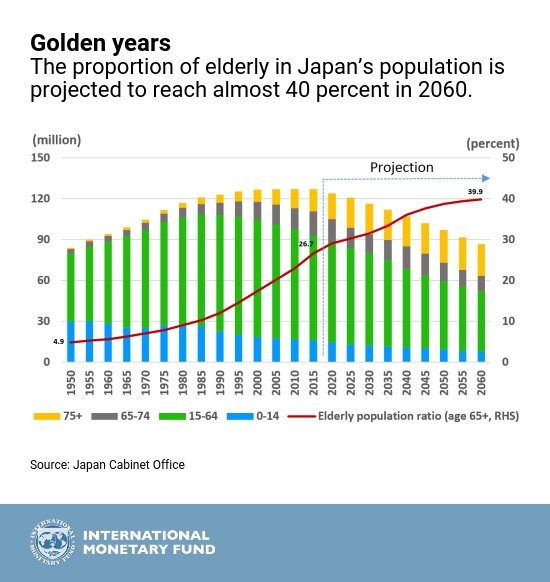
- Japan is the most aged society among advanced economies: almost 27 percent of its people are over 65.
- Japan faces a shortage of labor: unemployment is just 2.8 percent.
- Both aging and labor shortage limit the country’s growth potential.
- After 2018, the number of women of reproductive age will decline sharply.
- Japan’s total population is expected to drop between now and 2025 by almost 4 million—roughly the population of Los Angeles—and to decline even faster beyond that.
Causes and mechanisms limiting female full-time work and fertility
- Institutional and cultural factors discourage childbearing and full-time female employment: the tax code, social norms and corporate labor practices.
- Lifetime employment has traditionally benefited Japanese men; the same isn’t true for women.
- More than half of Japanese women with jobs choose part-time or temporary work, largely to balance child care, elder care and housework.
- Frequent demands for overtime in regular employment—often underpaid or unpaid—discourage full-time participation and have led to cases of “karoshi,” or death from overwork.
- Part-time workers earn about half that of full timers, which has helped limit wage gains despite low unemployment.
- Wage scales are based in part on the number of dependents in the household, assuming the husband is the sole breadwinner.
- Many women choose part-time work to stay under the minimum income levels that are subject to tax.
Evidence and research cited
- Evidence from Scandinavia suggests it is possible to reconcile higher female labor force participation with higher fertility.
- Research by IMF economists Naoko Miake, Kalpana Kochar, and Yuko Kinoshita supports the view that policy and norm changes can help.
Policy recommendations and behavioral changes
- Reform the tax code to eliminate disincentives to full-time work for women.
- Provide more child-care facilities to reduce the childcare burden.
- Limit overtime hours to give men more time to share in housekeeping and childrearing duties, and to encourage mothers to keep their jobs.
- Encourage cultural and social-norm changes that support professional women having families.
- Promote greater time spent at home by men; studies suggest couples have a better chance of having a second child if the man spends more time at home.
Source: Chart of the Week: Women Workers Wanted in Japan (The Editors, November 21, 2017).
Content in this bundle
- 本周图表:日本需要女性工人; IMF博客; 2017 年11 月21 日
- 今週のグラフ: 日本では働く女性が求められている; IMF ブログ 2017年11月21日掲載